Friday, October 12, 2012

Monster sightings in 1899

As expected, Conn's first Sousaphone begins to show up in many places the year after it was unveiled. For example, here is a photo of Sousa's Band at Manhattan Beach, Coney Island, which is likely during their stay there from June 17 through September 4, 1899:

Photo courtesy of the Library of Congress
Shortly after that time, there appears an article about John Philip Sousa in the September 17, 1899 edition of the Pittsburg Post, which features an artist's rendering of the Sousaphone, along with a brief description:


Image courtesy of George B. Class at J. W. Pepper

Assuming the artistic rendering is reasonably accurate, it seems that the valve section on this horn matches the "upgraded" version seen in the photo at the bottom of the post below (which would then date that image to no later than 1899).

In particular, notice how the mouthpipe emerges from within a loop of tubing coming from the third valve, rather than following the main coil of the horn, and how there is a lack of excessive tubing to the right of the fourth valve - both of which are different from the image at the top of the post below.

What is even more interesting is this rare photo of Sousa's Band actually marching in a parade - something they are said to have done only eight times in their forty years of existence:

Photo courtesy of Paul Bierley, The Incredible Band of John Philip Sousa, p. 24 
The event was to celebrate America's victory in the Spanish-American War, and in particular to honor Admiral George Dewey for what his naval forces accomplished. The date of the parade was September 30, 1899, and if you look closely all the way to the left, in the front row of the band, you'll see the Sousaphone.

Here is that horn enlarged from the photo. Details are not clear, but it appears to be that first "Monster."


Thursday, October 11, 2012

Introducing the Monster Sousaphone

This may very well be the earliest image of Conn's first Sousaphone - built in 1898, as noted in the post below (although this image and testimony appear in the April 1900 edition of C. G. Conn's Truth, vol. 4, no. 8, p. 17). The horn is referred to by Sousa's "Primo Basso," Herman Conrad, as the "Monster Sousaphone."

Image courtesy of Mark Overton at saxophone.org
A few observations about this important notice:
  • Conrad clearly loved this horn, calling it "the most perfect instrument I ever played on." He also states that Conn is "the only manufacturer in America who can ably supply the demands of a professional musician." Both of these comments imply his dissatisfaction with Pepper's Sousaphone - a horn which, as I noted in the post below, seemed to escape the notice of the music industry.
  • This "Monster Sousaphone" appears to have four valves, but the tubes and tuning slides seem strangely laid out - especially the angle of the largest tuning slide, which appears crooked, and the location of the mouthpipe, which follows the curve of the main coil of the horn.
  • Finally, you'll notice some sort of engraving just above the band on the lower part of the bell. As the photos below reveal more clearly, what is engraved, in large letters, is the word "Sousa" (or perhaps "Sousaphone"), as it wraps around the bell.
We see this horn in the only photo of which I am aware that shows Sousa's Band in 1898:

Photo courtesy of the Sousa Archives
Here's an enlargement of Conrad holding the Sousaphone in that photo, which reveals the same mouthpipe that follows the main coil of the horn, as well as the "Sousa" engraving on the bell (along with what appear to be more engravings above that):


But in an undated photo that shows Conrad with what appears to be the very same horn, you'll notice that the valve section is different (and there are straps that seem to be holding it on - is this perhaps at the Conn factory where the change had just been made?):

Photo courtesy of Ian Church
Here the four valves are clearly seen, but now the mouthpipe location has changed, as have the tubes emerging from the valves - especially the fourth valve. Years later, Conn did explain that, in crafting this instrument, "several experiments were necessary to adjust the proportions to secure the desired quality of tone and accuracy of scale" (Conn General Catalog, 1921, p. 27). Perhaps this horn, at least at first, was not as "perfect" as Conrad claimed!

Saturday, October 6, 2012

Announcing . . . the Sousaphone?

 
Tucked away in the lower corner of one of the many pages of the Music Trade Review dated January 22, 1898 is this brief notice:
 

This reads as if it is announcing something never before seen - the Sousaphone, so named by Conn himself, it says. So did the Pepper horn from a few years earlier, which Pepper himself called "the Sousaphone," escape the notice of the writers of this periodical? Was it flying that far under the radar?
 
Pepper claimed that his Sousaphone was "used daily in Sousa's peerless concert band," and Herman Conrad, who played it, said that it was "admired everywhere and gains in reputation daily." But were they perhaps overstating the case? And if they weren't, why wasn't that horn better known - especially given the immense popularity of Sousa's band?

Thursday, October 4, 2012

Conn's confusion continues

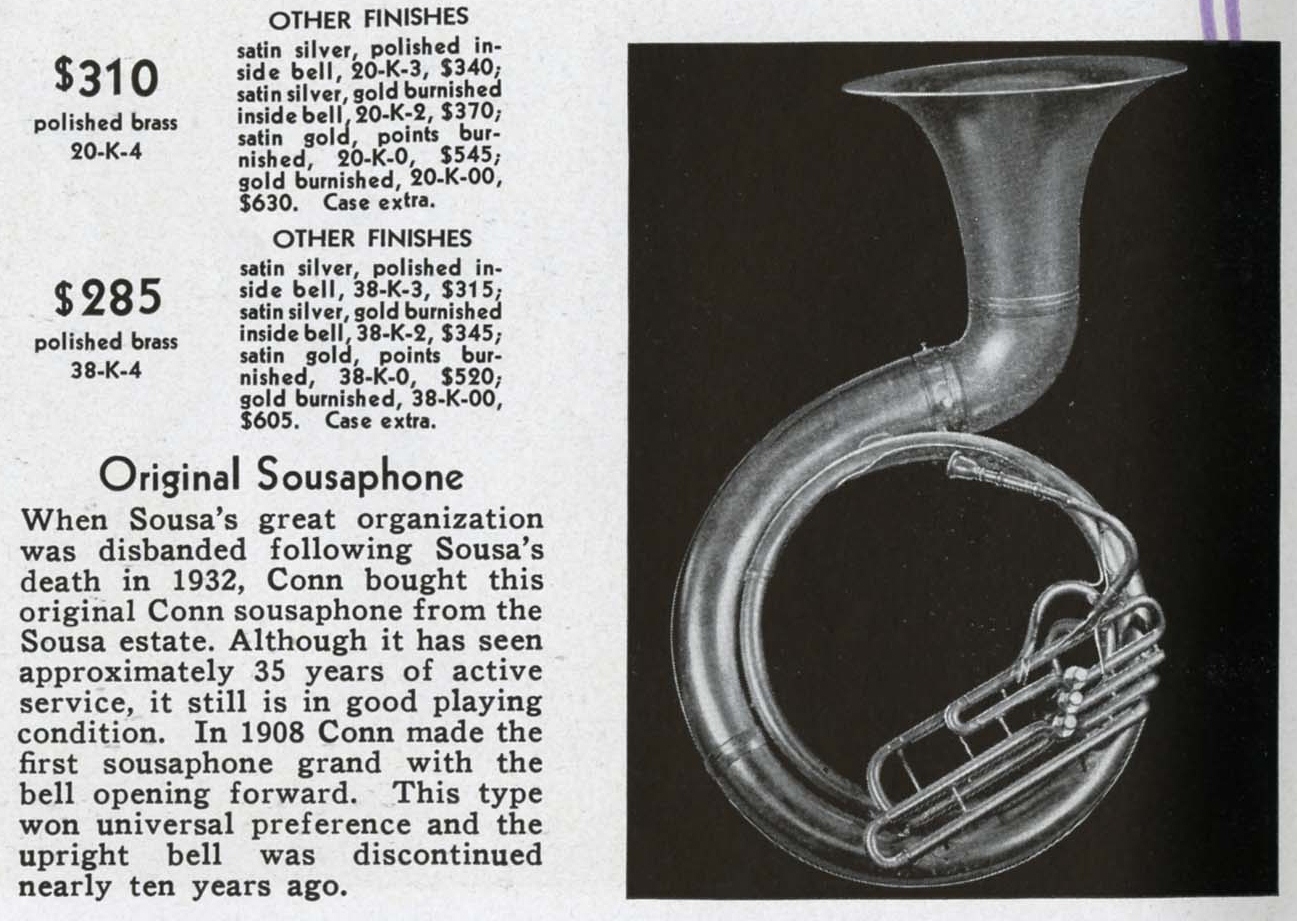
What did Conn's first Sousaphone actually look like? It would appear that Conn was confused about that as well - at least from 1935 onward. Here's what appears in their instrument catalog for that year:

Photo courtesy of Mark Overton at saxophone.org
According to this notice, the "Original Sousaphone" was built by Conn around 1900, and was a three-valve horn, as pictured. However, from the late 40s through the 50s, a very different Sousaphone is identified as the first one. Check out this important page from the March/April 1949 edition of The Instrumentalist (vol. 3, no. 4, p. 38):


Here we see a much larger, four-valve Sousaphone, said to be "The first sousaphone ever built, made for Sousa in 1898." And we are even introduced to the very craftsman who built that first horn - Ted Pounder. He, of all people, should know which Sousaphone was the first to come out of the Conn factory.

This horn shows up in a brief notice a few years later, in the September 1951 edition of The Instrumentalist (vol. 6, no. 1, p. 4) - although the date is off by a year:
It shows up again in the March/April 1953 edition of The Instrumentalist (vol. 7, no. 5, p. 21), as part of the promotion of the film, Stars and Stripes Forever. On the left is Ted Pounder once again, proudly holding his "first-born":

And it appears to show up in The Instrumentalist once more, this time in the November 1954 edition (vol. 9, no. 3, p. 39):
It even made an appearance in the December 1959 edition of Popular Mechanics:

Photo courtesy of Mark Overton at saxophone.org
All of this suggests that while Conn was confused in 1935 as to which horn was the original Sousaphone, they were eventually able to sort it out, with Ted Pounder's authoritative confirmation. The only problem is that we already know that Conn did not build the first Sousaphone - Pepper did. And, as I will reveal in future posts, the first Conn Sousaphone is neither of the two horns featured above! Confused, indeed!

Friday, September 28, 2012

The curious confusion of Conn

If one were to peruse some of the old C. G. Conn instrument catalogs and advertisements (as I now have), it would seem that Conn either had no idea that J. W. Pepper made a Sousaphone around 1894-86, or they were determined to act as if that horn never existed.  They proudly state that they built the first Sousaphone, but in what year did they build it?

To begin with, check out this ad for Conn Sousaphones found in the November-December 1952 edition of The Instrumentalist (p. 5):

Ad found by the author while browsing journals in the USC library

Here's the fine print in the middle of the ad:


Okay, so "Conn made the world's first sousaphone - for Sousa's band, in 1908." Except that's not what they say in their 1955 instrument catalog (and most everywhere else, for that matter):

Image courtesy of Mark Overton at saxophone.org
 
Got it - not 1908, but 1898 - but it was still the very first one, right? (For what it's worth, Conn is said to have built the first bell-front Sousaphone in 1908, so that might explain the typo.)

Now, is there more to the story of this revolutionary new instrument, for which Conn is laying claim? Check out this page from their 1921 instrument catalog (and this exact page is seen in their 1926 catalog as well, as if they just cut and pasted it five years later!):

Image courtesy of Mark Overton at saxophone.org
 
Here's an easier-to-read version of the first part:

 
This supports the date of 1898 noted above, but that is at least two years after Pepper's Sousaphone appeared. And the story goes on to suggest that the Conn horn actually didn't see action in Sousa's Band until "the following season," presumably meaning 1899. We've got some detective work to do now, so stay tuned!

Don't try this with a Sousaphone!

In an early post, I mentioned that the Sousaphone is essentially an adaped Helicon bass, only much larger and with its big bell pointing straight up. I also noted that Helicons were used, in part, by cavalry bands, meaning they were played while riding horseback.

Trying to imagine how that would work? Check out this photo I came across in the October 1922 edition of C. G. Conn's Musical Truth (vol. 11, no. 31):

Photo courtesy of Mark Overton at saxophone.org

Friday, September 21, 2012

No mention of Pepper's horn in 1898

Building on the post below, it is further curious that in Pepper's Musical Times and Band Journal dated May 1898 (vol. xv, no. 174), the following appears:
(Image courtesy of the Museum of Making Music and the J. W. Pepper Co.)
There are a few significant points we can make from this promotional piece from Pepper:
  • The image of Sousa is the very one used for the engraving on the first Sousaphone, showing the bandmaster in his uniform from 1894 or 1895. Once again, this reminds us that the first Sousaphone was most likely built during or after those years.
  • The same "ho-hum" endorsement of Pepper instruments from Sousa that was first published in 1896 (see post below) is now typed out for all to read clearly (couldn't they get a better quote from him?!).
  • The "prominent members of Sousa's Band who use and endorse" Pepper instruments include two BBb Bass players - Herman Conrad and Fred Walen. But in the 1896 Journal, Conrad is specifically identified as playing the Sousaphone. Why is he not so identified here? Unless, of course, he was no longer playing that Sousaphone, but had reverted back to a regular BBb Bass. This suggests that, by this time, Pepper's Sousaphone had, for some reason, fallen out of favor with Sousa, or with Conrad, or perhaps with both. And it is at this point in history that Conn enters the picture of Sousaphone history (lots more to come on that!).
  • Well, actually there is one more possibility to consider regarding the previous point. Perhaps Conrad is not mentioned as playing the Sousaphone at this time simply because that instrument was not in production, and so there would have been no point in drawing attention to a horn that no one could buy for themselves.

Thursday, September 20, 2012

Not exactly a ringing endorsement!

In trying to determine why the first Sousaphone seems to dissappear shortly after it was built (sometime between 1894-96, by my estimation), here is one distinct possibility: Sousa was not a fan.

In the middle of the front page of Pepper's Musical Times and Band Journal from early 1896, where many of Sousa's band members praise their Pepper instruments, notice what Sousa himself says:


In case you can't read it, it says "All of the Pepper instruments in use in my Band are thoroughly satisfactory." I wouldn't exactly call that a ringing endorsement!

Could it be that the Pepper Sousaphone simply didn't live up to Sousa's standards of quality? It is curious that the first time we see a Sousaphone in the band (in my search of photos so far) is in 1898, and it turns out to be Conn's first model.

Of course, there may be more going on there, as well. In that very year, 1898, Conn outfitted Sousa's entire Band with his instruments - and Sousa raved about them from that point on. Pepper instruments, and the first Sousaphone in particular, quickly faded away.

Friday, September 7, 2012

Pepper Sousaphone - 30 years later

I've been curious to know whether J. W. Pepper ever made another Sousaphone after building the prototype seen in the posts below. So far, I have found no evidence of that particular horn going into production, or even being made a second time. The reason may perhaps be the financial difficulties that faced the company in the 1890s (Paul Bierley mentions this in his outstanding work, The Incredible Band of John Philip Sousa, p. 56).

But it appears that Pepper did end up making other Sousaphones - at least eventually. Notice this page from the J. W. Pepper publication Everything Musical from the 1920s, courtesy of Mark Overton at saxophone.org:


You'll notice that at the top of the article, it says "The first 'Sousaphone' was named and built by J. W. Pepper over thirty years ago for Sousa's Band." This puts the publication at around 1925 - at which time the company was advertising the bell-front Sousaphone depicted here (for a mere $174.50!).

Wednesday, September 5, 2012

Pepper finally boasts - but when?

The word "Sousaphone" shows up in a big way in this advertisement that I'm told was inserted as a loose page in an issue of Pepper's Musical Times and Band Journal - perhaps the one noted in the post below (early 1896), but it could have been a bit earlier, or a bit later (the folks at Pepper today thought it was 1893; my guess is that it was either in 1896 or a bit later, given that Herman Conrad's endorsement in the 1896 Journal doesn't yet specifically speak of the Sousaphone, like it does in the advertisement below):
(Image courtesy of the Museum of Making Music and the J. W. Pepper Co.)

Since it's very hard to read what it says at the bottom of this document, I'll provide it here:

THE SOUSAPHONE. MADE BY J. W. PEPPER.

This instrument was made from the plans and under the direction of the famous bandmaster, John Philip Sousa. It is an original idea of his, and he considers it the best method and only correct way of obtaining the full tonal quality of the Helicon BBb Bass in band. We feel proud of the honor that Mr. Sousa has conferred in selecting us, from among the large American band instrument manufacturers, to receive the order for making this special instrument: thus showing his confidence in our ability to successfully make a perfect Sousaphone. The instrument is played by Mr. Herman Conrad, the first BBb Bass of Mr. Sousa's band. The other larger instruments used in this band were also made by Mr. Pepper. The Sousaphone is a Helicon BBb Bass of the largest size made.

And at the very bottom of the page is the following:

MR. HERMAN CONRAD'S TESTIMONIAL.

Mr. J. W. Pepper:
Dear Sir - the Sousaphone is admired everywhere and gains in reputation daily. It is in splendid tune and tone and has a wonderful carrying power. It proves an irresistible attraction.
Yours very truly, Herman Conrad

The insert does say, in the upper right corner, that this Sousaphone was  "used daily in Sousa's peerless concert band." And Conrad, in his testimonial at the bottom, adds that it was "admired everywhere and gains in reputation daily." It sure sounds like the horn was active in Sousa's Band, perhaps for some time. So why don't we hear about it anywhere else during this time period? I have not yet been able to locate any other reference to this  "irresistible attraction." Strange.

Further, I have not been able to locate any photos of Sousa's Band from 1894 through 1897 to confirm that this horn was played in it for all or part of that time. The earliest photo that I have found that shows a Sousaphone in use is from 1898, and it reveals an entirely different Sousaphone - one presumably made by Conn. And the buzz around that horn makes it seem as if it was the first to appear (more on that shortly). Again, strange. Why did Pepper's Sousaphone essentially dissappear?

[UPDATE on this important page from 2015]

Saturday, September 1, 2012

Clues from a Pepper journal in 1896

Here's the front page of J. W. Pepper's Musical Times and Band Journal, vol. xiv, no. 159, which appears to have been published in early 1896 (the only date seen on this image is the oval stamp between the two guys in the upper right, which says "Library of Congress copyright April 29 1896"):

Image courtesy of George B. Class at J. W. Pepper
A close up of the face and caption in the upper left corner suggests that the Sousaphone made by Pepper existed by this time, and was being played in Sousa's Band:


Combined with what we concluded a few posts below, we now can narrow the date that the first Sousaphone was built to no earlier than 1894 and no later than early 1896.