Friday, October 26, 2012

By April 1900, ten Sousaphones

In the April 1900 edition of C. G. Conn's Truth (vol. 4, no. 8, p. 29), we find the following article and photo:

Image courtesy of  Mark Overton at saxophone.org
Here we learn that "There are now ten Wonder Sousaphones used in America," and that "the number will be more than doubled before the political campaign opens" (I love it! That's what our presidential campaigns need today - more Sousaphones!).

The horn pictured here is one of those ten Sousaphones - although not the first or second one, as the posts below clarify. It was purchased by the Ancient Order of United Workers Military Band of Cedar Falls, Iowa, and played by B. K. Kilborne (shown with the horn), who helped establish that band, and even directed it from 1891-92.

Kilborne's letter to Conn, seen at the bottom part of the article above, and dated February 5, 1900, has him praising the instrument, saying that "it is quite as easily filled as the ordinary Eb bass and possesses a pipe organ tone of great power and brilliancy. It is a wonder and admiration of all who see it."

He then states that "We used it in the Grand Army parade at Philadelphia last September [the 5th, to be exact], and it was listed by the Press as one of the striking hits and incidents of the big parade." This tells us that the horn was built sometime in 1899, prior to September 5th.

Here's a closer and clearer look at this Sousaphone, showing Kilborne in 1902, when the band had become known as Fitzgerald's Concert Band:

Photo courtesy of Mark Welty of the Cedar Falls Municipal Band
You'll notice two things about the horn in this photo and in the earlier one above: First, the bell is being pointed a bit forward, rather than straight up, which is something we haven't yet encountered; and, second, the valve section is completely different from both versions we see of the original Conn Sousaphone, built in 1898.

Apparently, Conn was still trying out different configurations as it relates to the tubing, in order to improve the tone and intonation of his "monster four-valve Sousaphone."

Conn's second monster Sousaphone

On page six of the January 4, 1899 edition of the Portsmouth (Ohio) Daily Times, we read this:

Accessed online by the author
Given the date of the article, we can now say with confidence that the first Conn Souspahone was built no later than 1898, and the second was most likely delivered sometime the following year.

But did these two horns look identical? We don't know at this point, as I have yet to come across a photo of Prof. Dupere's prized possession. Nor have I been able to learn much about the Prof. himself - other than that he was perhaps at one time the band director at the Lima (Ohio) Central High School, and director of the Methodist Sunday School Orchestra around 1912.

Paul Bierley, in his outstanding resource, The Incredible Band of John Philip Sousa, even speculates that Dupere may have served with Sousa at one time (p. 247).

An interesting question might be where Dupere got the $250 to purchase the second Sousaphone built by Conn, which put himself on the cutting edge of band instrumentation at the turn of the century. One resource for calculating relative cost suggests that $250 in 1899 would amount to spending about $7,000 today!

And before leaving this post, did you notice that the article mentions the Sousaphone "in use in Sousa's band by Conrad"? It would seem that Conrad had become a bit of a "rock star" at that time, being casually referred to by his last name only, as if everyone would, of course, know who was being talked about. Who says that playing the Sousaphone isn't cool?!

Image courtesy of Mark Overton at saxophone.org

Wednesday, October 24, 2012

Where did the first Monster go?

The last time Conn's first Sousaphone is seen, at least in my research up to this point, is in this photo from the November 1913 edition of C. G. Conn's Musical Truth (vol. 9, no. 13):

Image courtesy of Mark Overton at saxophone.org
 As we will see in future posts, this is not the Sousaphone that Richardson normally played in Sousa's Band, but looks very much like the one built in 1898 (shown below; note the valve section in particular).

Could it be that when Richardson visited the Conn factory to secure his new horn, as noted in the article above, that he found the very first Sousaphone there, and decided to try it on for size, having his photo snapped in the process?

The question is, where is that "Monster Sousaphone" now?

Sunday, October 21, 2012

Do you have to be big and tall?

You may have noticed in a couple of the posts below that Herman Conrad, the very first Sousaphonist, was a rather tall man - 6 feet 6 inches, according to the Pittsburg Post article dated September 17, 1899; and 6 feet 4 inches, according to the Illustrated Mail article dated October 12, 1901 (not sure how he lost those two inches).

On the information sheet that accompanies what is (wrongly) claimed to be "The Original Sousaphone" up at the Interlochen Center for the Arts (more on that horn later), Conrad is said to have been "a six-foot eight-inch giant"! He was flexible, if nothing else, it seems.

It is interesting, however, that a number of very tall men followed in Conrad's footsteps. Jack W. Richardson, who was a Sousaphonist with Sousa's Band from 1903 to 1931, was of similar height:
Source: John Philip Sousa, Marching Along, p. 350A

Curiously, Richardson's sub for the 1911 world tour, Arthur L. Griswold, was nicknamed "Shorty" (note typo in article below) - perhaps because he was a mere 6 feet 2 inches tall!
Image courtesy of Mark Overton at saxophone.org
Source: C. G. Conn's Musical Truth, October 1911 (vol. 9, no. 10)
Then, in a January 1924 edition of the San Francisco Chronicle, William Bell, perhaps the most famous tubist to come out of Sousa's Band, is said to have been 6 feet 6 inches himself:


But I'm not so sure that the reporter didn't mix up Bell and Richardson. Here's a photo of the Sousaphone section for Sousa's 1923-24  tour, with Bell on the far right, and Richardson next to him:
Source: Paul Bierley, The Incredible Band of John Philip Sousa, p. 56
They don't both look 6 feet 6 inches to me! Plus, the two on the far left are positively short, so I guess being big and tall was not a requirement to play the Sousaphone (good news for me - I am but 5 feet 8 inches tall).

Friday, October 19, 2012

Conn's Monsters invade Europe

When the announcement of Conn's new instrument, "The Sousaphone," appeared in the January 22, 1898 edition of The Music Trade Review, it explained that "It will be a feature of Sousa's band during the forthcoming European tour."

That tour didn't launch until April 30, 1900, but before they set sail, Conn, who expected to wow Europe with his instruments (which he generously donated to the band for that very purpose!), explained that "The bass section is magnificent, comprising the great Conn Sousaphone, played by Mr. Herman Conrad, the monster American Model and Wonder Double Bb Basses, played by Messrs. Helleberg, Seavey and Del Negro" (C. G. Conn's Truth, April 1900, vol. 4, no. 8, p.17).

Here is the band at the Paris Exposition, either in May or July of that year. The Sousaphone and tubas can be seen in the upper right:

Photo courtesy of the Library of Congress
And here is the band in late May or early June, in Hamburg, Germany:

Photo courtesy of Paul Bierley, John Philip Sousa: American Phenomenon, p. 11

Getting a closer look at the Sousaphone in that photo, we can see that it appears to be the same "upgraded" version shown a few posts below. The valve section matches, and there is even the hint of the "Sousa" engraving on the bell:


Upon returning from this tour in September, many of the prominent members of Sousa's Band sent a letter to Conn declaring the superiority of his instruments. Conn, of course, loved it, and posted the letter in his December 1900 Truth magazine (vol. 4, no. 10), adding that his "Wonder Instruments shone in magnificent splendor to the surprise and admiration of the musicians of the old world."

I have yet to come across any of that "surprise and admiration" in my research - at least from that tour. But a year later, from October 4 through December 13, 1901, Sousa and his Band toured England and Scotland, and the trip caught the attention of London's Illustrated Mail. Here's their article, dated October 12, 1901:

Image courtesy of the Bodleian Library at Oxford University
At one point, they state that "The instruments used in the band include several never seen in an English musical combination. For instance, there is the 'sousaphone,' an immense wind instrument weighing 33lb. It is a modification of the helicon bass, and was invented by Mr. Sousa. It requires a strong man to play it, and Mr. Sousa found him in Mr. Herman Conrad, an ex-German soldier, who stands 6ft. 4in."

Conrad is then featured in a photo, emphasizing his height. But notice that the horn, once again, matches the modified version that Conn built in 1898:

Monday, October 15, 2012

And speaking of 1899 . . .


I'm assuming this circus poster was tongue-in-cheek, but the Library of Congress has the image posted online, and dates it from 1899. And I'm also assuming those are Helicons being "played" by the elephants (including left-handed versions!), as bell front Sousaphones didn't come along until 1908.

But this reminds me - have you seen this seemingly prophetic book cover from the 1930s? Bobo the Elephant playing a Sousaphone (or is that a bell front tuba)? The famous tuba master Roger Bobo was born in 1938. Hmmm . . . could there have been an influence?!

Friday, October 12, 2012

Monster sightings in 1899

As expected, Conn's first Sousaphone begins to show up in many places the year after it was unveiled. For example, here is a photo of Sousa's Band at Manhattan Beach, Coney Island, which is likely during their stay there from June 17 through September 4, 1899:

Photo courtesy of the Library of Congress
Shortly after that time, there appears an article about John Philip Sousa in the September 17, 1899 edition of the Pittsburg Post, which features an artist's rendering of the Sousaphone, along with a brief description:


Image courtesy of George B. Class at J. W. Pepper

Assuming the artistic rendering is reasonably accurate, it seems that the valve section on this horn matches the "upgraded" version seen in the photo at the bottom of the post below (which would then date that image to no later than 1899).

In particular, notice how the mouthpipe emerges from within a loop of tubing coming from the third valve, rather than following the main coil of the horn, and how there is a lack of excessive tubing to the right of the fourth valve - both of which are different from the image at the top of the post below.

What is even more interesting is this rare photo of Sousa's Band actually marching in a parade - something they are said to have done only eight times in their forty years of existence:

Photo courtesy of Paul Bierley, The Incredible Band of John Philip Sousa, p. 24 
The event was to celebrate America's victory in the Spanish-American War, and in particular to honor Admiral George Dewey for what his naval forces accomplished. The date of the parade was September 30, 1899, and if you look closely all the way to the left, in the front row of the band, you'll see the Sousaphone.

Here is that horn enlarged from the photo. Details are not clear, but it appears to be that first "Monster."


Thursday, October 11, 2012

Introducing the Monster Sousaphone

This may very well be the earliest image of Conn's first Sousaphone - built in 1898, as noted in the post below (although this image and testimony appear in the April 1900 edition of C. G. Conn's Truth, vol. 4, no. 8, p. 17). The horn is referred to by Sousa's "Primo Basso," Herman Conrad, as the "Monster Sousaphone."

Image courtesy of Mark Overton at saxophone.org
A few observations about this important notice:
  • Conrad clearly loved this horn, calling it "the most perfect instrument I ever played on." He also states that Conn is "the only manufacturer in America who can ably supply the demands of a professional musician." Both of these comments imply his dissatisfaction with Pepper's Sousaphone - a horn which, as I noted in the post below, seemed to escape the notice of the music industry.
  • This "Monster Sousaphone" appears to have four valves, but the tubes and tuning slides seem strangely laid out - especially the angle of the largest tuning slide, which appears crooked, and the location of the mouthpipe, which follows the curve of the main coil of the horn.
  • Finally, you'll notice some sort of engraving just above the band on the lower part of the bell. As the photos below reveal more clearly, what is engraved, in large letters, is the word "Sousa" (or perhaps "Sousaphone"), as it wraps around the bell.
We see this horn in the only photo of which I am aware that shows Sousa's Band in 1898:

Photo courtesy of the Sousa Archives
Here's an enlargement of Conrad holding the Sousaphone in that photo, which reveals the same mouthpipe that follows the main coil of the horn, as well as the "Sousa" engraving on the bell (along with what appear to be more engravings above that):


But in an undated photo that shows Conrad with what appears to be the very same horn, you'll notice that the valve section is different (and there are straps that seem to be holding it on - is this perhaps at the Conn factory where the change had just been made?):

Photo courtesy of Ian Church
Here the four valves are clearly seen, but now the mouthpipe location has changed, as have the tubes emerging from the valves - especially the fourth valve. Years later, Conn did explain that, in crafting this instrument, "several experiments were necessary to adjust the proportions to secure the desired quality of tone and accuracy of scale" (Conn General Catalog, 1921, p. 27). Perhaps this horn, at least at first, was not as "perfect" as Conrad claimed!

Saturday, October 6, 2012

Announcing . . . the Sousaphone?

 
Tucked away in the lower corner of one of the many pages of the Music Trade Review dated January 22, 1898 is this brief notice:
 

This reads as if it is announcing something never before seen - the Sousaphone, so named by Conn himself, it says. So did the Pepper horn from a few years earlier, which Pepper himself called "the Sousaphone," escape the notice of the writers of this periodical? Was it flying that far under the radar?
 
Pepper claimed that his Sousaphone was "used daily in Sousa's peerless concert band," and Herman Conrad, who played it, said that it was "admired everywhere and gains in reputation daily." But were they perhaps overstating the case? And if they weren't, why wasn't that horn better known - especially given the immense popularity of Sousa's band?

Thursday, October 4, 2012

Conn's confusion continues

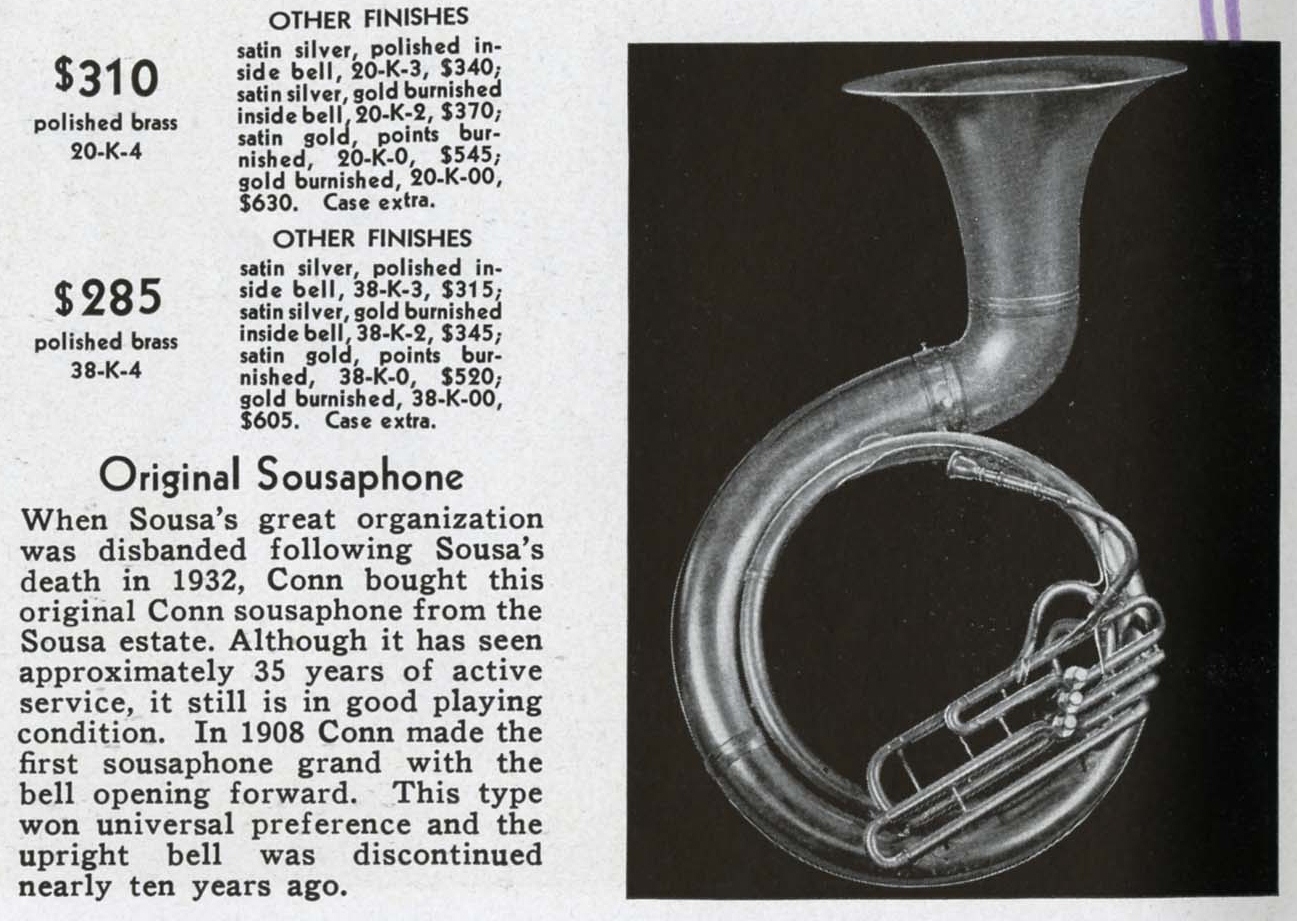
What did Conn's first Sousaphone actually look like? It would appear that Conn was confused about that as well - at least from 1935 onward. Here's what appears in their instrument catalog for that year:

Photo courtesy of Mark Overton at saxophone.org
According to this notice, the "Original Sousaphone" was built by Conn around 1900, and was a three-valve horn, as pictured. However, from the late 40s through the 50s, a very different Sousaphone is identified as the first one. Check out this important page from the March/April 1949 edition of The Instrumentalist (vol. 3, no. 4, p. 38):


Here we see a much larger, four-valve Sousaphone, said to be "The first sousaphone ever built, made for Sousa in 1898." And we are even introduced to the very craftsman who built that first horn - Ted Pounder. He, of all people, should know which Sousaphone was the first to come out of the Conn factory.

This horn shows up in a brief notice a few years later, in the September 1951 edition of The Instrumentalist (vol. 6, no. 1, p. 4) - although the date is off by a year:
It shows up again in the March/April 1953 edition of The Instrumentalist (vol. 7, no. 5, p. 21), as part of the promotion of the film, Stars and Stripes Forever. On the left is Ted Pounder once again, proudly holding his "first-born":

And it appears to show up in The Instrumentalist once more, this time in the November 1954 edition (vol. 9, no. 3, p. 39):
It even made an appearance in the December 1959 edition of Popular Mechanics:

Photo courtesy of Mark Overton at saxophone.org
All of this suggests that while Conn was confused in 1935 as to which horn was the original Sousaphone, they were eventually able to sort it out, with Ted Pounder's authoritative confirmation. The only problem is that we already know that Conn did not build the first Sousaphone - Pepper did. And, as I will reveal in future posts, the first Conn Sousaphone is neither of the two horns featured above! Confused, indeed!

Friday, September 28, 2012

The curious confusion of Conn

If one were to peruse some of the old C. G. Conn instrument catalogs and advertisements (as I now have), it would seem that Conn either had no idea that J. W. Pepper made a Sousaphone around 1894-86, or they were determined to act as if that horn never existed.  They proudly state that they built the first Sousaphone, but in what year did they build it?

To begin with, check out this ad for Conn Sousaphones found in the November-December 1952 edition of The Instrumentalist (p. 5):

Ad found by the author while browsing journals in the USC library

Here's the fine print in the middle of the ad:


Okay, so "Conn made the world's first sousaphone - for Sousa's band, in 1908." Except that's not what they say in their 1955 instrument catalog (and most everywhere else, for that matter):

Image courtesy of Mark Overton at saxophone.org
 
Got it - not 1908, but 1898 - but it was still the very first one, right? (For what it's worth, Conn is said to have built the first bell-front Sousaphone in 1908, so that might explain the typo.)

Now, is there more to the story of this revolutionary new instrument, for which Conn is laying claim? Check out this page from their 1921 instrument catalog (and this exact page is seen in their 1926 catalog as well, as if they just cut and pasted it five years later!):

Image courtesy of Mark Overton at saxophone.org
 
Here's an easier-to-read version of the first part:

 
This supports the date of 1898 noted above, but that is at least two years after Pepper's Sousaphone appeared. And the story goes on to suggest that the Conn horn actually didn't see action in Sousa's Band until "the following season," presumably meaning 1899. We've got some detective work to do now, so stay tuned!

Don't try this with a Sousaphone!

In an early post, I mentioned that the Sousaphone is essentially an adaped Helicon bass, only much larger and with its big bell pointing straight up. I also noted that Helicons were used, in part, by cavalry bands, meaning they were played while riding horseback.

Trying to imagine how that would work? Check out this photo I came across in the October 1922 edition of C. G. Conn's Musical Truth (vol. 11, no. 31):

Photo courtesy of Mark Overton at saxophone.org