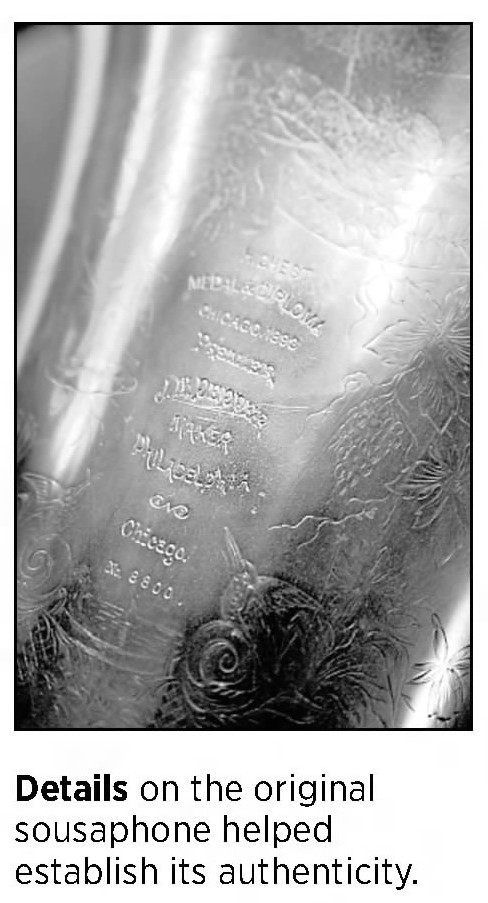
Friday, November 27, 2015

Pepper's full-page announcement

Almost exactly a year ago, the great folks at the J. W. Pepper company graciously allowed me to look through their archives to see what I might be able to find that was relevant to the first Sousaphone. And while we didn't find what I was most interested in - copies of the most important editions of Pepper's Musical Times and Band Journal (I had to search elsewhere for those), we did come across a tattered edition of Portraits of Great Artists.

This beautifully produced volume was apparently attached to the 1904 catalogue and contains 52 pages of photographs and brief testimonials of great musicians who favored Pepper instruments. But one entire page (47, although there are no numbers on the pages) introduces a new instrument to the world (noted in an earlier post, before I was aware of its context). Here's that page:
NOTE: This page is actually missing from the bound document. What remains is a copy of the page, while the original seems to have been lost, or perhaps was taken, back in the early 1990s.
Because this is the only known full-page announcement for Pepper's new horn, it is important to try to determine the date that it was originally created - and 1904 seems highly unlikely, as this would have been at least 8 years after the original Sousaphone was first played in public (see this post).

As it turns out, there are both internal and external clues that confirm that much of the content of Portraits of Great Artists appeared originally in the mid-1890s.

Internal clues

First of all, page 2 lists "Prominent Members and Former Members of Sousa's Peerless Concert Band who Use and Endorse the J. W. Pepper Premier - Own Make - Band Instruments" (lower right-hand column, but check out that monster helicon on the left - and note that the image of Sousa is exactly what we see engraved on the bell of Pepper's Sousaphone!):


The last ten names appear to be the “Former Members,” as their years with the band are listed. In analyzing these dates, comparing them with information from Paul Bierley’s The Incredible Band of John Philip Sousa, we can confirm that they are correct, and two of them are listed as having served for “Season 1895” – the latest date mentioned. The names above these ten musicians are presumably the current “Prominent Members” – one of which, Raffayolo, ended his time in 1895, and three of which, DeBleye, Grosskurth, and Wunderlich, joined the band in 1895. Everything in this list of names points to 1895.

Second, there are 14 other members of Sousa’s band in the publication that aren’t on the list on page 2. Of these, 4 appear to be former members, as they have dates listed that are prior to 1895. And the remaining 10, which have no dates listed for them, were all active in Sousa’s band in 1895.

Third, page 15 shows a handwritten testimony by Luciano Conterno in the middle, and it is dated “29/6/95” – suggesting that his comments were originally published shortly after that date (June 29, 1895):


Fourth, page 28 has A. A. Finnie in the middle, and below his name it says, “Trombone Soloist, Sousa’s Concert Band, Season 1896”:  


Interestingly, he appears on the list on page 2 as a former player with the Sousa Band from Season 1895. Bierley isn’t sure if Finnie served for at least one tour for both of those years, but speculates that he might have done so. For our purposes, the date here suggests that the publication either came out after 1896, or Finnie had just signed on as a soloist with Sousa for the upcoming 1896 season, and Pepper is posting that news. I’m thinking the latter might be the case, due to the external evidence below.

Finally, page 7 lists Solo Cornetist Walter D. Pryor (upper right) as playing in Pryor’s Military Band (not to be confused with the band that Arthur Pryor led after he left the Sousa Band):


Walter joined the Sousa Band for short periods in 1897 and 1898, but he is not listed as a former player of that band, suggesting that this testimony originally appeared prior to that time.

External evidence

First, the Sousaphone is mentioned briefly on page 24 of J. W. Pepper’s Musical Times and Band Journal, vol. 13, no. 155, which is from either late 1895 or early 1896 (see this post). It would appear that this new instrument had just been made and was getting some public attention while the Sousa Band was in St. Louis in October 1895. It would seem strange to publish the full-page announcement for the first time in the Portraits of Great Artists in 1904 – almost a decade later! This page almost certainly appeared around late 1895, when Pepper built the Sousaphone. But just where it appeared is unknown at present.

Second, the only other reference to “The Sousaphone” from that time period that I am aware of is on the cover of J. W. Pepper’s Musical Times and Band Journal, vol. 14, no. 159, which was published in April 1896 (see Herman Conrad in the upper left below). Again, the full-page announcement for his new instrument almost certainly appeared prior to that time.


Courtesy of Barry Owen Furrer
     Third, the Musical Times and Band Journal, vol. 12, no. 142, which came out in 1894, contains four pages also titled “Portraits of Great Artists,” and many of the images and testimonies found there match what we find in the current volume. Here's the first of those four pages:
      

      So we know that Pepper was pulling some of the content from much earlier publications.
     
      Finally, Pepper's Sousaphone was long gone by 1904. The horn that was featured in Sousa's band from 1898 onward was the one built by C. G. Conn. Pepper's full-page announcement declares that his horn was "Used Daily in Sousa's Peerless Concert Band," but the only year that we can confirm this statement is 1896. The page must have been initially published around that time.
     
      Conclusion

      It seems clear enough that the important page about “The Sousaphone” first appeared somewhere else back in late 1895 or early 1896. But at present, the only extant copy of this page is found in this edition of Portraits of Great Artists, which came out with the 1904 catalogue – and this is the only copy of this publication of which I am aware.

And just to be clear, there is good support for this publication coming out in 1904, as a number of the images and testimonies are seen for the first time in editions of the Musical Times and Band Journal from 1901-03.

Before closing out this rather long post, it should be noted that Conrad shows up prominently in the middle of page 5 (see below) - although, curiously, he is not explicitly listed as playing - or recommending - Pepper's Sousaphone, like he is on the full-page announcement toward the end of the publication. But then again, Conrad was no longer with Sousa's Band in 1904 - and neither was Pepper's Sousaphone, as noted above!


Wednesday, November 25, 2015

We'll swing by and pick it up!

Having mentioned the birthplace of the Sousaphone in the post below, we may now speculate as to just when Sousa and/or Conrad may have swung by the Pepper building at 8th and Locust in Philadelphia to pick up the new horn (assuming, of course, that's how it went down - work with me!).

View of offices on the second floor of the Pepper building from the 1894 catalogue
Here's what we know for sure:

  • Pepper built and named the Sousaphone at some point during or just prior to October 1895.
  • It was played on all or part of the Sousa Band's three month cross-country tour that launched on January 1, 1896 in Washington, D.C.
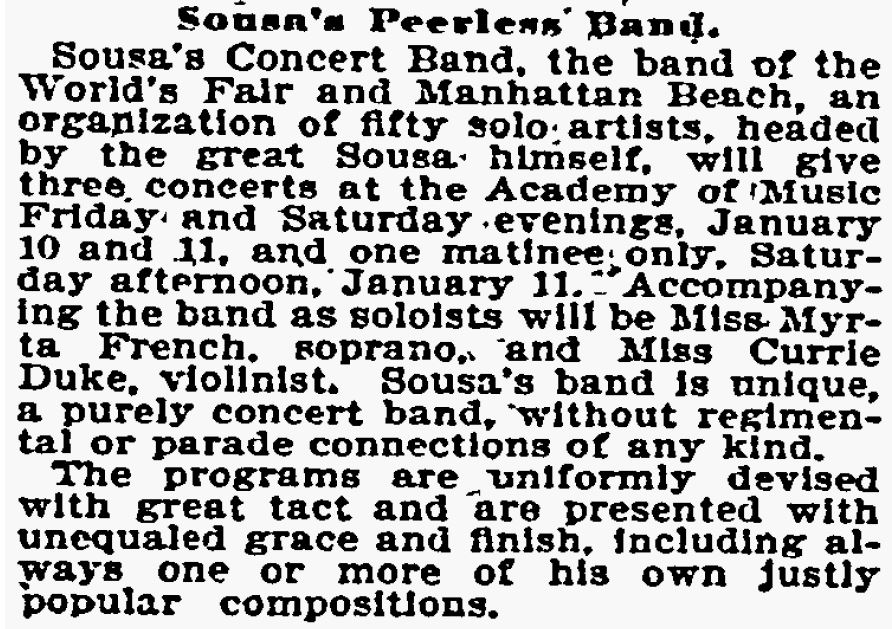
  • Nine days and nine concerts later, that tour made a two-day stop in Philadelphia, where the Sousa Band performed three times at the Academy of Music. Here's the notice in the Philadelphia Inquirer on December 29, 1895:
  • The Academy of Music, which was built way back in 1857 and is still being used today, is located at the southwest corner of Broad and Locust Streets:
The Academy is the first reddish-brown building on the left
Here's how it looked in 1910
  • Pepper's building was just down the street on Locust - a mere six blocks away (see map below: the Academy is noted by the red tag; the Pepper building would have been right where that little yellow man is located at the bottom right):

That seems pretty convenient to me! Could it be that Pepper's new instrument was picked up at that time and taken on the rest of that tour? Who knows!

Tuesday, November 24, 2015

Where the Sousaphone was created

In J. W. Pepper's 1897 catalogue we are provided with a brief sketch of the company's early history in the city of Philadelphia.


Here's what it says in the upper left-hand corner of the page above:
J. W. Pepper commenced business, in a small way, in 1876 (Centennial Year) at 9th and Filbert Streets [832 Filbert Street, to be exact], as a publisher of band, orchestra and miscellaneous music. In 1881 it  became necessary, on account of the growth of the business, to secure larger quarters, and he removed to 8th and Locust Streets [234 S. 8th Street, to be exact], to a building 22.5 ft. by 100 ft., with four floors. At that time he added as a branch to the business, all kinds of musical instruments, giving particular attention to those used in bands and orchestras. He soon afterwards added a factory for the manufacture of band instruments, which has grown, during the last fourteen years, to the largest and most complete establishment of its character in the United States.
Here's what that building looked like in 1883, which was twelve years before the first Sousaphone was built:


The account continues: "In order to secure needed space for the increasing business, it became necessary, at the beginning of 1890, to purchase an adjoining building, and this, together with the corner property, was torn down and the building illustrated on this page [at the top of this post], erected." Here's a better view of Pepper's new facility:


The account concludes: "As noted, this building contains, with basement (in which all of the heavy newspaper and lithograph presses are located) seven floors, each of which is 45 ft. by 100 ft., and is the most complete establishment of its character in the country."

It is in this building that the very first Sousaphone was built in 1895. We are even told of two of the men who were in high-level positions in Pepper's factory at that time, and may very well have worked on the Sousaphone: Alexander LeForrestier, who was the head of the Bell and Tube Making, and Construction Departments; and Walter Barnes, who managed the Valve Making Department.

Sadly, the building is long gone, but here's what you would have seen upon entering the front doors back in 1894 (images below are from Pepper's catalogue of that year):


And here are the spaces in which the first Sousaphone would have been created:


Shortly after this building had opened in 1890, Frank M. Stevens paid it a visit and reported back to The Music Trades. Here's what he shared, which was reprinted in an 1891 edition of Pepper's Musical Times and Band Journal:

Friday, November 20, 2015

Sousa sought sound, not spectacle

For the past few weeks there has been a youtube video making the rounds on social media that features a guy with the world's largest tuba spitting out the rapid-fire crowd-pleaser "The Flight of the Bumblebee." It is the epitome of the word "spectacle"!


Is that what Sousa was shooting for in coming up with the idea for the Sousaphone? Most certainly not. Here's how I put it at the end of my first ITEA article:
What is most important to remember, however, is what prompted the creation of this unique member of the tuba family that is almost never seen today in its original form. It certainly wasn't for marching purposes, nor was it to serve as a spectacle (although it must have been a sight to see!). Rather, it was to generate a bass sound that would help make the Sousa Band what it ended up becoming - the envy of the world! Sousa put it rather pointedly in 1922: "It is my belief, when properly played, that the Sousaphone tone mingles with better effect with the tones of other instruments, string and brass, than is the case with the ordinary bass instruments." Perhaps we should point the bells up again and let our Sousaphones return to the back rows of our concert bands and orchestras!
When the Sousaphone joined the band for the first time, on it's cross-country tour in early 1896, the press didn't mention anything about the new horn, but it sure made a big deal about the sound of the band. For example, in the February 9, 1896 edition of The Seattle Post-Intelligencer, we read the following:
Sousa will have about him only the most expert performers, whether they play leading or subordinate instruments. He is especially exacting in the quality of tone they produce. He will have no clarionet screamers, or brass slang-wangers, in his band, whatever be their other musicianly accomplishments . . . the purity and nobility of the tone of his brasses is a distinguishing feature of his band. . . . It is spectacular music that the band makes, and that is one reason why crowds go to the concert.
"Spectacular music." That's what prompted the creation of the Sousaphone.

Friday, November 6, 2015

Happy Birthday, Mr. Sousa-phone!

On this, the 161st birthday of John Philip Sousa, I thought I'd share something that I acquired recently. It's a paper flyer that came out when the 1952 movie, "Stars and Stripes Forever," was released:


It is signed by Ted Pounder, who built Conn's very first Sousaphone (and many after that!), although I have no way to verify that this is actually his signature. But some of the information on the flyer is inaccurate, or at least misleading. Most notably:

  • What is pictured here is most certainly not the "Original Sousaphone." That distinction, as I have made abundantly clear in this blog, belongs to the horn built by J. W. Pepper in 1895.
  • It's not even the "Original Sousaphone made by Conn for Sousa's Band in 1898." The style of horn seen here doesn't appear until 1903.
  • And, of course, it was not Ted Pounder "who created and made the first Sousaphone" - unless that is referring to the first Conn Sousaphone.
  • Finally, while Sousa clearly favored Conn instruments, he did at one time say something that is at least a mild recommendation of Pepper instruments.
It's also interesting to note that the Sousaphone that is played in the movie is not the one depicted on the flyer, as we can tell from the number of valves:


But the liner notes to the recent Blu-Ray edition of the movie come pretty close to getting the facts straight: "The big brass instrument that bears Sousa's name was actually conceived by . . . Sousa. In 1893 [close! 1892], he requested Philadelphia instrument maker J. W. Pepper to perfect his design and build the first Sousaphone. An 1898 version by instrument maker C. G. Conn later became Sousa's favorite." Indeed it did.


Happy Birthday, Mr. Sousa-phone!

Saturday, October 31, 2015

That's an odd looking helicon bass!

For the first few years of the Sousa Band, which was before the first Sousaphone had been created, it appears that Herman Conrad played a helicon bass. For example, check out the upper right of this band photo from 1893:

Sousa's band in St. Louis in 1893 (courtesy of the U. S. Marine Band Library)
Sousa was not a fan of helicons, as he felt their sound in a concert band was too "violent." And this is exactly why he had asked J. W. Pepper, back in 1892, to create a new horn that would have a body like a helicon, but a larger bell that pointed straight up, like a tuba, so that the sound would "diffuse over the entire band like the frosting on a cake."

But it took a few years for that modified helicon bass to become a reality, and until that time, Conrad seems to have continued to play the old-style horn. For example, in one of the newspaper notices for the band for its early 1896 cross-country tour, we see that helicon right in the middle of the back row in the drawing:

Seattle Post-Intelligencer, February 9, 1896, p. 16
While this illustration was used to promote the previous year's stint at Manhattan Beach for Sousa's band (see the fine print in the ribbons at the lower left), it suggests that this was the standard look of the group. The bass section consisted of a helicon and a couple of tubas.

But for at least part of that early 1896 tour, as we now know, Conrad was playing the very first Sousaphone. And yet most people might have simply thought it was an odd-looking helicon, and maybe that's why it didn't create the stir that a huge new instrument should have. Further, perhaps it was not yet known that the modified helicon had a cool new name - a Sousaphone! That would have created a stir, don't you think?

Great concert, no mention of horn

Courtesy of the Library of Congress
The photograph featured a few posts below was taken at the second of two concerts the Sousa Band gave in Salt Lake City on March 6 and 7, 1896. But the first concert received an over-the-top review on page 8 of The Salt Lake Herald the next morning.

Noting that "A Tumult of Enthusiasm Greets the Bandmaster," here's some of what the review goes on to say:
There was a genuine musical love feast at the tabernacle last evening. Military men are indebted to John Philip Sousa for some soul-stirring marches; dancing society is indebted to him for his entrancing two steps; the whole world is indebted to him for Sousa's band. We acknowledge our part of the indebtedness, and render to him our heartfelt obligations for one of the most enchanting evenings ever passed.
It is doubtful if ever in its long history the tabernacle has known a more thoroughly popular night; it was emphatically the night of the masses; by that we do not mean it was given up to trashy music or trivial achievements, but it was pure music, not Algebraic sounds; it mingled the classic with the simple; it got down to the level of our souls and caused our foundations to tremble; it was a night when the audience took no note of the flight of time, but kept on demanding encores and double encores that almost taxed the patience of the most accommodating of conductors.
Sounds like it was an amazing night! And my, did they love Sousa, gushing that "as graceful as he is handsome, he excites a charm that everyone about him feels."

And the concert ended with a bang: "The big novelty of the night was the closing number, 'The Band Came Back,' a medley of popular tunes which introduced nearly every member of the band in solos, duetts or quartettes." This, of course, included Arthur Pryor, "the trombone virtuoso . . . an admirable performer on a difficult instrument."

But was the Sousaphone featured as well? Was it even noticed?! There is no mention of it in the article, and yet, given that it had been created only a handful of months earlier, this had to be the first time anyone in Salt Lake City had seen and heard the new instrument. Strange silence, unless . . . well, I'll address that in my next post!

From the same page as the article, promoting the concert later that day (March 7, 1896)

Friday, October 30, 2015

Why I thought it was never played

The one and only photo of the first Sousaphone,
or so I thought! (Courtesy of J. W. Pepper)
For my first ITEA Journal article, I found overwhelming evidence to settle the question of who made the first Sousaphone - it was J. W. Pepper in 1895. But what I wasn't able to find was any evidence that the horn had actually been played in Sousa's band. Pepper claimed that it was, but I wondered if perhaps he was anticipating something that never ended up happening. After all, . . .
  • Why was I unable to find a single mention of the new instrument at that time outside of a few Pepper publications?
  • Why did The Music Trade Review, over two years later, announce Conn's Sousaphone as if such a horn had never been seen before?
  • Why did Herman Conrad, who we can assume was well-acquainted with Pepper's Sousaphone (that's the two of them above), rave about Conn's horn, calling it "perfect" and "best of all in good tune"? Did Pepper's prototype simply not cut it with the great bass player?
  • Why was Sousa himself so ho-hum about Pepper instruments, giving them only a "satisfactory" rating (see his less-than-ringing endorsement below). Did that first Sousaphone not cut it with him either?
  • Why was I unable to find a single photograph of Conrad and the historic instrument with Sousa's band, whether posing or in concert?
  • Why, when the Pepper Sousaphone was found in 1973 (stay tuned for that amazing story!), was it unfinished, that is, raw brass? Would it have appeared in concert in that condition?
All of this suggested to me that perhaps the horn was never played in Sousa's peerless concert band, and that's what I speculated in my article. But all of that changes now with the historic photograph of the band - and the Pepper Sousaphone - in Salt Lake City on March 7, 1896!
I still have a hard time reconciling much of what I said above, but now we know that Pepper's horn was played with the band for at least part of one tour in early 1896. And perhaps the newspapers didn't ignore the new instrument entirely; perhaps I just haven't found a reference to it yet. It's significant that there is a hole in the Sousa Band Press Books from September 4, 1894 to June 13, 1896, which is where a relevant clipping or two might have been found!

Friday, October 23, 2015

A truly historic photograph (1896)

The whole story will have to wait for my follow-up article for the ITEA Journal (due to be published early next year), but this truly historic photograph was found recently at the archives of the International Society Daughters of Utah Pioneers in Salt Lake City:

Photo courtesy of the ISDUP, and used with permission
What can be seen here, albeit at a considerable distance, is the Sousa Band in concert at the Tabernacle on March 7, 1896. There is no question about the date, as it is written on the back of the photo, and it squares with Sousa's itinerary for that year. Plus, the huge flag on the Tabernacle ceiling was only there from January 1896 until the summer of 1897.

From the Deseret Evening News, February 24, 1896, p. 11 (courtesy of the Library of Congress)
And I said this photograph is truly historic because it is now the earliest known image of Sousa and his band in concert! Here's a closer view of the band itself:


But look carefully. While movement in the band caused many of the members to be out of focus (Sousa himself is fully a blur), we can make out some of the instruments and their players. Most importantly, look right above the first chair clarinet. What we can barely see is a man with a mustache playing not a tuba (there is one of those to his left, and it is much smaller) but a Sousaphone. This would almost certainly have to be the horn built by J. W. Pepper the previous year (Conn's first Sousaphone wasn't introduced to the world until January 1898).


This is now proof that Pepper's historic horn - the very first Sousaphone ever built - was indeed "Used Daily in Sousa's Peerless Concert Band," just as Pepper had claimed. Prior to this photo being discovered a few months ago, I had been unable to find any evidence that this new instrument had been played under Sousa's baton. And there were a few clues that seemed to confirm the idea that it was perhaps never played in public at that time.

But that all changes now with this image - the one and only time (for now) that we see the original Sousaphone in action with Sousa's band!

Again, I'll share more of the story in my upcoming follow-up article in the ITEA Journal.

Thursday, October 22, 2015

From ITEA article to documentary


The folks at J. W. Pepper have been wonderful to work with these past few years, and they have taken great interest in my research (no surprise there, as they have much to boast about now regarding the first Sousaphone!). This past summer they produced a 24-minute documentary on "The Birth of the Sousaphone." Along with an extensive interview with me, it features Steve Dillon and Matt Walters of Dillon Music in NJ, as they examined the historic instrument and got it ready to be played in concert (more on that later).


Wednesday, October 21, 2015

Publishing my findings - round one!

A lot has happened since I last posted here, and I felt it was time to get you up-to-speed on everything I've learned about the early history of the Sousaphone since we last "talked."

First of all, about a year ago now, at the encouragement of a friend, I reached out to Ben Pierce, the editor of the ITEA Journal to see if he might be interested in an article on this topic, and he was! That launched me into much more serious research (portions of which I will post on later), and resulted in the following article, published this past May (and showing just the first page):


Here's how I summed up my findings:
For years, confusion and even controversy swirled around the early history of the Sousaphone. But no longer. We can now say with confidence that Pepper, who received the idea from Sousa in 1892, built the first Sousaphone in 1895. But for some reason it quickly faded away, attracting very little public attention. The idea was then picked up by or delivered to Conn, whereby he was able to produce, in early 1898, the first Sousaphone that appears in use by Sousa's band. This horn went through a few modifications in its early years, and remained the sole Sousaphone in Sousa's bass section until 1915, when we see a second Sousaphone added for the first time. Then, from 1921 onward, the entire section consisted exclusively of Sousaphones.
One of the most important pieces of evidence for the Pepper horn being the first was mentioned in a previous post, but here is the actual scan of Pepper's Musical Times and Band Journal, vol. 13, no. 155, which came out in late 1895 or perhaps early 1896 and was graciously shared with me by collector and musician Don Johnson. First, the cover (and yes, this is the original color of the first and last pages!):


And now - drumroll, please! - here's what we find on page 24:


So the horn clearly existed in October 1895. But you'll note that it was the photographs of the Sousaphone that were "a great attraction," making me wonder if the horn was actually being played at that time in Sousa's band. And this, along with other clues, led me to speculate that perhaps Pepper's historic instrument was never featured under Sousa's baton. There was simply no evidence that it was - no mention in newspaper articles, as far as I could find, and no photographs showing the Pepper Sousaphone in action. That is, until now. There will need to be a follow up article!


Additional support for the first Sousaphone being built in 1895:

Friday, May 1, 2015

Sousaphone makes front page news!

Today The Philadelphia Inquirer did a front page feature on the very first Sousaphone. Here is that article in its entirety: