Thursday, March 2, 2017

Not the original, but fun to see!

I stumbled upon a short film that was recently uploaded to youtube by the National Archives. It was produced around 1955 and features the director of the U. S. Marine Band, Lt. Col. William F. Santelmann, walking through through the history of that great ensemble.

What interested me the most, as you might imagine, is the appearance of what was thought to be the original Sousaphone, built by C. G. Conn.


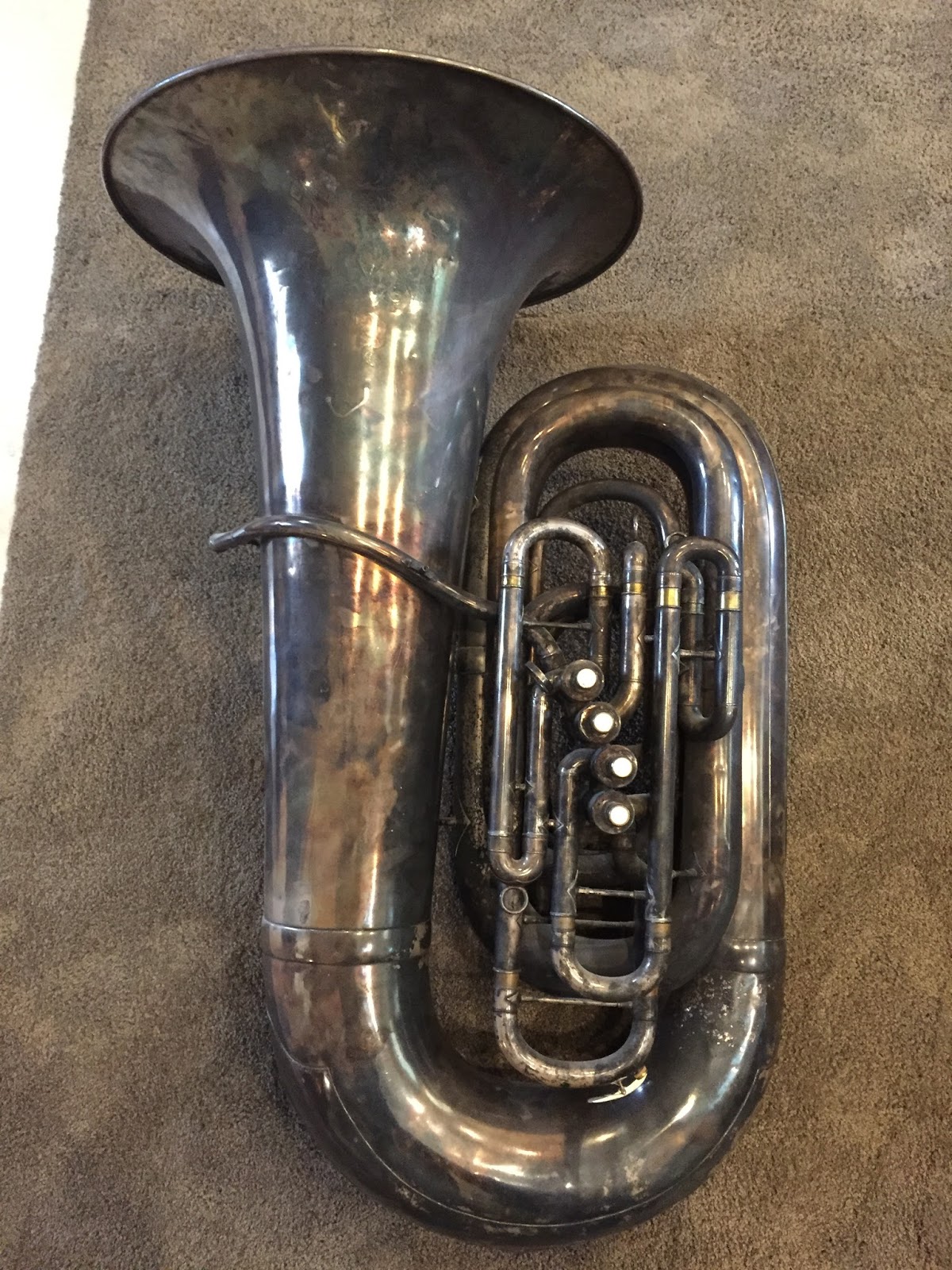
The director mentions that, at that time, this historic instrument (although decidedly not the original Sousaphone, as I've clarified in this blog) was on display at the Museum of Science and Industry in Chicago. I'm wondering if it is actually the horn that ended up at the Interlochen Center for the Arts, which I saw and played back in the summer of 2012:


Here's the full video, which is worth watching all the way through. But the reference to Sousa, and the Sousaphone, begins at around 15:55.


Friday, January 6, 2017

A sample of Conrad's recordings

Herman Conrad made hundreds of recordings during his years with the Victor Talking Machine Co. (1903-1920), but mostly without explicit credit. He was simply part of the "Victor Orchestra," or "Victor Military Band," or whatever other name might have been given to the Victor studio musicians for a given recording.

But there are a number of recordings where Conrad is identified as playing with Arthur Pryor's Band during those years, and some of those can be listened to here at the National Jukebox, courtesy of the Library of Congress. The tuba part really shines in "The Girl I Left Behind Me," "Arkansas Traveler," and "Reinzi Overture."

Better still, I was able to get access to a very rare recording of Gilmore's Band from 1891 that almost certainly includes Conrad on his monster helicon. Conrad had emigrated from West Prussia to America just a few years earlier, and here he was, recording with what was hailed as "the greatest band in the world"! And he was only 24 years old!


Here's another number from that same recording session in 1891:


But I've saved the best for last: Conrad was featured in what was called a "tuba solo" in a special 1902 recording, while he was still with Sousa's Band. Is he playing his Sousaphone? We can't be sure. But this piece does bring Conrad to the front of the band for a change. Enjoy!


Tuesday, December 27, 2016

Herman's horns: an emerging history

Herman Conrad, who I have dubbed "the forgotten giant of the tuba," can be seen with at least eight, and perhaps nine, different horns over his illustrious music career in America (1888-1920). Here they are, in the order of their appearance:

Conrad with a monster helicon in Gilmore's Band, 1889
When Conrad emigrated to the U.S. in late 1887, it was only a matter of months before he became part of Gilmore's world-famous band. The instrument we find him playing, which may have been used in the band prior to his arrival (I'm looking into that) is a BBb bass "Monster" helicon built by F. Sudre and imported by Lyon & Healy under the trade name "Henry Gunckel of Paris."

We don't know much about this horn, and I have yet to find one that has survived the ravages of time, but it had a 21 inch bell, "celebrated French piston valves and improved light action," and sat very strangely below the left shoulder (notice in the photo above, which is how it looks in every photo I have found of it being held; frankly, I'm baffled!). According to a Lyon & Healy catalogue from 1880 - eight years before Conrad started playing it - the helicon sold for $330, which translates to about $11,400 today. So I would imagine it was a pretty decent horn.

Conrad appears to have used this massive helicon for all five years he played with Gilmore's Band (1888-1892), as well as the first three years he was with Sousa's Band (1893-1895). But Sousa was not a fan of helicons, so he had J. W. Pepper modify a helicon into what became known as a "Sousaphone." In 1896, the Sousa Band went on tour with the very first one:

With the very first Sousaphone, built by J. W. Pepper in 1895
This historic horn can be seen today at the J. W. Pepper headquarters in Exton, PA. It is a BBb modified helicon with three valves, a bell diameter of 24 inches, a bore of .680 inches, a height of 4 feet 5 inches, and a weight of 24.9 pounds. Engravings on the bell include a portrait of Sousa in his 1894 uniform, and the words "SOUSA" and "PHONE" laid out separately.

Just how long this new instrument was played by Conrad in Sousa's Band is uncertain, but in early 1898 we see him playing a completely different Sousaphone - the first one built by C. G. Conn:
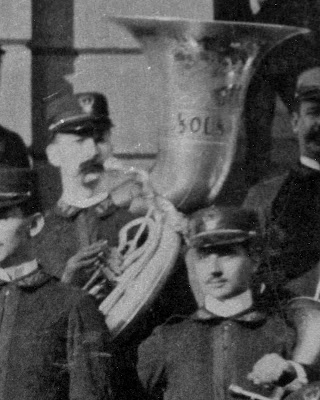
With Conn's first Sousaphone for Sousa's Band, 1898
This historic horn has yet to be found, but it was likely built in the latter part of 1897 and then introduced to the world in January 1898. Very little is known about it, other than what we can see - that it had four valves instead of three, and a lot of engraving on the bell, including the word "SOUSA" (or perhaps "SOUSAPHONE") in large capital letters. One newspaper article claimed that it had a bell diameter of 26 inches, and a height of 5 feet.

The second Sousaphone built by Conn, which came out barely a year later, was purchased by Joseph Dupere, who was not connected with Sousa's Band. He allegedly paid $250 for the horn, which is around $8,300 today, or, interestingly, about what a Conn Sousaphone sells for now.

By 1900 we find that the Conn Sousaphone played by Conrad had been modified into what we will refer to as version 2:

With Conn's second version of his Sousaphone for Sousa's Band, 1900
This version had a very different valve cluster, although still with four valves. One report, coming from a London newspaper, revealed that this horn weighed 33 pounds. It was likely played until 1903, when we find Conrad playing version 3 of Conn's Sousaphone:

With Conn's third version of his Sousaphone for Sousa's Band, 1903
Once again, the valve cluster is different than either of the previous two versions, but the bell also appears to be different. Whether this horn still exists today is uncertain, but there are numerous examples of this model of Conn Sousaphone still around. Eventually two of these four-valve monsters, along with 2-4 smaller three-valve Conn Sousaphones, were featured in the Sousa Band until the great bandmaster died in 1932.

Conrad played this horn with Sousa until he left the band in late 1903 to join Arthur Pryor's new band and, shortly after that, to become part of the newly formed Victor Orchestra, which served as the "house band" for the Victor Talking Machine Company. Here is what might be a photo of him with Pryor in 1904 (it does look a bit like him, but we can't be sure):

With what appears to be a CC Sander rotary-valve tuba in Pryor's Band, 1904
If this is indeed Conrad, then it is the first time we see him with a standard tuba, and it may be a CC horn built by German maker Rudolf Sander. Tubist and collector Sam Gnagey owns a unique Sander CC tuba that looks very much like what we see Conrad holding in the photo above. Check it out:

Sam Gnagey's CC Sander - possibly the very same tuba
It is perhaps significant that August Helleberg played a Sander tuba, and we think that Helleberg is one of the tubists in the full version of the Pryor Band photo above.

However, Sam has another photo of this horn from the early 1900s, and it is being held by someone who is definitely not Conrad. Sam understands it to be Fred Geib, who, incidentally, was subbing in the Philadelphia Orchestra from 1904-05, while C. Stanley Mackey was touring Britain with Sousa's Band (Mackey played tuba with the Philadelphia Orchestra from its founding in 1900 until his death in 1915 - with the exception of his brief stint with Sousa). So, it may very well be Geib, rather than Conrad, in the photo above. We just can't say for sure.

But what we can say is that Sam's CC Sander tuba has a 16 inch diameter bell, a .807 inch bore, a weight of only 14 pounds, and a height of 35 inches. He describes the sound as "rather dark but with a good focus and core."

This is the only rotary-valve tuba connected with Conrad at this point. He seems to have preferred front action piston valves, as we shall see, which is one more reason to question that it is Conrad in the photo above.

By 1912 Conrad can be seen playing a unique Holton Mammoth BBb Bass:

With a custom Holton Mammoth BBb tuba at Victor, 1912
This horn appears to have been custom built for Conrad in early 1912 by Frank Holton of Chicago. The two had been in the Sousa Band together in 1893 (Holton played trombone), and had perhaps remained friends ever since.

Tubist and collector Mike Lynch owns what appears to be this exact horn:
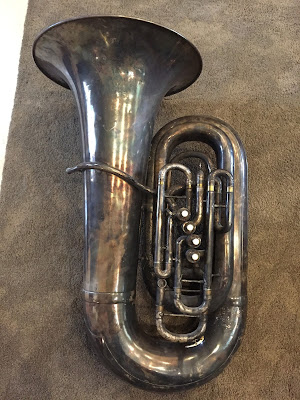
Mike Lynch's BBb Holton  - possibly the very same tuba
The serial number is 20192, which squares with 1912, and it has a bell diameter of 20 inches, a bore of .750 inches, and a weight of 27 pounds. According to Mike, the sound is "somewhat between the very pillowy sound of later Holtons, and the crisper sound of the 60's versions."

With an unknown BBb recording bell tuba at Victor, 1913
At around this same time there appeared another photo of Conrad with a very different tuba - one much smaller and with a recording bell - the latter making sense, given that he was recording for the Victor Talking Machine Company!

At first glance, it looks very much like a Conn 48j CC "New Wonder" Phonograph Model, although that horn came along later, as far as I can tell. But according to master tuba technician Matt Walters, there are enough differences to suggest that it was perhaps another Holton, and more likely a small BBb horn.

With another (custom?) BBb Holton tuba at Victor, 1918
The last horn that I found connected with Conrad was from a school poster produced by Victor in 1918 (two years before Conrad's untimely death). Whether he actually played this horn in his work is unclear. But according to Matt Walters, it appears to be another unique Holton BBb tuba with a likely bore of .656 inches. And according to another technician, Robb Stewart, the valve cluster may have come from a Sousaphone, which was not uncommon for front-action American tubas.


Saturday, October 15, 2016

Just published in The Brass Herald

As with my first article on the early history of the Sousaphone, Philip Biggs, editor of The Brass Herald was eager to re-publish my follow-up article for his largely European readership. Issue 65 arrived from the UK in my mailbox yesterday! (Thanks to the ITEA Journal for gladly allowing the article to be reprinted.)


Saturday, October 1, 2016

The curious concave Conrad Model

In my ongoing research on Herman Conrad (1867-1920), I learned that at some point Frank Holton made a "Conrad Model" tuba mouthpiece. Don Harry let me know about this, as he has one of these in his collection:


On the other side of the mouthpiece it says "Frank Holton, Chicago," which means that it was produced prior to the Spring of 1918, as that is when Holton moved his business from Chicago to Elkhorn, WI.


From 1903 until he passed in 1920, Conrad was part of the elite group of musicians who were the "house band" at the Victor Talking Machine Company, and this mouthpiece probably came out during those Victor years. He was playing Holton tubas during much (and possibly all) of that time, so it's not surprising to see a Holton mouthpiece bearing the great bass player's name.

What is most curious is that the rim is concave, which I'm thinking is something that Conrad preferred (although Holton made a whole line of concave rim mouthpieces, starting at around 1911). According to Don, "the concave shape went horizontally for a very narrow jaw formation." Here's the Conrad Model next to a more standard Holton mouthpiece:


At this point, I am not aware of another copy of this mouthpiece existing - nor have I been able to find any notice of it in a Holton publication from that era (although, granted, I don't have access to everything they produced during those years).

But I would imagine that calling it a "Conrad Model" was a nod to Conrad's fame as a tubist in the early 20th century (and perhaps a way to sell more mouthpieces?!). Conn had his "Helleberg Model" bass mouthpiece around that time, and Holton had his "Conrad Model." Two giants of that era!


Tuesday, September 27, 2016

Herman's great-great grandson!

After various searches through Herman Conrad's family tree, I was finally able to locate a living descendant of that great tubist who was the first to play the Sousaphone. His name is Daniel Corry, and he is Herman's great-great grandson (Daniel's father was Christopher, whose mother was Henrietta Alice Conrad, whose father was Edward Columbus Conrad, whose father was Herman).

As it turns out, Daniel lives within a few hours of me, so we connected this past Saturday and had a marvelous time! I was able to share the whole story of his great-great grandfather, of whom he was unaware, and we made a trip out to the J. W. Pepper headquarters, in Exton, PA, where Daniel was able to play the historic horn that Herman was the first to play 121 years ago:


 And just for kicks, here's a side-by-side of Herman, 1895, and Daniel, 2016:


Sunday, September 25, 2016

Documentary: Pepper's 140th year

Earlier this year I was privileged to be included in a special documentary created to celebrate the 140th anniversary of J. W. Pepper (written and directed by Jeff Blake, who did a fantastic job!). My comments - some of which, of course, mention the Sousaphone! - can be found at 6:10, 7:22, and 25:17. Enjoy!


Friday, July 29, 2016

Seeing Sousaphones at Disneyland!

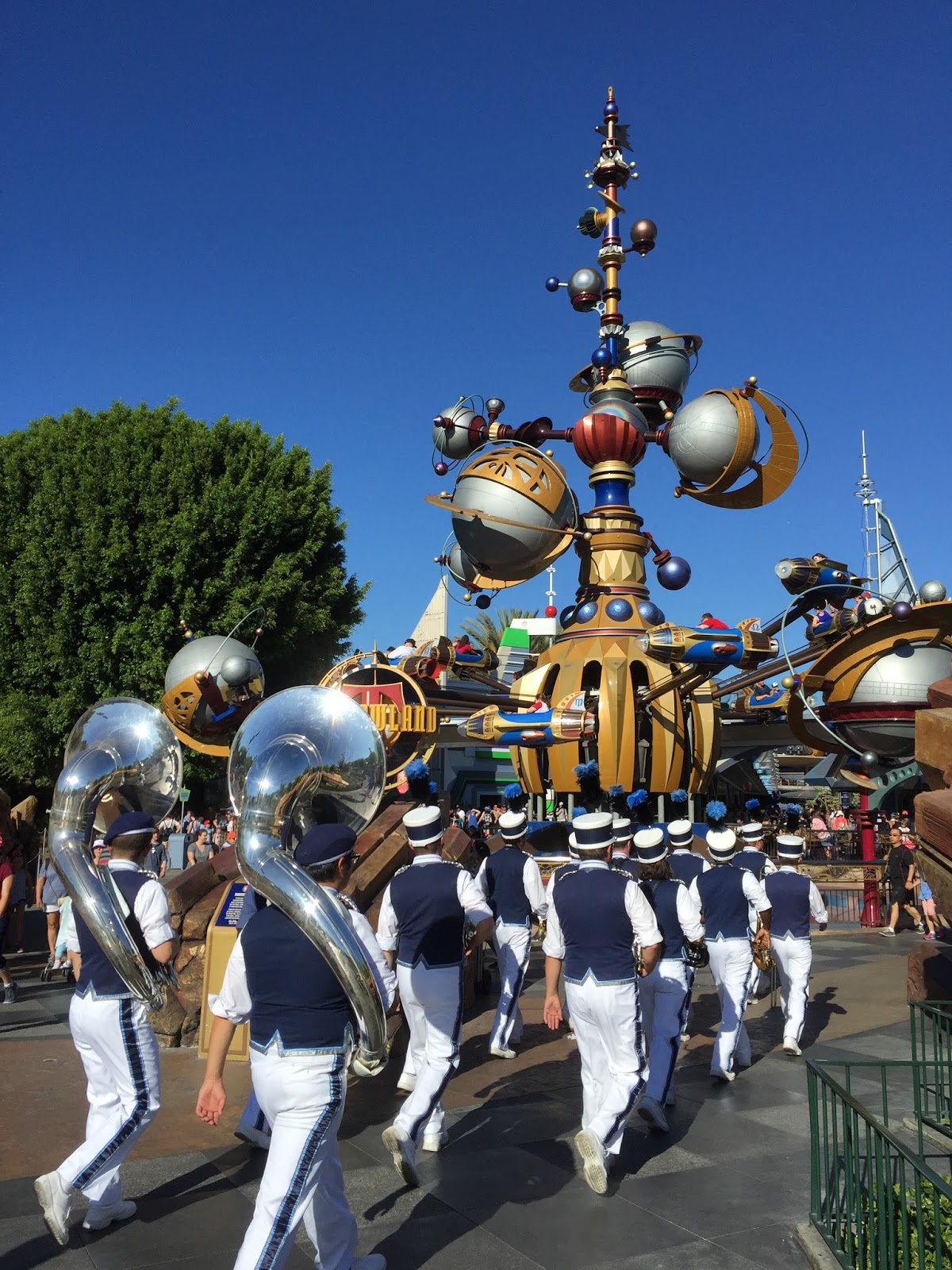
This past week my family, along with my wife's family, converged on Disneyland for a few days. While I've been there many times, I had yet to see the new Disneyland Band in action, so it was great to catch them a couple of times throughout the day:


What was even more fun was discovering that one of the new collectible pins for 2016 featured Donald Duck with a Sousaphone! I love it (and yes, I bought it!):


Monday, July 25, 2016

Conrad with the Victor Orchestra

In a little Victor publication, about the size of an iPhone and titled New Victor Records February 1906, we learn about the recently formed Victor Orchestra, of which Herman Conrad was a founding member. As far as I can tell, Conrad did not play Sousaphone with this long-standing Victor "house band," but opted for standard upright tubas (more on that shortly). But he stayed with Victor, after leaving the Sousa Band in 1903, until his death in 1920.

Here are the relevant pages, courtesy of Michael Khanchalian, who has a fabulous collection of items from the early years of the recording industry:


Monday, June 27, 2016

Sousa & Sousaphone history for kids!

I had the opportunity to help out with a project this past year that was produced by Alfred Music, and a complimentary copy arrived in the mail today. It is "An Interactive Storybook About John Philip Sousa," but it also reveals the history of the first Sousaphone - which is that part I helped with, of course!


Here are a few of the pages that highlight the history of the Sousaphone:


It is recommended for all ages, but it will be particularly appropriate for younger kids. Alfred Music did a great job with this, and I am grateful for Andy Beck, one of the authors, asking me to participate in the project.

For more info on this digital storybook, click here, or check out this video:


Update: To see other, older, children's resources that don't get the history right, click here.

Saturday, June 25, 2016

Sousaphone solo by Herman Conrad


Conrad was often listed among the soloists in Sousa's band, but I have yet to find any record of him actually playing a solo in concert during those years (1892-1903). But in the July 25, 1905 edition of the Asbury Park Press, Conrad is listed as playing the solo "Rocked in the Cradle of the Deep" on the Sousaphone with Pryor's Band.

Whether Conrad was a regular with Pryor at that time is yet to be determined. As far as I can tell, from 1903 onward he was part of the elite group of musicians known as the Victor Orchestra (among other names), making records for the Victor Talking Machine Company, first in Philadelphia, and then in Camden, NJ.

An interesting question would be what Sousaphone Conrad might have played in 1905. Was it the one he had played while with Sousa, or did that remain with the band? Or could he have been reunited with the Pepper Sousaphone? Who knows!

Monday, June 20, 2016

Conrad with Gilmore's Band, 1889

As I continue to research the life and musical career of Herman Conrad, the first Sousaphonist, I am learning a great deal about the great bandmaster who came before Sousa - Patrick Sarsfield Gilmore.

Conrad emigrated from Prussia to the U. S. in late 1887, and within months he had joined Gilmore's Band - which means he must have been a hot-shot bassist already, probably with one of the military bands of the Prussian Army (I'm still trying to track that down).

Had Gilmore summoned Conrad, having heard that he was already an accomplished bass player? I have learned that Gilmore kept track of the best bandsmen in Europe, and often successfully recruited them into his band. He always wanted the best players, so at the very least, we have to assume that Conrad was as good a player as any, and Gilmore was able to add him to the group.

Here is Gilmore's Band a year or so later, in 1889, on the steps of the St. Louis Exposition and Music Hall, and you can see Conrad in the upper right, holding a massive helicon bass (but check out some of the other interesting instruments in the band - the other helicon, which has rotary valves, and seems to have a slightly curved-up bell, the bass saxophone, the sarrusophone, the antoniophones, and more!).

Courtesy of the Missouri History Museum, St. Louis.
That huge BBb bass was built by Henry Gunckel of Paris and referred to as a "Monster" (and it was imported into the U. S. by Lyon & Healy from as early as 1880). Whether Conrad brought that horn with him, or it was given to him by Gilmore when he arrived, we simply can't say. But here's a closer look at the instrument:


And here's that same horn, advertised nine years earlier, in the 1880 Lyon & Healy catalogue.


Note the price - a whopping $330! By comparison, the second Conn Sousaphone, built almost 20 years later, sold for a mere $250. That helicon must have been some horn! And Conrad played it not only during his time with Gilmore, but also for the first few years he was with Sousa's Band.

But Sousa was not a fan of helicon basses - even expensive, well-crafted ones like this one (assuming it was both of those things)! In 1892, he pitched the idea to J. W. Pepper for a modified helicon that turned the huge bell straight up, and in 1895, Pepper finally made the very first one. From that point on, as far as we can tell, Conrad only ever played a Sousaphone during his remaining years with Sousa (ending after the 1903 season).