Tuesday, December 26, 2017

Sousa's early visit to Pepper's factory

In 1882, Henry John Distin, along with his son, William Henry Diston, moved from New York to Philadelphia to work with J. W. Pepper in producing band instruments.

Henry Distin, and his son, William (image courtesy of Ray Farr)
Starting in mid-April, they oversaw the construction of a new factory connected to the existing Pepper building on 8th and Locust streets.


If the above image is accurate, the left side of the building, once it was finished, stated, "J. W. Pepper, American Distin Band Instrument Factory, Supervised by the Original Henry Distin from London, Eng." And here's what it looked like on the factory floor:


Shortly before it was opened on June 1, 1883, John Philip Sousa, who had been leading the U. S. Marine Band in Washington, D.C. for the past three years, paid a visit to the new facility. Afterward, Distin asked Sousa for his opinion on the instruments he would be producing there. Here is his response (reproduced in a brand new resource, A Sousa Reader, ed. Bryan Proksch):

Washington, D.C., May 8, 1883

Mr. Henry Distin

Dear Sir:- I will endeavor to reply briefly to your request for my opinion of your celebrated band instruments.
       The name of Henry Distin was always familiar to me as being synonymous with superiority in the manufacture of brass band instruments, and my association with bands and bandsmen assures me of the universal estimation they are held in by discriminating performers.
       On my recent visit to Philadelphia when I inspected the new steam factory erected for you by Mr. J. W. Pepper, I was greatly surprised at the magnitude and completeness of it. It is apparent that there is nothing lacking in its appointments for the production of the very best instruments. I was particularly pleased with your recent inventions for improving the tone and register of brass instruments. I have no doubt your thorough knowledge, both theoretically and practically, of the entire range of brass instruments enables you to produce a class of instruments which are unrivalled.
       With the earnest with that your endeavors will meet with complete success for yourself and Mr. Pepper,

I am, yours sincerely,
John Philip Sousa

While Distin's partnership with Pepper lasted only until early 1886, it is interesting to see Sousa connected with Pepper at this time - now as an instrument maker and not just a music publisher. Could it be that this contributed to Sousa giving Pepper the nod, in 1892, to start playing around with his idea for a modified helicon bass?

We can only speculate, of course, but it was Pepper who produced that first "Sousaphone" in 1895.


Friday, December 22, 2017

Long forgotten poem about the tuba

In the April 1896 edition of The Dominant, an obscure music journal published in Philadelphia way back when, I stumbled upon this rather cheesy poem about the tuba:


Harry Coleman helicon bass - 1897

While slogging through an old microfilm of the obscure music journal The Dominant (published in Philadelphia in the late 19th and early 20th centuries), I came across an ad for Harry Coleman band instruments in the February 1897 edition:


The helicon bass featured is pretty cool looking (as is the uniform of the player!), so I couldn't pass up the opportunity to share it. Here's a close up. Enjoy!


Thursday, December 21, 2017

No question - Pepper built the first!


Toward the end of the 19th century, Arthur A. Clappe started a music journal in Philadelphia called The Dominant. At the end of the July 1896 edition, where he reports on some of the companies advertising in the journal, we find this:


Did you catch it? Here are the last three sentences of that long opening paragraph:
During the last year the members of Sousa's famous band were furnished with instruments from this factory, and among others, Mr. Pepper produced, especially for Mr. Sousa, a monster circular tuba, the lines of construction differing very materially from those of other tubas. To this instrument, made, I understand at Mr. Sousa's suggestion, is given the title of Sousaphone. It is readily distinguishable in the band by its enormous but symmetrically shaped bell, which points upward, instead of forward as it the case with other circular tubas.
This is further confirmation that the very first Sousaphone was:
  • built by J. W. Pepper
  • in 1895 ("During the last year")
  • in his factory on 8th and Locust streets in Philadelphia
  • especially for John Philip Sousa
  • who had suggested the idea sometime earlier
  • and it was a modifed helicon bass ("other circular tubas"), where the "enormous bell points upward."

And all of this is confirmed almost two years before Conn's first Sousaphone appeared. This is now the second reference to Pepper's Sousaphone, prior to 1898, that I have found outside of Pepper publications (here's the first reference). There really is no question that Pepper designed and built the original Sousaphone - although the current C. G. Conn website persists in claiming otherwise:
C. G. Conn also continued on a series of "firsts," building the first American made saxophone and the first sousaphone, built to John Philip Sousa's specifications.
This claim has been made by Conn since at least the early 1920s, and perhaps even earlier than that. But it just isn't true, as we have seen.

Finally, just for fun, here is the full page Pepper ad featured in The Dominant at that time (starting with the June 1896 edition):


Of particular interest are the musicians who were supposedly playing or endorsing Pepper instruments at that time. Included is Herman Conrad, who was playing the Pepper Sousaphone in Sousa's Band that year. Here's a closer look at that paragraph:


Saturday, December 9, 2017

Merry TubaChristmas, 2017!

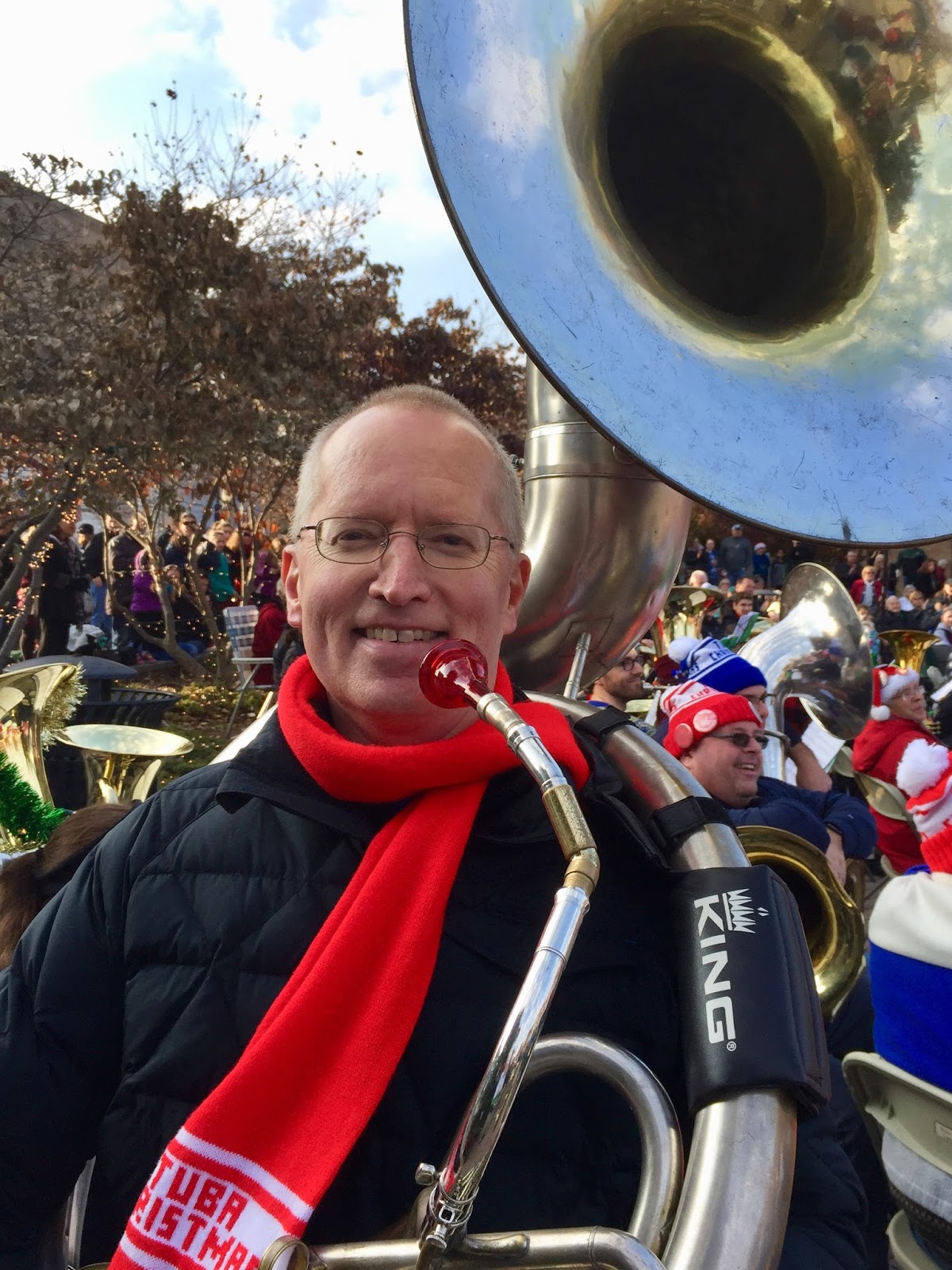
I meant to post these last Sunday, but we had a great turnout for TubaChristmas that day in Lansdale, PA. Seventy-five horns showed up, and we sounded, well, very tuba-y! Here we are rehearsing at the local fire station:


And here I am after the concert, with the 1927 Pan American Sousaphone that my son and I rescued from a local middle school a number of years ago (he just performed at TubaChristmas out at State College today):


Sunday, November 26, 2017

Kid's books and Sousaphone history

I accompanied my wife to our local library one day, and thought I'd peruse the children's book section to see what I could learn about Sousaphone history. It turns out that kids are getting a lot of bad information. Here are a few samples:


First up, from 1964 (above), is the often-mentioned falsehood that the Sousaphone "was first used . . . in  marching band."


The same falsehood appears in this book, but also note the backwards facing bell in the drawing above.


Yeah, I didn't know that, because 1910 is 15 years after the fact. And the first Sousaphone was not quite that tall. I've held it and played it.

And here are some fun comics from a book on Sousa:


Finally, and this was not at our local library, but in a kid's book I found in The Creamery up at Penn State, where my son is enjoying his second year. Check out the ergonomics on that Sousaphone!


For a children's resource that does get Sousaphone history right, click here.


Saturday, November 11, 2017

Veteran's Day (cartoon) Sousaphone!

My Mom likes to send our family these online "live" greeting cards, and the one she just sent for Veteran's Day is right up my alley!


Not surprisingly, this little bear band is playing Sousa's "Stars & Stripes Forever" when you let the card do it's thing. Happy Veteran's Day to you all!

Friday, October 6, 2017

More Blue Band highlights (Sept 30)

Me, our son, Jonathan, and my wife, Kim
The parade from the band building to the stadium
"Snailing" along the way!
Pregame, during the "floating LION"
Halftime, playing "Star Wars"!

Friday, September 8, 2017

My all-time favorite Onion post!

This was posted by The Onion ten years ago, but I ran across it again today and figured I had to post it here for posterity. Click here for the full article!


Sunday, September 3, 2017

The college tradition continues!

Yesterday was my son's first game in the Penn State Blue Band - almost exactly thirty-eight years after my first game in the USC Trojan Marching Band (although, frankly, he's a much better player than I was at his age). I still bleed cardinal and gold, but you can already see a blue tinge starting to appear! I love it!

Here are a few shots of him in action on a rather rainy, but wonderful day:


And here's a photo of my favorite tailgate flag on gameday!


Finally, if you'd like to watch the pregame show from yesterday, here it is:


Sunday, August 20, 2017

Okay, so it really is in my blood!

According to my parents, I became fascinated with the tuba back in 1965-66, when I was 4-5 years old and our family was living in Germany while my Dad taught there.

When we returned to America, and a few years later I reached the age where I could choose an instrument to play in the school band, I was adamant about the tuba. But my elementary school didn't have a small horn for a little guy like me to play, so I was set up with a Sousaphone that was sitting on a special chair in which I crawled into in order to play.

What I don't recall ever hearing back then, although he probably told me, is that my Dad played the Sousaphone when he was in high school. I remember hearing about that later, when I played in high school, and then in college, but I had never seen a photo of my Dad with a horn. That is, until now.

Here's what he discovered a few days ago in the 1947 Tucson High School yearbook, which he then enlarged the best he could and documented for me:


How cool is that?! And here's my son, his grandson, who also played the Sousaphone in high school - and just this week made it into the Penn State Blue Band (stay tuned for more on that)!


Add me in the middle, and that is three generations of Detwiler men holding down the bass line in marching band!


Saturday, August 5, 2017

Band books and Sousaphone facts

As a follow up to my previous post, it turns out that the year the first Sousaphone was built is equally all over the place in general books about the history of bands in America.

For example, in 1951 Alberta Powell Graham, in Great Bands of America, wrote, "While he was with the Great Lakes Band, Sousa designed a new band instrument - a mellow-toned horn to replace the Helicon tuba with its harsh sound. This Sousaphone is in use in all large bands today" (p. 67) That would be, let's see, 1917!

Six years later (1957), in his wonderfully engaging book, Bands of America, H. W. Schwartz revealed that a number of bandmasters (Brooke and Innes) had a giant tuba constructed at one time as a spectacle for their bands, and then adds that
Even Sousa became infected with the "bigger" virus, for in 1898 he placed an order with an instrument maker to build for his band a bass tuba, large in bore and surmounted with a big bell opening upward. Sousa did not claim that his instrument was bigger than others, but it was a spectacular instrument, both in performance and in appearance, especially when held and played by the military giant Herman Conrad. In time this instrument proved its merit as a musical instrument and became known as the sousaphone (p. 183).
Schwartz, as it turns out, worked as an executive for C. G. Conn, Ltd, so he appears to be perpetuating the claim that Conn built the first Sousaphone in 1898 (although, strangely, he doesn't name Conn!). But what was built in 1898 (or early 1897) was Conn's first Sousaphone. Pepper built the original Sousaphone 2-3 years earlier - and it was called a "Sousaphone" from the start, even when Conn created his version.

But hey, Schwartz mentions Conrad, and he does so four different times in his book, and that got me excited! Conrad wasn't yet a "forgotten giant" in the late 1950s. But he is now, and I am hoping to rectify that with my upcoming article.

Finally, Richard Hansen, in his 2005 book, The American Wind Band: A Cultural History, mentions on his timeline that in 1899 "The sousaphone is developed and named for John Philip Sousa" (p. 241). Nope - not 1899, not 1898, and certainly not 1917!

Once again, it seems that over the decades no one knew, or remembered, that J. W. Pepper built the first Sousaphone in 1895. That fact had somehow gotten lost early on.