Thursday, August 30, 2012

Who knew the Sousaphone in 1892?

The October 24, 1925 edition of Presto speaks of Sousa and his band "in those exciting days of the World's Columbian Exposition of 1892 in Chicago. . . . Who in that time . . . knew the sousaphone? That was the March-King's own device for obtaining a distinctive sound; and today the sousaphone is part of every big band, of many small ones, and has a place in the great modern orchestras" (p. 20).

Photo courtesy of Paul Bierley, John Philip Sousa: American Phenomenon, p. 60
Above is the Sousa Band in 1893 - which does not yet have a Sousaphone. What you see in the top right is Herman Conrad playing a Helicon bass - the forerunner to the Sousaphone.


Tuesday, August 28, 2012

Clues from Sousa's uniform

In trying to determine the year that the first Sousaphone was made, the engraving of Sousa on the bell offers some important evidence:

 
It turns out that this engraving is based on a photo (or is it a drawing?) that shows up on this poster for the 1895 season - however the photo negative was loaded backwards (note the "S"s on Sousa's collar):


So here is that photo flipped and enlarged, and - voila! - it matches the engraving on the bell (note in particular the embroidery on the jacket):


Now, when was this photo taken? We can't say for sure, but based on extant photos of Sousa from 1892 and 1893 (see below), it would seem that this particular uniform was new either in 1894 or 1895. And, of course, the Sousaphone had to be made after the photo was taken, eliminating 1893 as an option (well, unless the horn originally didn't have an engraving on the bell, but it was added a year or more later).

September 1892
 
1893 (month not specified)
 
June 1893

Monday, August 27, 2012

When was this horn actually built?

All of the evidence points to the Sousaphone made by J. W. Pepper, serial number 8800, and shown a few posts below, as the very first one. Sousa gave Pepper the idea for the horn back in 1892, but what year was it actually built?

Having examined the horn close up, it seems that the answer is provided right there on the bell - 1893:


However, many Pepper instruments have this, or something like this, on their bells (see this website for a detailed list). For example, here is a tuba, serial number 9293:


And here's a trombone, serial number 11054 - although now it clarifies that it is referring to receiving some sort of award at the "World's Fair Columbian Exposition Chicago 1893":


Same goes for this cornet, serial number 11158 - quite a ways from 8800, meaning it may very well have been built later than 1893:


It would seem that this information on the bell of these instruments is not providing the date of construction, but only boasting of the award received at the World's Fair in 1893.

Photo courtesy of Paul Bierley, The Incredible Band of John Philip Sousa, p. 18
Sousa's Band performed at the Fair, both at the dedication of the buildings in October 1892 (shown above), and for parts of May and June 1893, but did they feature the first Sousaphone in the band that latter year? We simply don't know - yet.

What we do know is that in 1893, Pepper received a World's Fair award for band instruments (noted in the September 30, 1893 edition of The Music Trade Review - vol.18, no. 10, p. 1). And this fact was stamped on the bells of many of their instruments from that point on.

So was the first Sousaphone built in 1893? Possibly, but we'll have to look elsewhere to find a certain answer.

Sunday, August 26, 2012

Don't try to order this at IHOP

It looks more like a tuba than a Sousaphone, but my Mom, who is famous for her custom pancakes, was taking requests from my kids (her grandkids) the other day, and then asked what I wanted. Being immersed in Sousaphone history this summer, my request made perfect sense. Here's what she came up with. Pass the syrup, please!

Thursday, August 23, 2012

The very first Sousaphone - up close

Right before our family left for vacation in southern California four weeks ago, I learned that the very first Sousaphone, made by J. W. Pepper in 1893 (or perhaps a few years later), is currently on loan to the Museum of Making Music in Carlsbad, CA (great museum, by the way).

That was just 45 minutes south of where we were staying in Laguna Beach, so I couldn't pass up the opportunity to see that horn for myself. Actually, I took my Dad along with me, as he played Souspahone in his high school band back in the 1940s. Here's what we saw:


The engraving suggests that the horn was built in 1893, but I'm not so sure. The idea for the horn was given to Pepper by Sousa in 1892, but, as far as I can tell, Pepper didn't publicize the new instrument until a number of years later (more on that shortly). And the engraving of Sousa on the bell, seen below, shows him in the uniform for the 1895 season (more on that shortly as well).


Just below the engraving of Sousa himself is a ribbon that contains the two words "SOUSA" and "PHONE" - just not together as one word. Is it possible that this is the earliest use of this term? Here's the first word, with the second just beginning to start on the lower part of the ribbon:


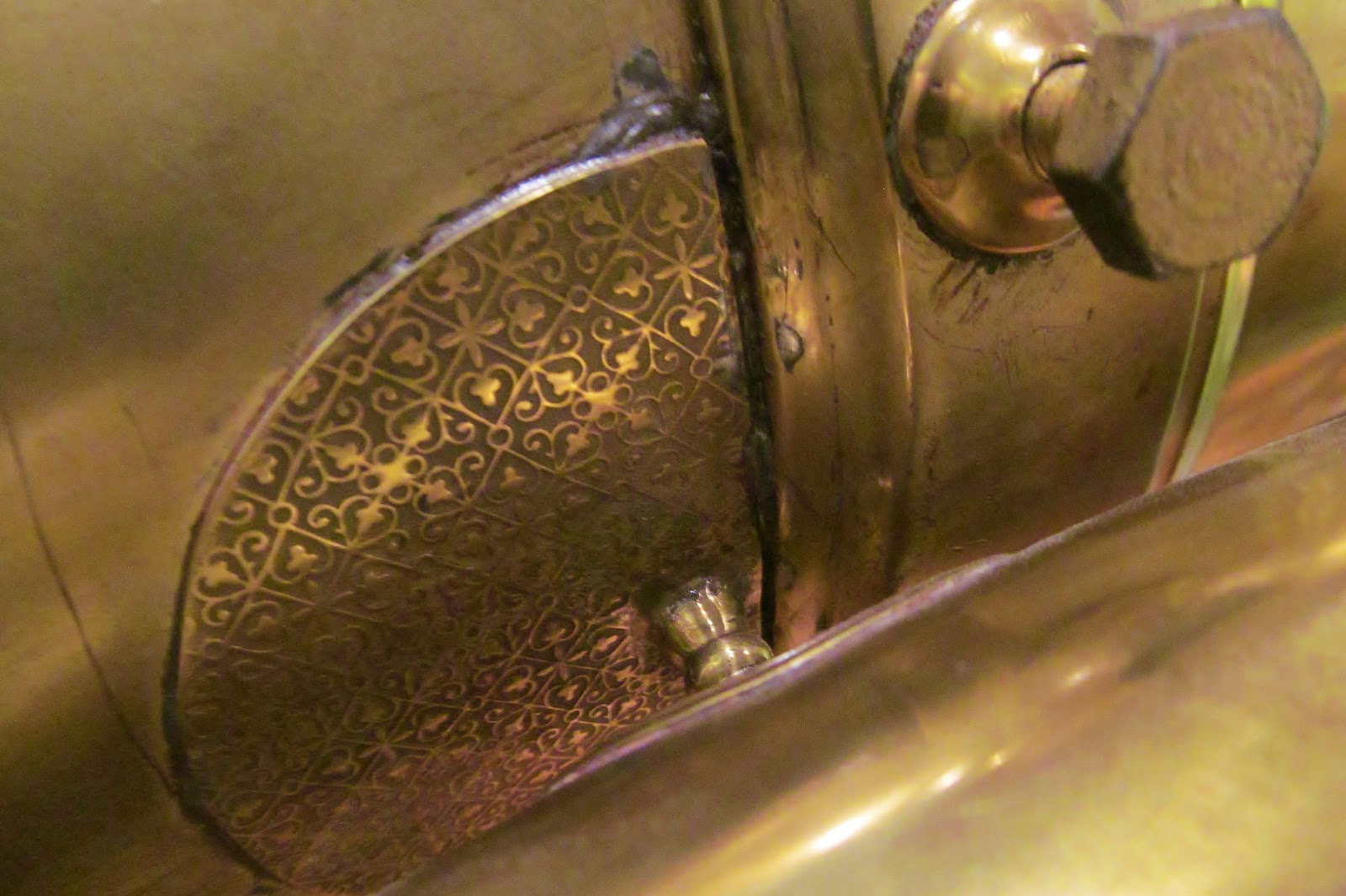
Other parts of the horn feature beautifully stamped brass, as shown in the two photos below:


Again, you can currently see this historic instrument for yourself at the Museum of Making Music (in the NAMM building) in Carlsbad, CA. It's a great little museum!


Thursday, August 2, 2012

More Sousa on the Sousaphone

A few years after making his quote about the origin of the Sousaphone in the Christian Science Monitor (see post below), Sousa wrote this in his autobiography, published in 1928:

I strove in every way to improve the quality and variety of the instruments. Way back when I was with the Marines they used a Helicon tuba wound around the body. I disliked it for concert work because the tone would shoot ahead and be too violent. I suggested to a manufacturer that we have an upright bell of large size so that the sound would diffuse over the entire band like the frosting on a cake! He designed a horn after that description and it has been in use ever since, by many bands, under the name of the Sousaphone (p. 334).

Tuesday, July 31, 2012

From Helicon to Sousaphone

As Sousa mentioned below, the Sousaphone was essentially an adapted Helicon (a coiled bass instrument first produced in Vienna in 1845, the name coming from the Greek word for "the mountain of the Muses" - apparently being only coincidentally related to the word helix, meaning "a coil"). You can see the similarities here, with a Helicon on the left and a Sousaphone on the right (both in BBb; from a Conn advertisment in 1907):


The primary difference is the bell size and direction. The Helicon bell is considerably smaller, and points somewhat forward and to the left of the player (and it is not detachable), enabling the instrument to be carried easily by the player, whether he was on foot or on horseback (yep, they rode with these instruments in cavalry bands!). But it also created the tone that was, according to Sousa, "apt to shoot ahead too prominently and explosively to suit me for concert performances."


Above is a Helicon imported for J. W. Pepper in the 1880s, and below is that very first Sousaphone built by Pepper following Sousa's request in 1892. And so begins the life of this unusual member of the tuba family.


UPDATE: For more about the history of the helicon - especially in Sousa's Band - click here.


Monday, July 30, 2012

Sousa on the first Sousaphone (1922)

The Sousaphone, as you could probably guess, was named in honor of John Philip Sousa, the famous band leader and composer (1854-1932). But what's the story behind the first Sousaphone?


In a very interesting article in the August 30, 1922 edition of the Christian Science Monitor, with the title seen above, along with a photo of Sousa's star Sousaphonist at that time, the great bandmaster himself recounted this:


Here we learn that:
  •  Sousa himself came up with the idea for this new horn.
  • This was while he was still with the Marine Band (1892)
  • It was made by the J. W. Pepper Company (not Conn, as many have claimed over the years - although Sousa clearly preferred Conn Sousaphones, as noted in his quote).
  • It had an upright bell, like a tuba (although larger), but with a Helicon-type body, meaning that it rested on the left shoulder.
  • It was created for concert purposes, not marching. This is a big surprise to most people.
  • Mr. Pepper honored Sousa by calling it a "Sousaphone."

And just for fun, here is Sousa in 1922, the year of the quote above, with one of the two large, four-valve Conn Sousaphones featured in the band at that time (the little guy "playing" the horn is young actor Jackie Coogan) - and it may be the very horn shown with Bell in the photo above:


How I got interested in all this

While on sabbatical this summer, I had the opportunity to take my family to the Interlochen Center for the Arts, in Interlochen, Michigan, where I had been both a student (National Music Camp, 1979) and a staff member (NMC, 1981, Interlochen Arts Academy, 1984-86).

I recalled from those years that "The Original Sousaphone" was on display there in the Giddings Concourse. As a former Sousaphone player (USC Trojan Marching Band, 1979-83), I was hoping to check it out again, but it was no longer to be seen - that is, until I was directed to a room in the library basement where I met John Beery, who is the curator for the impressive Greenleaf collection of instruments.

John very graciously not only allowed me to see the horn, but also to hold it and play it a bit, as pictured above. Needless to say, I was  thrilled!

The framed information sheet that had accompanied the Sousaphone when it was on display features a photo of Herman Conrad (who was with Sousa's band from 1892-1903) and says the following:

The Original Sousaphone, 1898 - This double Bb instrument was built especially for John Philip Sousa's band in 1898. It was a variety of a Helicon, with the bell opening upward. To honor Sousa, the name "Sousaphone" was suggested by Herman Conrad, a six-foot eight-inch giant who was the first man to play the Sousaphone professionally, using it on a world tour. Conrad's immense stature, together with the fact that this was the largest band instrument ever manufactured, caused the "Monster Sousaphone," as it was called, to be come a sensation. This instrument has been around the world many times and had been played before every king and queen and head of state of every country by 1931 when it was returned to Conn. It sold for $250 in 1898. Ten years later, in 1908, Conn built the first bell front Sousaphone which is the most popular type in the American band of today.
Upon returning home, I began to research the invention of the Sousaphone and began to wonder just how much of what that info sheet says is true. Is it really the very first Sousaphone? I quickly learned that there was debate about the claim. Further, did Conrad actually play it while he was with Sousa's band? And was he the one to suggest calling it a "Sousaphone."? (And, okay, was he really that tall?!).

Answers to all of these questions, and many others, will (eventually) be answered in this blog.

Friday, July 27, 2012

Regarding the name of this blog

When I was a young boy, way back in elementary school, I took up the Sousaphone as my instrument of choice. Actually, I wanted to play the tuba, but it was too big for me at that time, so that either meant starting on a baritone (not interested) or playing the fiberglass Sousaphone that sat in a special chair, into which I crawled in order to play.

From that moment onward, I was hooked! My family noticed this, and one Christmas purchased the record album that you see posted here. Strictly Oompah!

Of course, I came to learn that there was much more to playing the tuba than "strictly oompah," but it was a start. And in starting this blog, I gladly go back to my earliest days.