Friday, May 1, 2015

Sousaphone makes front page news!

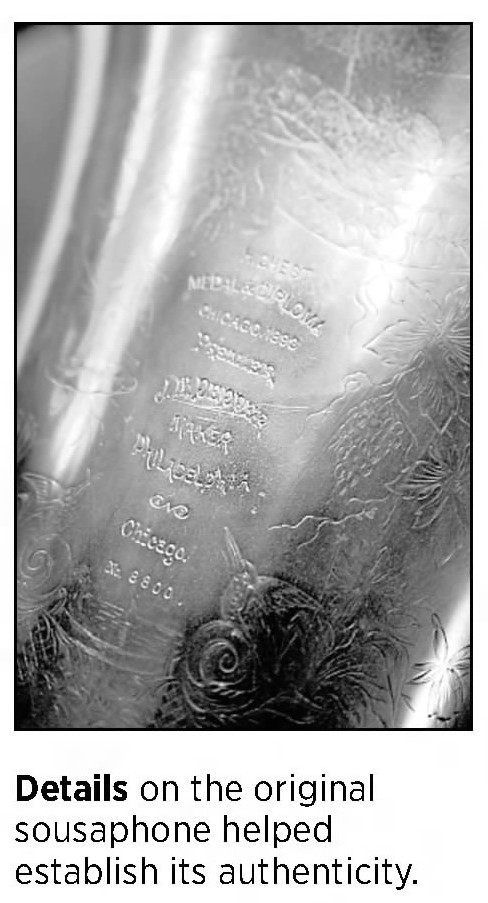
Today The Philadelphia Inquirer did a front page feature on the very first Sousaphone. Here is that article in its entirety:


Sunday, August 4, 2013

Visiting Mr. Sousa in Washington

Our family vacationed in D.C. this past week, and I was able to check out John Philip Sousa's old neighborhood near the Marine Barracks (most of the info below comes from Paul Bierley, John Philip Sousa: American Phenomenon, Rev. Ed., 2001). Here's what I found on my walking tour:


Sousa was born here at 636 G Street, SE, on November 6, 1854 (the family moved a block down the road in early 1855). 


The plaque found just to the left of the red front door confirms this historical spot.


In 1858 the Sousa family built, and soon after lived in, this home on the southeast corner of 7th and E Streets. It was originally a frame house, with the brick façade added around 1878, when Sousa's father retired. John Philip, who was making decent money by this time, paid for the upgrade so that his parents could stay in their home during their retirement (Bierley, pp. 40-41).


Sousa, who died on March 6, 1932 at the age of 77, is buried in the Congressional Cemetery at 18th and E Streets, SE - a beautiful spot.


A close up of the bench, flanked by lovely flowering trees (Crepe Myrtles, I think), whose pink blossoms are seen in the photos above and below. This bench was not originally part of the burial plot, but was created for a special Sousa memorial planned in 1938 that never quite materialized due to insufficient funding (Bierley, p. 205).


The bench is inscribed as follows: "Sousa, Leader, United States Marine Band, 1880-1892."


Sitting on the bench, the actual burial spot is at your feet. The marker simply says, "John Philip Sousa, Lt. Com. U.S.N.R.F., Nov. 6, 1854, Mar. 6, 1932," and then there are a few measures of music, which are hard to read now, but they show a portion of "The Stars and Stripes Forever," Sousa's most famous march, and the last piece of music he conducted before his death (Bierley, p. 92).


A few blocks from Sousa's birthplace, down at the Marine Barracks, is the only statue of Sousa in Washington. It was unveiled on Nov. 5, 2005, the last day of Sousa’s sesquicentennial (150th) year. Unfortunately, the statue is not accessible to the public, as it sits behind the gates on this restricted military property. At first this fact really bothered me (I tried sweet-talking the armed guard, but no luck!), but then it occurred to me that the best way to honor Sousa in public is to continue playing his music, which happens at least every July 4th - and all around the country!


Here's the best shot I could get of the actual statue, taking the photo through the fence. Is it just me, or does Sousa seem a little stiff in this pose? Perhaps it's a military thing!

Monday, July 29, 2013

So we finally have a date: 1895

Last summer I had the opportunity to examine and even hold (but unfortunately not play) the very first Sousaphone, built by J. W. Pepper. However, I was not able to confirm the date that the horn was made, but only to narrow down the range of possible years to 1894-96 (as per various posts below).

But this past Spring I received word that appears to confirm that Pepper's Sousaphone was built in 1895. While I have not seen the actual document (yet!), I'm told that the following appears in Pepper's Musical Times and Band Journal, no. 155:

"In a letter dated October 14, 1895, Mr. Herman Conrad, the famous bass player of Sousa's Peerless Concert Band, writes as follows concerning the new instrument, the Sousaphone, which was made by J. W. Pepper, under Mr. Sousa's special instructions: 'The Sousaphone has become the talk of the town and gains in reputation daily. The Sousaphone is a splendid instrument. It is well in tune and has wonderful carrying power. The photographs of the Sousaphone are in the windows of one of the principal music stores on Olive Street (St. Louis), which is THE street of this city, and are a great attraction.'"

Curiously, as I noted in posts below, this horn doesn't seem to have received much press, and had essentially disappeared by 1898, at which time Conn's first Sousaphone got all of the attention - even to the point of assuming that their horn was the first!

[Thanks to Don Johnson, of the Kentucky Baroque Trumpets, for drawing my attention to the above quote. Don hopes to write a book someday on the history of the J. W. Pepper company - a book I would be eager to read! Get crackin', Don!]

Sunday, December 30, 2012

The Original Sousaphone? Well...


When I started this blog back in July, I mentioned that I would be seeking to find answers to all of the questions raised by the info sheet above, which has accompanied the modified "Monster" Sousaphone residing up at the Interlochen Center for the Arts. I'm now in a good position to do this, so let's go through it line-by-line:

The Original Sousaphone 1898
       Definately not the original, as the Interlochen horn was made by Conn no earlier than 1903. J. W. Pepper made the first Sousaphone sometime between 1894-96 by my estimate, after John Philip Sousa had given him the idea back in 1892.

This double Bb instrument was built especially for John Philip Sousa's band in 1898
       Yes and no - yes, it may very well have been built for use in Sousa's band (we simply can't say for sure), but no, not in 1898. Again, the style of horn places it no earlier than 1903.

It was a variety of Helicon, with the bell opening upward
       True. The original Sousaphone, and all Sousaphones up until 1908, had an upward pointing bell with what was essentially a Helicon body.

To honor Sousa, the name "Sousaphone" was suggested by Herman Conrad
       This is not impossible, but in 1922 Sousa recounted that it was J. W. Pepper who honored Sousa with the name. But perhaps Conrad suggested the name to Pepper - we just don't know.

a six-foot eight-inch giant who was the first man to play the Sousaphone professionally
       Conrad was indeed the first Sousaphonist, playing the Pepper horn briefly, and then the first horn to come out of the Conn factory in 1898. But the tallest my sources place his height at is six-feet six-inches.

using it on a world tour
       Not exactly. Conrad did play an earlier Conn Sousaphone - the one actually built in 1898 - while Sousa's band went to France and Germany in 1900, and England and Scotland in 1901. But the only "world tour" that Sousa went on (which was really just a selective trip around the globe) was in 1911, although Conrad was long gone from the band by then. The Interlochen horn, however, may very well have been the Sousaphone on that tour. It's certainly the same model.

Conrad's immense stature, together with the fact that this was the largest band instrument ever manufactured, caused the "Monster Sousaphone," as it was called, to become a sensation.
       Seems to be the case - especially when it  first appeared in Europe (1900-01). But again, we're talking about a Sousaphone earlier than the Interlochen horn.

This instrument has been around the world many times and had been played before every king and queen and head of state of every country by 1931 when it was returned to Conn.
       A free and clear exaggeration. As mentioned above, Sousa did go around the world once - but just once. And he certainly didn't make it to every country, whether on that trip, or on all of his trips combined. The horn surely logged a lot of miles from 1903-31 (if it was indeed built in 1903), but those would have been mainly in the US, and certain parts of Europe.

It sold for $250 in 1898.
       Perhaps - although, again, remember that we're talking about a horn earlier than the one at Interlochen. The only evidence I came across was the approximate sale price of Conn's second Sousaphone in 1899, which was "in the neighborhood of $250."

Ten years later, in 1908, Conn built the first bell front Sousaphone which is the most popular type in the American band of today.
       Yep - no argument there.

One last bit of information - and this surprised me - is that in the photo on the info sheet (enlarged below), Conrad is wearing a hat that says "Pryor" rather than "Sousa." But I have not come across any other evidence that Conrad played with Pryor's band. However, both Pryor and Conrad served in Sousa's band from 1892, when it started, until 1903, when Pryor decided to form his own band. Conrad, it seems, played with Pryor at least long enough to have his photo snapped in a Pryor Band uniform!


ESPN at least got it half right


This may very well be the first time a Sousaphone (or at least half a Sousaphone) has been featured on ESPN's college football home page. I love it - even if it does feature a rival band!

Friday, December 28, 2012

Introducing a fiberglass Sousaphone!

The year 1961 brought what is arguably the most significant development in the history of the Sousaphone. Here's what was reported in the Wednesday, July 26 edition of Variety that year (p. 51):


While I don't know if the very first fiberglass Sousaphone can be identified today, the Museum of Making Music in Carlsbad, CA has one of the earliest ones on display, having been built in 1962:

Photo taken by author
Of course, other instrument companies immediately began producing their own fiberglass Sousaphones, as they knew they would be a hit with school bands (being so much lighter and much less easy to damage). For example, here is an ad from September 1961 for the RMC/Reynolds Contempora version:


Thursday, December 27, 2012

Sousaphones and World War II

The Conn factory in Elkhart, Indiana (postcard from the 1930s)
According to the article titled "Conn" in The New Grove Dictionary of Music and Musicians (second edition, 2001):
During World War II, C. G. Conn Ltd. retooled the Elkhart plant to manufacture products for the government. No musical instruments were produced for civilian use in 1942-6. The resulting loss of sales, as well as a delayed reconversion of the plant in 1946, caused a serious decline in Conn's status as the leading band instrument manufacturer in the USA.

One has to assume that other companys were similarly diverted from producing musical instruments for the public during those challenging years. But in the January-February 1950 edition of The Instrumentalist (vol. 4, no. 3, p. 8), this brief notice appeared:

Wednesday, December 26, 2012

Solving the big problem of pain

The Sousaphone, of course, is quite a pain to carry for very long - there is simply no way around it. Whether in marching band or concert band, you are guaranteed to have at least 25 pounds of brass pressing down on your shoulder for the duration of the event. Ouch!

This reality led Edward J. Gulick, who worked for the C. G. Conn Co.,  to file the following patent on February 15, 1929 (I'm surprised it took so long before someone thought of this):

Patent application and drawing below can be found online here
Here's the illustration that accompanied the patent application, showing the device on a Helicon bass, but it would have been the same for a Sousaphone:


I've not come across any photos of this device actually being used, but perhaps it was. What I have seen are various attempts to put padding of some kind on the branch part of the horn, where the weight rests on the player's shoulder (even some of the big and tall guys who played for Sousa's Band did this).

Another option, for a concert setting at least, was to do what the gal to the left did back in the 1930s, although that doesn't quite look right, does it? (Might as well just play a tuba with a recording bell.) But in 1948 a band director from the midwest named Harry Wenger came up with a great solution. Here's what the advertisement looked like in the May-June issue of The Instrumentalist of that year (vol. 11, no. 5, p. 46):


The ad goes on to list the price at $29.95, and states that the chair is "a must item for the young beginner or the girl sousaphonist" (how's that for a sexist remark!) and that it "serves as a rack when [the] instrument is not in use." Here's the notice for the new invention in that same journal, but back on page 35:


When I first started playing the Sousaphone, way back in when I was in 4th grade (1970), that chair was the only reason I was able to fulfill my desire to be a tuba player at that young age. I distinctly remember crawling into the chair, with it's forest green seat pad, and playing my heart out with not a single ounce of weight on my shoulder (marching band, of course, was a different story, but I was bigger and stronger by that time, and the horn was made of plastic - more on that shortly).

I suppose it has never been easy to get comfortable sitting while playing a Sousaphone - at least until that chair came along. Even the men in Sousa's band, as you can see below in this photo from 1930, seemed to have their coping mechanisms:

Photo courtesy of Paul Bierley, The Incredible Band of John Philip Sousa, p. 54


Tuesday, December 25, 2012

Deck the halls with lots of Tubas!

Wishing you grace and peace this beautiful Christmas Day. Here are some of the highlights from the various Tuba Christmas celebrations this year, where Sousaphones figured prominently:

New York City

West Lafayette, IN

Jacksonville, FL

Fort Collins, CO

Los Angeles, CA

Monday, December 24, 2012

Anything you can do, I can do . . .

Not to be outdone by Conn's 50th anniversary Sousaphone (see post below), the Holton Company created its own oversized, ornately engraved horn. Well, okay, it appears that it was actually over 10 years later, in 1935, but one has to wonder if they were perhaps thinking of Conn's beautiful creation when crafting this mammoth Holtonphone:

Image found online here
According to a C. G. Conn website that is no longer online (but thankfully I had printed out a hard copy of the article), a page titled "Holton Donates Historic 'Holtonphone" to National Music Museum," reveals the following:
Ornately engraved and decorated with cast brass wreaths, ribbons, and a natural horn extending through a lyre, the mammoth "Holtonphone" was the company's largest Sousaphone model. The bell decoration features a large elk head with 12-point antlers. The 58-inch-tall, model 130 Sousaphone with a 30" bell was marketed in Holton's 1935 catalog as the "Revelation BB-flat mammoth Holtonphone, the size recommended for both band and orchestra."

The article also explains that this historic Sousaphone was donated to the National Music Museum (along with a lot of other stuff) in 2008, marking the 110th anniversary of the founding of the Holton Company.

The largest playable Sousaphone

Image courtesy of Mark Overton at saxophone.org
Marking the 50th anniversary of the company, this notice appeared in a 1924 edition of C. G.Conn's Musical Truth (vol. 14,no. 36). Here is what the first two paragraphs say:
As a fitting emblem of its progress during the fifty years since its founding, C. G. Conn, Ltd., has just completed the construction of the world's largest playable Sousaphone, which is illustrated to the left. This remarkable instrument is finished completely in burnished gold, with oxidized silver and other precious metals used to bring out the details of the highly ornate engraving which entirely covers the bell, inside and out. This engraving alone required more than three solid weeks. The bell itself is 10 feet, 2 1/2 inches in circumference, and the instrument weighs nearly fifty pounds. Were this monster Sousaphone to be listed for sale the price would be in the neighborhood of $3,000.00.
This titanic instrument will be on display at the various Conn branches and agencies  throughout the country during the coming months.

This historic horn is currently part of the Greenleaf collection of instruments at the Interlochen Center for the Arts in Interlochen, MI. Having visited there just this past summer, I had the chance to see it hanging on the wall:


If I knew what I was encountering at that time, I would have arranged to examine this amazing instrument in more detail. But click here for a video of Ian Church, who was able to do just that, courtesy of John Beery, the curator of the Greenleaf collection, who is also featured. And just to give you an idea of how large this Monster really is, note the photo on the left, showing it in 1927 (C. G. Conn's Musical Truth, vol. 17, no. 44).

Here's a more recent photo of the Sousaphone, showing the ornate engraving on the inside of the bell, when it was displayed previously at the Elkhart County Historical Museum:

Photo found online here, at the Conn Loyalist website

Sunday, December 23, 2012

Girls just want to have fun, too!

There may very well have been women playing the Sousaphone prior to the 1920s, but it is during that decade, according to my research, that they began getting much-deserved publicity.

For example, Cleora Miller, pictured at left, began playing when she was twelve years old, and while she was still in her teens, she was considered "One of the most remarkable lady Bass Virtuosos." In a 1924 edition of  C. G. Conn's Musical Truth (vol. 14, no. 34, p. 15), in which the quote is found, Miss Miller is further described as
an Artist on the Bass of exceptional ability. Her Bass solos consist of heavy numbers demanding rapid technique which she executes with perfect ease and assurance on her Conn Sousaphone. The audience always marvels at the versatility of Miss Miller for she is so "tiny" and yet handles the Monster Sousaphone with such apparent ease. . . . Miss Miller is the star of her own Musical Company which is considered as one of the highest class musically on the stage of all time.
Ellen Ross
In 1925, we hear of Georgia Bigelow Bryan, Sousaphonist with the Bigelow family band (Musical Truth, vol. 15, no. 37, p. 16); in 1926 we read of Cleora Miller once again, as well as Gertrude Stevens, Sousaphonist with the Lopez Debutantes (vol. 16, no. 40, p. 16); and in 1927, Ellen Ross shows up in the gallery and is called "a classy bass player" (vol. 17, no. 43, p. 21).

Toward the end of the decade, all-girl bands began to appear (as the men didn't want the ladies in their groups, regardless of how talented they were!), such as the Parisian Red Heads, shown here in 1929:

Click here for more info about female jazz groups starting in the 1920s
One of the most successful of the all-girl bands (well, all-girl except for the director) was Phil Spitalny & His Musical Queens, shown here in the 1930s:

Note how the Sousaphone is being held! Click here for another group similar to this one

The photo at the right is floating around the internet (can't imagine why), and while I cannot confirm this, one source contends that it is the Sousaphonist from Spitalny's group. If so, she would totally blow away the stereotype of Sousaphonists being large, overweight men!

Before leaving this topic, check out this ad I came across when browsing old editions of The Instrumentalist. It is promoting King Sousaphones in the November 1955 edition: