Saturday, October 31, 2015

That's an odd looking helicon bass!

For the first few years of the Sousa Band, which was before the first Sousaphone had been created, it appears that Herman Conrad played a helicon bass. For example, check out the upper right of this band photo from 1893:

Sousa's band in St. Louis in 1893 (courtesy of the U. S. Marine Band Library)
Sousa was not a fan of helicons, as he felt their sound in a concert band was too "violent." And this is exactly why he had asked J. W. Pepper, back in 1892, to create a new horn that would have a body like a helicon, but a larger bell that pointed straight up, like a tuba, so that the sound would "diffuse over the entire band like the frosting on a cake."

But it took a few years for that modified helicon bass to become a reality, and until that time, Conrad seems to have continued to play the old-style horn. For example, in one of the newspaper notices for the band for its early 1896 cross-country tour, we see that helicon right in the middle of the back row in the drawing:

Seattle Post-Intelligencer, February 9, 1896, p. 16
While this illustration was used to promote the previous year's stint at Manhattan Beach for Sousa's band (see the fine print in the ribbons at the lower left), it suggests that this was the standard look of the group. The bass section consisted of a helicon and a couple of tubas.

But for at least part of that early 1896 tour, as we now know, Conrad was playing the very first Sousaphone. And yet most people might have simply thought it was an odd-looking helicon, and maybe that's why it didn't create the stir that a huge new instrument should have. Further, perhaps it was not yet known that the modified helicon had a cool new name - a Sousaphone! That would have created a stir, don't you think?

Great concert, no mention of horn

Courtesy of the Library of Congress
The photograph featured a few posts below was taken at the second of two concerts the Sousa Band gave in Salt Lake City on March 6 and 7, 1896. But the first concert received an over-the-top review on page 8 of The Salt Lake Herald the next morning.

Noting that "A Tumult of Enthusiasm Greets the Bandmaster," here's some of what the review goes on to say:
There was a genuine musical love feast at the tabernacle last evening. Military men are indebted to John Philip Sousa for some soul-stirring marches; dancing society is indebted to him for his entrancing two steps; the whole world is indebted to him for Sousa's band. We acknowledge our part of the indebtedness, and render to him our heartfelt obligations for one of the most enchanting evenings ever passed.
It is doubtful if ever in its long history the tabernacle has known a more thoroughly popular night; it was emphatically the night of the masses; by that we do not mean it was given up to trashy music or trivial achievements, but it was pure music, not Algebraic sounds; it mingled the classic with the simple; it got down to the level of our souls and caused our foundations to tremble; it was a night when the audience took no note of the flight of time, but kept on demanding encores and double encores that almost taxed the patience of the most accommodating of conductors.
Sounds like it was an amazing night! And my, did they love Sousa, gushing that "as graceful as he is handsome, he excites a charm that everyone about him feels."

And the concert ended with a bang: "The big novelty of the night was the closing number, 'The Band Came Back,' a medley of popular tunes which introduced nearly every member of the band in solos, duetts or quartettes." This, of course, included Arthur Pryor, "the trombone virtuoso . . . an admirable performer on a difficult instrument."

But was the Sousaphone featured as well? Was it even noticed?! There is no mention of it in the article, and yet, given that it had been created only a handful of months earlier, this had to be the first time anyone in Salt Lake City had seen and heard the new instrument. Strange silence, unless . . . well, I'll address that in my next post!

From the same page as the article, promoting the concert later that day (March 7, 1896)

Friday, October 30, 2015

Why I thought it was never played

The one and only photo of the first Sousaphone,
or so I thought! (Courtesy of J. W. Pepper)
For my first ITEA Journal article, I found overwhelming evidence to settle the question of who made the first Sousaphone - it was J. W. Pepper in 1895. But what I wasn't able to find was any evidence that the horn had actually been played in Sousa's band. Pepper claimed that it was, but I wondered if perhaps he was anticipating something that never ended up happening. After all, . . .
  • Why was I unable to find a single mention of the new instrument at that time outside of a few Pepper publications?
  • Why did The Music Trade Review, over two years later, announce Conn's Sousaphone as if such a horn had never been seen before?
  • Why did Herman Conrad, who we can assume was well-acquainted with Pepper's Sousaphone (that's the two of them above), rave about Conn's horn, calling it "perfect" and "best of all in good tune"? Did Pepper's prototype simply not cut it with the great bass player?
  • Why was Sousa himself so ho-hum about Pepper instruments, giving them only a "satisfactory" rating (see his less-than-ringing endorsement below). Did that first Sousaphone not cut it with him either?
  • Why was I unable to find a single photograph of Conrad and the historic instrument with Sousa's band, whether posing or in concert?
  • Why, when the Pepper Sousaphone was found in 1973 (stay tuned for that amazing story!), was it unfinished, that is, raw brass? Would it have appeared in concert in that condition?
All of this suggested to me that perhaps the horn was never played in Sousa's peerless concert band, and that's what I speculated in my article. But all of that changes now with the historic photograph of the band - and the Pepper Sousaphone - in Salt Lake City on March 7, 1896!
I still have a hard time reconciling much of what I said above, but now we know that Pepper's horn was played with the band for at least part of one tour in early 1896. And perhaps the newspapers didn't ignore the new instrument entirely; perhaps I just haven't found a reference to it yet. It's significant that there is a hole in the Sousa Band Press Books from September 4, 1894 to June 13, 1896, which is where a relevant clipping or two might have been found!

Friday, October 23, 2015

A truly historic photograph (1896)

The whole story will have to wait for my follow-up article for the ITEA Journal (due to be published early next year), but this truly historic photograph was found recently at the archives of the International Society Daughters of Utah Pioneers in Salt Lake City:

Photo courtesy of the ISDUP, and used with permission
What can be seen here, albeit at a considerable distance, is the Sousa Band in concert at the Tabernacle on March 7, 1896. There is no question about the date, as it is written on the back of the photo, and it squares with Sousa's itinerary for that year. Plus, the huge flag on the Tabernacle ceiling was only there from January 1896 until the summer of 1897.

From the Deseret Evening News, February 24, 1896, p. 11 (courtesy of the Library of Congress)
And I said this photograph is truly historic because it is now the earliest known image of Sousa and his band in concert! Here's a closer view of the band itself:


But look carefully. While movement in the band caused many of the members to be out of focus (Sousa himself is fully a blur), we can make out some of the instruments and their players. Most importantly, look right above the first chair clarinet. What we can barely see is a man with a mustache playing not a tuba (there is one of those to his left, and it is much smaller) but a Sousaphone. This would almost certainly have to be the horn built by J. W. Pepper the previous year (Conn's first Sousaphone wasn't introduced to the world until January 1898).


This is now proof that Pepper's historic horn - the very first Sousaphone ever built - was indeed "Used Daily in Sousa's Peerless Concert Band," just as Pepper had claimed. Prior to this photo being discovered a few months ago, I had been unable to find any evidence that this new instrument had been played under Sousa's baton. And there were a few clues that seemed to confirm the idea that it was perhaps never played in public at that time.

But that all changes now with this image - the one and only time (for now) that we see the original Sousaphone in action with Sousa's band!

Again, I'll share more of the story in my upcoming follow-up article in the ITEA Journal.

Thursday, October 22, 2015

From ITEA article to documentary


The folks at J. W. Pepper have been wonderful to work with these past few years, and they have taken great interest in my research (no surprise there, as they have much to boast about now regarding the first Sousaphone!). This past summer they produced a 24-minute documentary on "The Birth of the Sousaphone." Along with an extensive interview with me, it features Steve Dillon and Matt Walters of Dillon Music in NJ, as they examined the historic instrument and got it ready to be played in concert (more on that later).


Wednesday, October 21, 2015

Publishing my findings - round one!

A lot has happened since I last posted here, and I felt it was time to get you up-to-speed on everything I've learned about the early history of the Sousaphone since we last "talked."

First of all, about a year ago now, at the encouragement of a friend, I reached out to Ben Pierce, the editor of the ITEA Journal to see if he might be interested in an article on this topic, and he was! That launched me into much more serious research (portions of which I will post on later), and resulted in the following article, published this past May (and showing just the first page):


Here's how I summed up my findings:
For years, confusion and even controversy swirled around the early history of the Sousaphone. But no longer. We can now say with confidence that Pepper, who received the idea from Sousa in 1892, built the first Sousaphone in 1895. But for some reason it quickly faded away, attracting very little public attention. The idea was then picked up by or delivered to Conn, whereby he was able to produce, in early 1898, the first Sousaphone that appears in use by Sousa's band. This horn went through a few modifications in its early years, and remained the sole Sousaphone in Sousa's bass section until 1915, when we see a second Sousaphone added for the first time. Then, from 1921 onward, the entire section consisted exclusively of Sousaphones.
One of the most important pieces of evidence for the Pepper horn being the first was mentioned in a previous post, but here is the actual scan of Pepper's Musical Times and Band Journal, vol. 13, no. 155, which came out in late 1895 or perhaps early 1896 and was graciously shared with me by collector and musician Don Johnson. First, the cover (and yes, this is the original color of the first and last pages!):


And now - drumroll, please! - here's what we find on page 24:


So the horn clearly existed in October 1895. But you'll note that it was the photographs of the Sousaphone that were "a great attraction," making me wonder if the horn was actually being played at that time in Sousa's band. And this, along with other clues, led me to speculate that perhaps Pepper's historic instrument was never featured under Sousa's baton. There was simply no evidence that it was - no mention in newspaper articles, as far as I could find, and no photographs showing the Pepper Sousaphone in action. That is, until now. There will need to be a follow up article!


Additional support for the first Sousaphone being built in 1895:

Friday, May 1, 2015

Sousaphone makes front page news!

Today The Philadelphia Inquirer did a front page feature on the very first Sousaphone. Here is that article in its entirety:


Sunday, August 4, 2013

Visiting Mr. Sousa in Washington

Our family vacationed in D.C. this past week, and I was able to check out John Philip Sousa's old neighborhood near the Marine Barracks (most of the info below comes from Paul Bierley, John Philip Sousa: American Phenomenon, Rev. Ed., 2001). Here's what I found on my walking tour:


Sousa was born here at 636 G Street, SE, on November 6, 1854 (the family moved a block down the road in early 1855). 


The plaque found just to the left of the red front door confirms this historical spot.


In 1858 the Sousa family built, and soon after lived in, this home on the southeast corner of 7th and E Streets. It was originally a frame house, with the brick façade added around 1878, when Sousa's father retired. John Philip, who was making decent money by this time, paid for the upgrade so that his parents could stay in their home during their retirement (Bierley, pp. 40-41).


Sousa, who died on March 6, 1932 at the age of 77, is buried in the Congressional Cemetery at 18th and E Streets, SE - a beautiful spot.


A close up of the bench, flanked by lovely flowering trees (Crepe Myrtles, I think), whose pink blossoms are seen in the photos above and below. This bench was not originally part of the burial plot, but was created for a special Sousa memorial planned in 1938 that never quite materialized due to insufficient funding (Bierley, p. 205).


The bench is inscribed as follows: "Sousa, Leader, United States Marine Band, 1880-1892."


Sitting on the bench, the actual burial spot is at your feet. The marker simply says, "John Philip Sousa, Lt. Com. U.S.N.R.F., Nov. 6, 1854, Mar. 6, 1932," and then there are a few measures of music, which are hard to read now, but they show a portion of "The Stars and Stripes Forever," Sousa's most famous march, and the last piece of music he conducted before his death (Bierley, p. 92).


A few blocks from Sousa's birthplace, down at the Marine Barracks, is the only statue of Sousa in Washington. It was unveiled on Nov. 5, 2005, the last day of Sousa’s sesquicentennial (150th) year. Unfortunately, the statue is not accessible to the public, as it sits behind the gates on this restricted military property. At first this fact really bothered me (I tried sweet-talking the armed guard, but no luck!), but then it occurred to me that the best way to honor Sousa in public is to continue playing his music, which happens at least every July 4th - and all around the country!


Here's the best shot I could get of the actual statue, taking the photo through the fence. Is it just me, or does Sousa seem a little stiff in this pose? Perhaps it's a military thing!

Monday, July 29, 2013

So we finally have a date: 1895

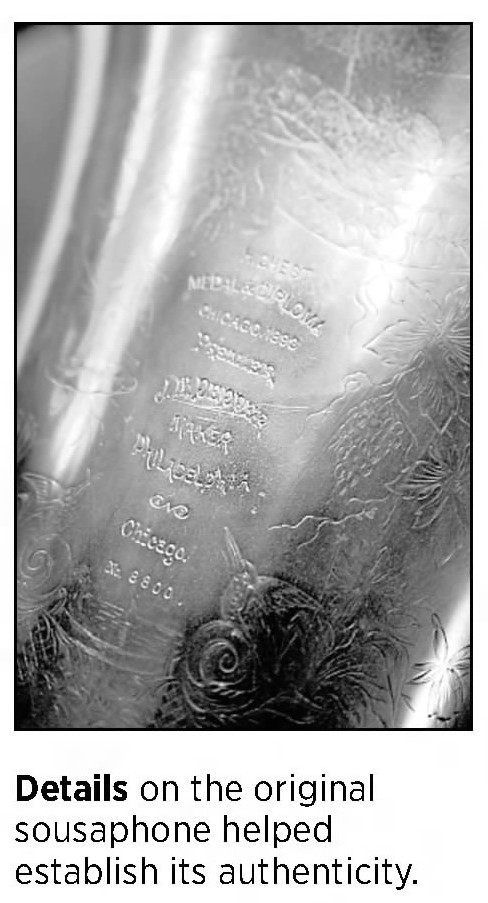
Last summer I had the opportunity to examine and even hold (but unfortunately not play) the very first Sousaphone, built by J. W. Pepper. However, I was not able to confirm the date that the horn was made, but only to narrow down the range of possible years to 1894-96 (as per various posts below).

But this past Spring I received word that appears to confirm that Pepper's Sousaphone was built in 1895. While I have not seen the actual document (yet!), I'm told that the following appears in Pepper's Musical Times and Band Journal, no. 155:

"In a letter dated October 14, 1895, Mr. Herman Conrad, the famous bass player of Sousa's Peerless Concert Band, writes as follows concerning the new instrument, the Sousaphone, which was made by J. W. Pepper, under Mr. Sousa's special instructions: 'The Sousaphone has become the talk of the town and gains in reputation daily. The Sousaphone is a splendid instrument. It is well in tune and has wonderful carrying power. The photographs of the Sousaphone are in the windows of one of the principal music stores on Olive Street (St. Louis), which is THE street of this city, and are a great attraction.'"

Curiously, as I noted in posts below, this horn doesn't seem to have received much press, and had essentially disappeared by 1898, at which time Conn's first Sousaphone got all of the attention - even to the point of assuming that their horn was the first!

[Thanks to Don Johnson, of the Kentucky Baroque Trumpets, for drawing my attention to the above quote. Don hopes to write a book someday on the history of the J. W. Pepper company - a book I would be eager to read! Get crackin', Don!]

Sunday, December 30, 2012

The Original Sousaphone? Well...


When I started this blog back in July, I mentioned that I would be seeking to find answers to all of the questions raised by the info sheet above, which has accompanied the modified "Monster" Sousaphone residing up at the Interlochen Center for the Arts. I'm now in a good position to do this, so let's go through it line-by-line:

The Original Sousaphone 1898
       Definately not the original, as the Interlochen horn was made by Conn no earlier than 1903. J. W. Pepper made the first Sousaphone sometime between 1894-96 by my estimate, after John Philip Sousa had given him the idea back in 1892.

This double Bb instrument was built especially for John Philip Sousa's band in 1898
       Yes and no - yes, it may very well have been built for use in Sousa's band (we simply can't say for sure), but no, not in 1898. Again, the style of horn places it no earlier than 1903.

It was a variety of Helicon, with the bell opening upward
       True. The original Sousaphone, and all Sousaphones up until 1908, had an upward pointing bell with what was essentially a Helicon body.

To honor Sousa, the name "Sousaphone" was suggested by Herman Conrad
       This is not impossible, but in 1922 Sousa recounted that it was J. W. Pepper who honored Sousa with the name. But perhaps Conrad suggested the name to Pepper - we just don't know.

a six-foot eight-inch giant who was the first man to play the Sousaphone professionally
       Conrad was indeed the first Sousaphonist, playing the Pepper horn briefly, and then the first horn to come out of the Conn factory in 1898. But the tallest my sources place his height at is six-feet six-inches.

using it on a world tour
       Not exactly. Conrad did play an earlier Conn Sousaphone - the one actually built in 1898 - while Sousa's band went to France and Germany in 1900, and England and Scotland in 1901. But the only "world tour" that Sousa went on (which was really just a selective trip around the globe) was in 1911, although Conrad was long gone from the band by then. The Interlochen horn, however, may very well have been the Sousaphone on that tour. It's certainly the same model.

Conrad's immense stature, together with the fact that this was the largest band instrument ever manufactured, caused the "Monster Sousaphone," as it was called, to become a sensation.
       Seems to be the case - especially when it  first appeared in Europe (1900-01). But again, we're talking about a Sousaphone earlier than the Interlochen horn.

This instrument has been around the world many times and had been played before every king and queen and head of state of every country by 1931 when it was returned to Conn.
       A free and clear exaggeration. As mentioned above, Sousa did go around the world once - but just once. And he certainly didn't make it to every country, whether on that trip, or on all of his trips combined. The horn surely logged a lot of miles from 1903-31 (if it was indeed built in 1903), but those would have been mainly in the US, and certain parts of Europe.

It sold for $250 in 1898.
       Perhaps - although, again, remember that we're talking about a horn earlier than the one at Interlochen. The only evidence I came across was the approximate sale price of Conn's second Sousaphone in 1899, which was "in the neighborhood of $250."

Ten years later, in 1908, Conn built the first bell front Sousaphone which is the most popular type in the American band of today.
       Yep - no argument there.

One last bit of information - and this surprised me - is that in the photo on the info sheet (enlarged below), Conrad is wearing a hat that says "Pryor" rather than "Sousa." But I have not come across any other evidence that Conrad played with Pryor's band. However, both Pryor and Conrad served in Sousa's band from 1892, when it started, until 1903, when Pryor decided to form his own band. Conrad, it seems, played with Pryor at least long enough to have his photo snapped in a Pryor Band uniform!


ESPN at least got it half right


This may very well be the first time a Sousaphone (or at least half a Sousaphone) has been featured on ESPN's college football home page. I love it - even if it does feature a rival band!

Friday, December 28, 2012

Introducing a fiberglass Sousaphone!

The year 1961 brought what is arguably the most significant development in the history of the Sousaphone. Here's what was reported in the Wednesday, July 26 edition of Variety that year (p. 51):


While I don't know if the very first fiberglass Sousaphone can be identified today, the Museum of Making Music in Carlsbad, CA has one of the earliest ones on display, having been built in 1962:

Photo taken by author
Of course, other instrument companies immediately began producing their own fiberglass Sousaphones, as they knew they would be a hit with school bands (being so much lighter and much less easy to damage). For example, here is an ad from September 1961 for the RMC/Reynolds Contempora version: