As with my first article on the early history of the Sousaphone, Philip Biggs, editor of The Brass Herald was eager to re-publish my follow-up article for his largely European readership. Issue 65 arrived from the UK in my mailbox yesterday! (Thanks to the ITEA Journal for gladly allowing the article to be reprinted.)
Saturday, October 15, 2016
Saturday, October 1, 2016
The curious concave Conrad Model
In my ongoing research on Herman Conrad (1867-1920), I learned that at some point Frank Holton made a "Conrad Model" tuba mouthpiece. Don Harry let me know about this, as he has one of these in his collection:
On the other side of the mouthpiece it says "Frank Holton, Chicago," which means that it was produced prior to the Spring of 1918, as that is when Holton moved his business from Chicago to Elkhorn, WI.
From 1903 until he passed in 1920, Conrad was part of the elite group of musicians who were the "house band" at the Victor Talking Machine Company, and this mouthpiece probably came out during those Victor years. He was playing Holton tubas during much (and possibly all) of that time, so it's not surprising to see a Holton mouthpiece bearing the great bass player's name.
What is most curious is that the rim is concave, which I'm thinking is something that Conrad preferred (although Holton made a whole line of concave rim mouthpieces, starting at around 1911). According to Don, "the concave shape went horizontally for a very narrow jaw formation." Here's the Conrad Model next to a more standard Holton mouthpiece:
At this point, I am not aware of another copy of this mouthpiece existing - nor have I been able to find any notice of it in a Holton publication from that era (although, granted, I don't have access to everything they produced during those years).
But I would imagine that calling it a "Conrad Model" was a nod to Conrad's fame as a tubist in the early 20th century (and perhaps a way to sell more mouthpieces?!). Conn had his "Helleberg Model" bass mouthpiece around that time, and Holton had his "Conrad Model." Two giants of that era!
Tuesday, September 27, 2016
Herman's great-great grandson!
After various searches through Herman Conrad's family tree, I was finally able to locate a living descendant of that great tubist who was the first to play the Sousaphone. His name is Daniel Corry, and he is Herman's great-great grandson (Daniel's father was Christopher, whose mother was Henrietta Alice Conrad, whose father was Edward Columbus Conrad, whose father was Herman).
As it turns out, Daniel lives within a few hours of me, so we connected this past Saturday and had a marvelous time! I was able to share the whole story of his great-great grandfather, of whom he was unaware, and we made a trip out to the J. W. Pepper headquarters, in Exton, PA, where Daniel was able to play the historic horn that Herman was the first to play 121 years ago:
And just for kicks, here's a side-by-side of Herman, 1895, and Daniel, 2016:
As it turns out, Daniel lives within a few hours of me, so we connected this past Saturday and had a marvelous time! I was able to share the whole story of his great-great grandfather, of whom he was unaware, and we made a trip out to the J. W. Pepper headquarters, in Exton, PA, where Daniel was able to play the historic horn that Herman was the first to play 121 years ago:
Sunday, September 25, 2016
Documentary: Pepper's 140th year
Earlier this year I was privileged to be included in a special documentary created to celebrate the 140th anniversary of J. W. Pepper (written and directed by Jeff Blake, who did a fantastic job!). My comments - some of which, of course, mention the Sousaphone! - can be found at 6:10, 7:22, and 25:17. Enjoy!
Friday, July 29, 2016
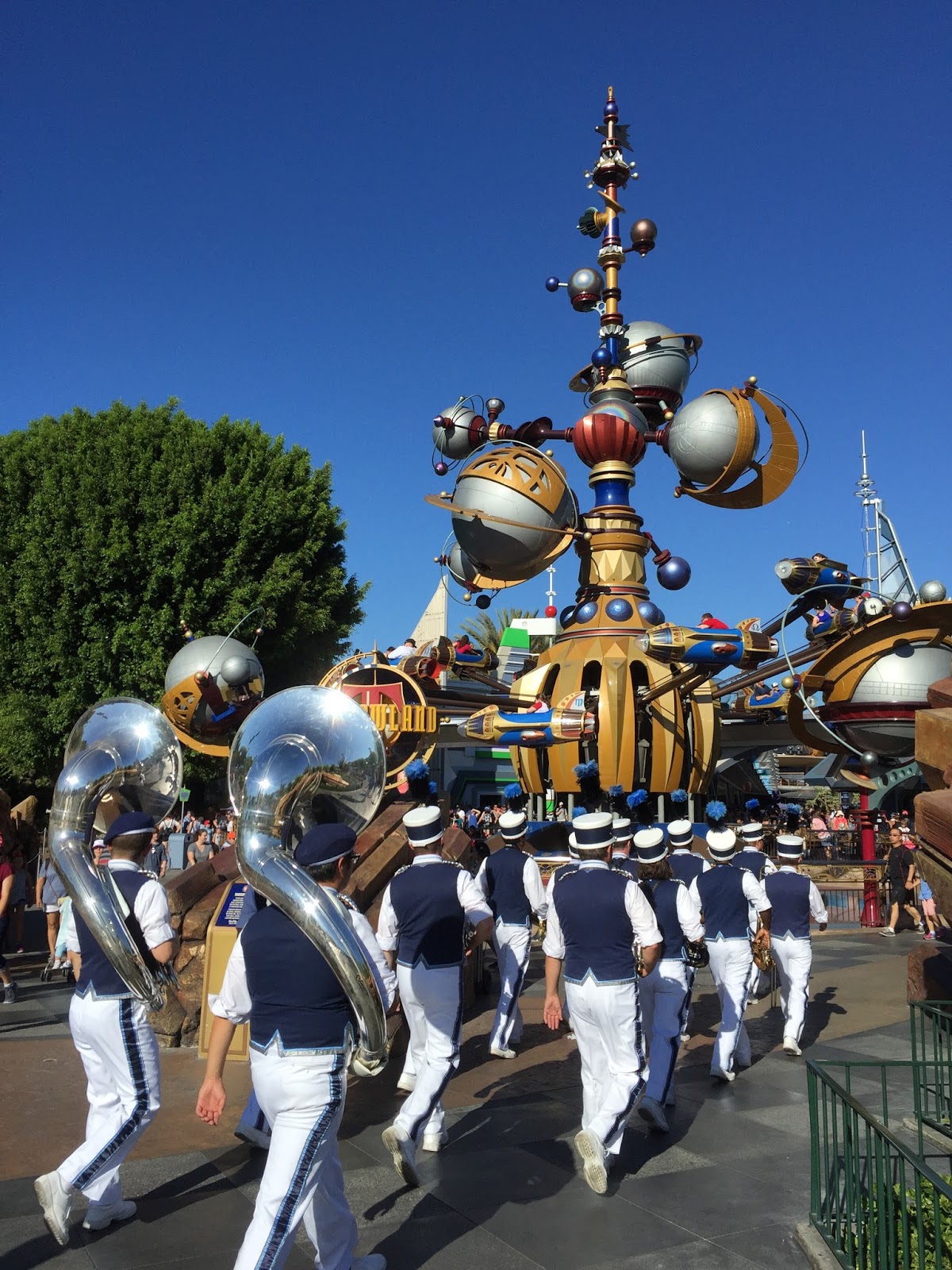
Seeing Sousaphones at Disneyland!
This past week my family, along with my wife's family, converged on Disneyland for a few days. While I've been there many times, I had yet to see the new Disneyland Band in action, so it was great to catch them a couple of times throughout the day:
What was even more fun was discovering that one of the new collectible pins for 2016 featured Donald Duck with a Sousaphone! I love it (and yes, I bought it!):
Monday, July 25, 2016
Conrad with the Victor Orchestra
In a little Victor publication, about the size of an iPhone and titled New Victor Records February 1906, we learn about the recently formed Victor Orchestra, of which Herman Conrad was a founding member. As far as I can tell, Conrad did not play Sousaphone with this long-standing Victor "house band," but opted for standard upright tubas (more on that shortly). But he stayed with Victor, after leaving the Sousa Band in 1903, until his death in 1920.
Here are the relevant pages, courtesy of Michael Khanchalian, who has a fabulous collection of items from the early years of the recording industry:
Monday, June 27, 2016
Sousa & Sousaphone history for kids!
I had the opportunity to help out with a project this past year that was produced by Alfred Music, and a complimentary copy arrived in the mail today. It is "An Interactive Storybook About John Philip Sousa," but it also reveals the history of the first Sousaphone - which is that part I helped with, of course!
Here are a few of the pages that highlight the history of the Sousaphone:
It is recommended for all ages, but it will be particularly appropriate for younger kids. Alfred Music did a great job with this, and I am grateful for Andy Beck, one of the authors, asking me to participate in the project.
For more info on this digital storybook, click here, or check out this video:
Update: To see other, older, children's resources that don't get the history right, click here.
Here are a few of the pages that highlight the history of the Sousaphone:
For more info on this digital storybook, click here, or check out this video:
Update: To see other, older, children's resources that don't get the history right, click here.
Saturday, June 25, 2016
Sousaphone solo by Herman Conrad
Conrad was often listed among the soloists in Sousa's band, but I have yet to find any record of him actually playing a solo in concert during those years (1892-1903). But in the July 25, 1905 edition of the Asbury Park Press, Conrad is listed as playing the solo "Rocked in the Cradle of the Deep" on the Sousaphone with Pryor's Band.
Whether Conrad was a regular with Pryor at that time is yet to be determined. As far as I can tell, from 1903 onward he was part of the elite group of musicians known as the Victor Orchestra (among other names), making records for the Victor Talking Machine Company, first in Philadelphia, and then in Camden, NJ.
An interesting question would be what Sousaphone Conrad might have played in 1905. Was it the one he had played while with Sousa, or did that remain with the band? Or could he have been reunited with the Pepper Sousaphone? Who knows!
Monday, June 20, 2016
Conrad with Gilmore's Band, 1889
As I continue to research the life and musical career of Herman Conrad, the first Sousaphonist, I am learning a great deal about the great bandmaster who came before Sousa - Patrick Sarsfield Gilmore.
Conrad emigrated from Prussia to the U. S. in late 1887, and within months he had joined Gilmore's Band - which means he must have been a hot-shot bassist already, probably with one of the military bands of the Prussian Army (I'm still trying to track that down).
Had Gilmore summoned Conrad, having heard that he was already an accomplished bass player? I have learned that Gilmore kept track of the best bandsmen in Europe, and often successfully recruited them into his band. He always wanted the best players, so at the very least, we have to assume that Conrad was as good a player as any, and Gilmore was able to add him to the group.
Here is Gilmore's Band a year or so later, in 1889, on the steps of the St. Louis Exposition and Music Hall, and you can see Conrad in the upper right, holding a massive helicon bass (but check out some of the other interesting instruments in the band - the other helicon, which has rotary valves, and seems to have a slightly curved-up bell, the bass saxophone, the sarrusophone, the antoniophones, and more!).
That huge BBb bass was built by Henry Gunckel of Paris and referred to as a "Monster" (and it was imported into the U. S. by Lyon & Healy from as early as 1880). Whether Conrad brought that horn with him, or it was given to him by Gilmore when he arrived, we simply can't say. But here's a closer look at the instrument:
And here's that same horn, advertised nine years earlier, in the 1880 Lyon & Healy catalogue.
Note the price - a whopping $330! By comparison, the second Conn Sousaphone, built almost 20 years later, sold for a mere $250. That helicon must have been some horn! And Conrad played it not only during his time with Gilmore, but also for the first few years he was with Sousa's Band.
But Sousa was not a fan of helicon basses - even expensive, well-crafted ones like this one (assuming it was both of those things)! In 1892, he pitched the idea to J. W. Pepper for a modified helicon that turned the huge bell straight up, and in 1895, Pepper finally made the very first one. From that point on, as far as we can tell, Conrad only ever played a Sousaphone during his remaining years with Sousa (ending after the 1903 season).
Conrad emigrated from Prussia to the U. S. in late 1887, and within months he had joined Gilmore's Band - which means he must have been a hot-shot bassist already, probably with one of the military bands of the Prussian Army (I'm still trying to track that down).
Had Gilmore summoned Conrad, having heard that he was already an accomplished bass player? I have learned that Gilmore kept track of the best bandsmen in Europe, and often successfully recruited them into his band. He always wanted the best players, so at the very least, we have to assume that Conrad was as good a player as any, and Gilmore was able to add him to the group.
Here is Gilmore's Band a year or so later, in 1889, on the steps of the St. Louis Exposition and Music Hall, and you can see Conrad in the upper right, holding a massive helicon bass (but check out some of the other interesting instruments in the band - the other helicon, which has rotary valves, and seems to have a slightly curved-up bell, the bass saxophone, the sarrusophone, the antoniophones, and more!).
![]() |
| Courtesy of the Missouri History Museum, St. Louis. |
And here's that same horn, advertised nine years earlier, in the 1880 Lyon & Healy catalogue.
Note the price - a whopping $330! By comparison, the second Conn Sousaphone, built almost 20 years later, sold for a mere $250. That helicon must have been some horn! And Conrad played it not only during his time with Gilmore, but also for the first few years he was with Sousa's Band.
But Sousa was not a fan of helicon basses - even expensive, well-crafted ones like this one (assuming it was both of those things)! In 1892, he pitched the idea to J. W. Pepper for a modified helicon that turned the huge bell straight up, and in 1895, Pepper finally made the very first one. From that point on, as far as we can tell, Conrad only ever played a Sousaphone during his remaining years with Sousa (ending after the 1903 season).
Wednesday, May 11, 2016
Uhm, wait, that's not a Sousaphone!
Found this brief article and photo in the Detroit Free Press, Sunday, April 17, 1904. What is shown here is not a Sousaphone, but a sarrusophone.
Saturday, April 23, 2016
Herman Conrad's brother, Gustave
I've been researching Herman Conrad, the world's first Sousaphonist, and learned recently that his younger brother, Gustave, was also a musician. I haven't found out yet what instrument he played, but I did get confirmation that he was a member of the Ford Motor Band - most likely from 1910, when the band was formed, until his death in 1916. He's probably one of the guys in this photo from 1915 - I just don't know which one!
| Courtesy of the Hagley Library |
Thursday, March 17, 2016
Publishing my findings - round two!
The winter edition of the ITEA Journal just arrived yesterday, and I was surprised to find my follow-up article on the early history of the Sousaphone featured on the cover!
And here's the title page inside the Journal:
Subscribe to:
Posts (Atom)