Monday, March 5, 2018

When Conrad joined Gilmore's Band

As I continue my research on Herman Conrad, the forgotten giant of the tuba, there remain a few gaps in the story of his illustrious career. But one of those has now been closed, and it has to do with exactly when he joined Gilmore's Band after emigrating from West Prussia in the fall of 1887.

My working assumption was that Gilmore had summoned him from Europe to join his band, as he was in need of a new bass player and had heard that young Herman (just 20 years old when he left for America), was already viewed as one of the best tubists in the world.

And while that may perhaps still be the case, here's what we know from the records that I have been able to track down:
  • Conrad sailed on board the S. S. Rhein, from Bremen, around September 20, 1887, and arrived in Baltimore on either October 3 or 6 (there is a discrepancy in the records).
  • He is listed in the Detroit directory for 1888 as living with his parents, who had emigrated to America on June 8, 1886. The listing says, "Wonderland, bds e s Clark av 5 n of Dix av." and identifies him as a "musician."
  • Wonderland, as it turns out, was a theater in the heart of Detroit's entertainment district (80 Woodward Ave.) that opened on Christmas Day, 1886. Here it is a few years later, on the far right, when it was called the Avenue Theater:


And here is the location of Wonderland in center city Detroit (refer to the yellow dot on this 1897 map):


And here is one notice in the Detroit Free Press, dated June 11, 1887, that reveals what all was going on at the Wonderland at that time:


It appears that Conrad started playing at the Wonderland shortly after he arrived in Detroit, and it was while he was working there that he was recruited by Gilmore, according to the June 16, 1888 edition of The New York Clipper:


The Gilmore Band tour that was in progress was heading toward the Midwest at that time (June), having been in the South the previous month, so perhaps Conrad jumped right in when they were nearby. Or maybe he joined them for their time in Manhattan Beach later that summer. But either way, he was now part of the best band in the world - and he had just turned 21 that Spring!


Friday, February 2, 2018

The prelude to Conn's Sousaphone?

When C. G. Conn introduced his first Sousaphone to the world in January 1898, which shows up in Sousa's Band almost immediately, it wasn't the first big bass horn that he had created for a famous bandleader. A year or more earlier, T. P. Brooke had requested that Conn build him a giant tuba to be featured in his band.

From a newspaper ad in early 1897

In the February 7, 1897 edition of the Logansport [Indiana] Pharos-Tribune, we find this curious notice:


Here is what the "monster tuba" looked like (photo courtesy of Dr. Margaret Downie Banks at the National Music Museum):


 Later that year, in the September 29, 1897 edition of the Pittsburgh Daily Post, we learn that Brooke designed the horn:


But, as it turns out, this was not the only "immense tuba" to be seen in a big-time touring band in the 1890s. Sousa, of course, already had his "Sousaphone," built by J. W. Pepper in 1895, and which toured with his band in 1896. But Frederick Innes also had Conn build him a giant bass horn for his band in 1897! (Did Brooke and Innes know of each other's dealings with Conn?!) Check out what appeared in the July 18, 1897 edition of The Tennessean:


So now we have a new "largest horn ever made" - although we don't yet know how it compared to Brooke's "monster tuba," as there are no specifications provided in the article. But there is a drawing of this beast of a helicon bass:


A week later, in the July 25, 1897 edition of The Tennessean, there is another drawing, this time of the entire band, featuring Innes' spectacular "giant tuba":


We learn a bit more about both of these giant tubas in  H. W. Schwartz's wonderful work, Bands of America, published in 1957 (and, according to the dust cover back flap, Schwartz "was for many years an executive of C. G. Conn, Ltd." - how interesting!). He contends that Innes got wind of Brooke's plan to have Conn build for him the world's largest tuba, but "before it was finished, Innes placed his order for a bigger one - bigger by one inch in bell diameter!" (p. 181).

Schwartz also suggests that the reporter who wrote the article above, about "Innes' Giant Tuba," either
had an uninhibited imagination or (what is more probable) . . . was a young and gullible reporter who had the misfortune to fall into the hands of William Grett, the tuba player. Grett, with his tongue in his cheek, no doubt enjoyed talking about his big tuba and facetiously advanced the hypothesis that this one bass would take the place of four other basses, and that the reason for this was to save Innes money by requiring fewer players. The reporter thought Grett was leveling with him and wrote it up as the truth. (pp. 182-83).
Further, Schwartz wrote that "the facts about [Innes'] tuba came out in the Dominant, a musical magazine of relatively small circulation, edited primarily for professional musicians by Arthur A. Clappe" (p. 183). But I looked through issues of the Dominant from around that time, and couldn't locate what he found, which was this:
Clappe gave the relatively prosaic but accurate specifications of the tuba as weighing sixty-three pounds and as having three piston valves and a bell thirty-three inches in diameter. Its range was the same as any other tuba of the time, going down to the Bb which was in the third octave below middle C. Its principal distinction was its wide bore and sonorous tone quality. (p. 183).
So there you have it - according to Schwartz's research.

The interesting question for my purposes, of course, is whether Conn's work on these two giant tubas of Brooke and Innes had something to do with him building a Sousaphone for Sousa. In less than a year, such a horn shows up in Sousa's band. But did Sousa request it, or did Conn take the initiative? Stay tuned!


Saturday, January 27, 2018

Origins still a mystery as late as 1999

Today, I was finally able to see the last time someone weighed in on the origins of the Sousaphone in the ITEA Journal prior to the publication of my articles (the great folks at ITEA have been slowly making past editions of the journal available to members for browsing online).

In the Spring 1999 edition of what was then called the TUBA Journal, Mike Knaack published this:


The subtitle was, "Origins a Mystery, but Its Inspiration Clear," and the content is engagingly written.  The cover of the Journal, as well as the first page of the article features a Conn Sousaphone from 1904:


Toward the end of the first page, Mike wrote, "At this point we get into one of the enduring controversies of the sousaphone: Who made the first sousaphone? Or, more exactly, who made the first one that Sousa really used?"

Mike then shares what he had unearthed at that time about the Pepper claims, as well as the Conn claims, but concluded with this: "Don't look for a resolution any time soon."

Well, the resolution finally came 16 years later, so I guess he was right!

He does, however, pass along some interesting "facts" that are almost surely incorrect. For example, he references Dan Shideler (of UMI) as saying that "the first Conn sousaphone was called 'The Monster' and was a BB-flat model [correct], gold-plated [never heard that before], with a 32- to 34-inch bell [probably not that big] and had four valves [correct]. It had the name 'Sousa' prominently engraved on its bell [correct again], and guesses it could have weighed as much as 75 pounds [yikes! I seriously doubt that!].

Mike goes on to suggest, via a comment by Paul Bierley, that Conn's first horn probably weighed somewhere around 45 pounds, and then adds this: "Regardless, it was large enough that it required a hefty player like [Herman] Conrad (who was about 6 feel 6 inches tall and weighed 275 pounds) to handle it."

Conrad's height is probably accurate, as it is right around the multiple sources that list him as anywhere from 6 feet 4 inches to almost seven feet tall! But 275 pounds? I'm not sure where Mike got that information. Conrad was not overweight in any of the photographs I have seen of him throughout his career (including when we see him with Conn's first Sousaphone in 1898), and 215 pounds is listed as the high end of the normal weight range for a 6 foot 6 inch male. That is, 275 pounds would put him well into the obese range, and he just doesn't look overweight at all.

But those inaccuracies aside, it was great to finally read this article. Thanks, Mike!

Oh, and toward the end of the article, there is a great photograph featuring the two historically significant Conn Sousaphones in the Greenleaf Collection up at the Interlochen Center for the Arts:


The one on the left is the so-called "Original Sousaphone," which dates from around 1905. The one on the right is the richly engraved oversized horn built in 1924 for Conn's 50th anniversary (and that one is indeed burnished in gold, and has at least a 34 inch diameter bell!).

Tuesday, December 26, 2017

Sousa's early visit to Pepper's factory

In 1882, Henry John Distin, along with his son, William Henry Diston, moved from New York to Philadelphia to work with J. W. Pepper in producing band instruments.

Henry Distin, and his son, William (image courtesy of Ray Farr)
Starting in mid-April, they oversaw the construction of a new factory connected to the existing Pepper building on 8th and Locust streets.


If the above image is accurate, the left side of the building, once it was finished, stated, "J. W. Pepper, American Distin Band Instrument Factory, Supervised by the Original Henry Distin from London, Eng." And here's what it looked like on the factory floor:


Shortly before it was opened on June 1, 1883, John Philip Sousa, who had been leading the U. S. Marine Band in Washington, D.C. for the past three years, paid a visit to the new facility. Afterward, Distin asked Sousa for his opinion on the instruments he would be producing there. Here is his response (reproduced in a brand new resource, A Sousa Reader, ed. Bryan Proksch):

Washington, D.C., May 8, 1883

Mr. Henry Distin

Dear Sir:- I will endeavor to reply briefly to your request for my opinion of your celebrated band instruments.
       The name of Henry Distin was always familiar to me as being synonymous with superiority in the manufacture of brass band instruments, and my association with bands and bandsmen assures me of the universal estimation they are held in by discriminating performers.
       On my recent visit to Philadelphia when I inspected the new steam factory erected for you by Mr. J. W. Pepper, I was greatly surprised at the magnitude and completeness of it. It is apparent that there is nothing lacking in its appointments for the production of the very best instruments. I was particularly pleased with your recent inventions for improving the tone and register of brass instruments. I have no doubt your thorough knowledge, both theoretically and practically, of the entire range of brass instruments enables you to produce a class of instruments which are unrivalled.
       With the earnest with that your endeavors will meet with complete success for yourself and Mr. Pepper,

I am, yours sincerely,
John Philip Sousa

While Distin's partnership with Pepper lasted only until early 1886, it is interesting to see Sousa connected with Pepper at this time - now as an instrument maker and not just a music publisher. Could it be that this contributed to Sousa giving Pepper the nod, in 1892, to start playing around with his idea for a modified helicon bass?

We can only speculate, of course, but it was Pepper who produced that first "Sousaphone" in 1895.


Friday, December 22, 2017

Long forgotten poem about the tuba

In the April 1896 edition of The Dominant, an obscure music journal published in Philadelphia way back when, I stumbled upon this rather cheesy poem about the tuba:


Harry Coleman helicon bass - 1897

While slogging through an old microfilm of the obscure music journal The Dominant (published in Philadelphia in the late 19th and early 20th centuries), I came across an ad for Harry Coleman band instruments in the February 1897 edition:


The helicon bass featured is pretty cool looking (as is the uniform of the player!), so I couldn't pass up the opportunity to share it. Here's a close up. Enjoy!


Thursday, December 21, 2017

No question - Pepper built the first!


Toward the end of the 19th century, Arthur A. Clappe started a music journal in Philadelphia called The Dominant. At the end of the July 1896 edition, where he reports on some of the companies advertising in the journal, we find this:


Did you catch it? Here are the last three sentences of that long opening paragraph:
During the last year the members of Sousa's famous band were furnished with instruments from this factory, and among others, Mr. Pepper produced, especially for Mr. Sousa, a monster circular tuba, the lines of construction differing very materially from those of other tubas. To this instrument, made, I understand at Mr. Sousa's suggestion, is given the title of Sousaphone. It is readily distinguishable in the band by its enormous but symmetrically shaped bell, which points upward, instead of forward as it the case with other circular tubas.
This is further confirmation that the very first Sousaphone was:
  • built by J. W. Pepper
  • in 1895 ("During the last year")
  • in his factory on 8th and Locust streets in Philadelphia
  • especially for John Philip Sousa
  • who had suggested the idea sometime earlier
  • and it was a modifed helicon bass ("other circular tubas"), where the "enormous bell points upward."

And all of this is confirmed almost two years before Conn's first Sousaphone appeared. This is now the second reference to Pepper's Sousaphone, prior to 1898, that I have found outside of Pepper publications (here's the first reference). There really is no question that Pepper designed and built the original Sousaphone - although the current C. G. Conn website persists in claiming otherwise:
C. G. Conn also continued on a series of "firsts," building the first American made saxophone and the first sousaphone, built to John Philip Sousa's specifications.
This claim has been made by Conn since at least the early 1920s, and perhaps even earlier than that. But it just isn't true, as we have seen.

Finally, just for fun, here is the full page Pepper ad featured in The Dominant at that time (starting with the June 1896 edition):


Of particular interest are the musicians who were supposedly playing or endorsing Pepper instruments at that time. Included is Herman Conrad, who was playing the Pepper Sousaphone in Sousa's Band that year. Here's a closer look at that paragraph:


Saturday, December 9, 2017

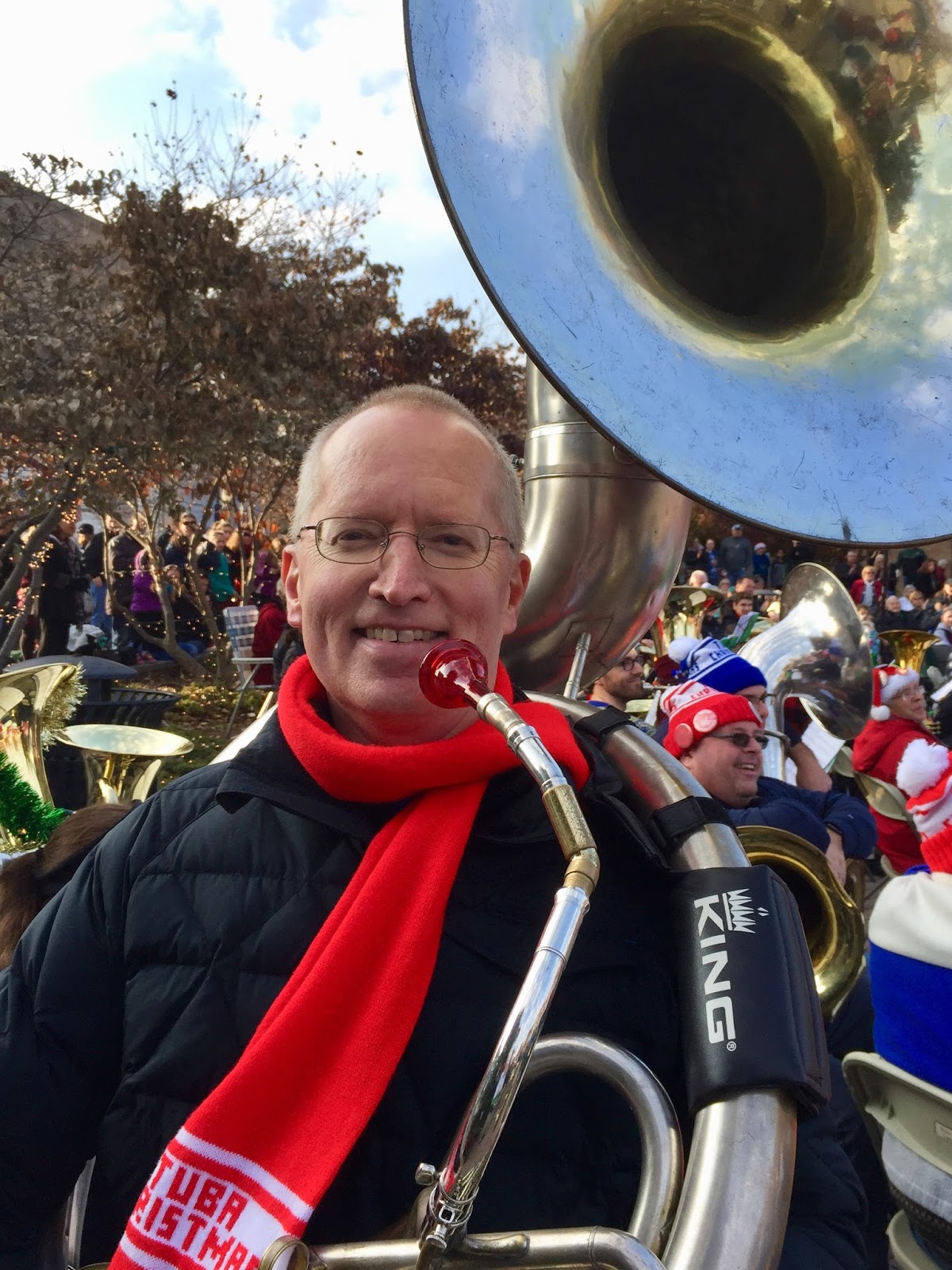
Merry TubaChristmas, 2017!

I meant to post these last Sunday, but we had a great turnout for TubaChristmas that day in Lansdale, PA. Seventy-five horns showed up, and we sounded, well, very tuba-y! Here we are rehearsing at the local fire station:


And here I am after the concert, with the 1927 Pan American Sousaphone that my son and I rescued from a local middle school a number of years ago (he just performed at TubaChristmas out at State College today):


Sunday, November 26, 2017

Kid's books and Sousaphone history

I accompanied my wife to our local library one day, and thought I'd peruse the children's book section to see what I could learn about Sousaphone history. It turns out that kids are getting a lot of bad information. Here are a few samples:


First up, from 1964 (above), is the often-mentioned falsehood that the Sousaphone "was first used . . . in  marching band."


The same falsehood appears in this book, but also note the backwards facing bell in the drawing above.


Yeah, I didn't know that, because 1910 is 15 years after the fact. And the first Sousaphone was not quite that tall. I've held it and played it.

And here are some fun comics from a book on Sousa:


Finally, and this was not at our local library, but in a kid's book I found in The Creamery up at Penn State, where my son is enjoying his second year. Check out the ergonomics on that Sousaphone!


For a children's resource that does get Sousaphone history right, click here.


Saturday, November 11, 2017

Veteran's Day (cartoon) Sousaphone!

My Mom likes to send our family these online "live" greeting cards, and the one she just sent for Veteran's Day is right up my alley!


Not surprisingly, this little bear band is playing Sousa's "Stars & Stripes Forever" when you let the card do it's thing. Happy Veteran's Day to you all!

Friday, October 6, 2017

More Blue Band highlights (Sept 30)

Me, our son, Jonathan, and my wife, Kim
The parade from the band building to the stadium
"Snailing" along the way!
Pregame, during the "floating LION"
Halftime, playing "Star Wars"!