Friday, October 8, 2021

Eldon Baker - An Early Bass Soloist

Eldon Baker (1860-1935) with his bass Antoniophone in 1889 as part of Gilmore's Band

One of my favorite things to happen in the course of my research is to hear from someone who is related to a long-forgotten musician that I have drawn attention to in my work. Just last night I discovered a Facebook Messenger request from an 82-year-old woman who recently learned that the bass player above is her maternal great grandfather!

She has been working on her family tree to connect all of the dots, but reached out to me, based on an old TubeNet post of mine related to that funky instrument in the photo, to see if I could shed any light on Eldon as a musician. 

Well, I love this sort of thing, and welcomed the opportunity to dig back into my research files and see what I could piece together about this remarkable bass player. Here's what I've learned so far . . .

Eldon Baker (1860-1935) was born in Quebec, but by the time he was in his late teens, he was living with his family in St. Albans, Vermont, and performing with the St. Albans Brigade Band, which consisted of 24 young men, led by H. W. Hatch. In the band with him were his brothers, Calino (or Calno; Eb Clarionet) and Clarence (Solo Euphonium). Eldon himself was listed not merely as a tuba player, but as "Solo Tuba." Here's a brief review of the 19-year-old soloist in the November 1, 1879 edition of the Swanton Courier:


The three Baker brothers, along with three other musicians, formed a small dance orchestra, to perform at the dances that frequently followed concerts by the band. Eldon, it appears, played the upright bass in this group:


But it was his tuba solos with the band that continued to be popular with the audience, as noted here in the May 17, 1880 edition of the St. Alban's Daily Messenger:


By the end of that year, he was on the road with a minstrel show, as reported in the November 27, 1880 edition of that same paper. Keep in mind, he had just turned 20-years-old a few months earlier!


Two years later, Eldon went on the road with comedian Johnny (or Johnnie) Prindle. Here's what was reported in the August 12, 1882 edition of the Swanton Courier:


It should be noted that, in those days, as well as today, featuring, much less being, a tuba soloist was exceedingly rare. But Eldon was apparently quite a sensation! He was part of the "Silver Band and Classic Orchestra" that supported the "Chaste and Refined" comedy routines of Prindle (so, while it was billed as a "Pleasure Party," apparently the comedy was clean!):


By early 1885, he was based in Minneapolis and featured in "Prof. Danz' and Siebert's Orchestra," Here's the earliest notice I found about this, from the April 27 edition of the Minneapolis Tribune, and notice that he is, once again, a soloist:


Within a few months, Eldon was eager to upgrade his instrument, to keep pace with his rising star (this was reported in the June 13 edition of the Saint Paul Globe): 


It appears that he remained with the Danz Orchestra until sometime in 1886, when he moved to Knoxville, Tennessee to join Crouch's band (as reported in the September 26 edition of the Knoxville Journal):


A year later, we find him back in Minneapolis, but this time as a guest soloist with the Danz Orchestra, according to the October 6, 1887 edition of the Minneapolis Tribune:


But at some point shortly after that, Eldon hit the big time, as Patrick Sarsfield Gilmore, hailed as "the greatest bandmaster in the world," recruited him to join his celebrated band. Gilmore switched him from tuba to the unique new brass horn known as an Antoniophone, and here's one of the earliest references I found of him being featured as a soloist on the bass version of that instrument (from the May 3, 1888 edition of Nashville's Daily American):


At one point, Gilmore featured a quintette of Antoniophones in his band, as seen here in a photograph from the September 28, 1889 edition of Harper's Weekly (that's Eldon on the right, with the bass version):


The accompanying article had this to say about these horns:


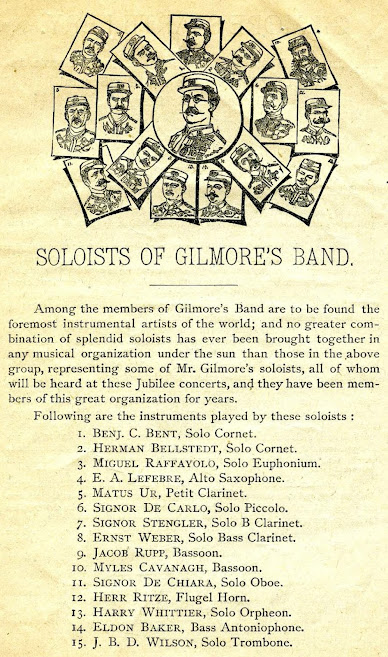
Later that year, while Gilmore's Band was touring the country, we learn that Eldon remained one of Gilmore's favorite soloists. Here's a page from the program created for the concerts in Portland, Oregon on November 4 and 5, 1889 (see number 14 below):

And here is yet another image of Eldon with Gilmore's Band that year (this time in St. Louis, a few months earlier; he is directly behind Gilmore's music stand, holding his bass Antoniophone):


A roster for Gilmore's Band from 1890 lists Eldon as having been in the band for three years by that point (so starting in either 1887 or 1888), and continues to connect him with the bass Antioniophone. Two years later, in 1892, Gilmore formed a band of one hundred, which he dubbed "The Greatest Band in the World," and Eldon was part of it.

Gilmore suddenly died while that massive band was at the St. Louis Exposition that fall, but when D. W. Reeves was elected Gilmore's successor, Eldon remained on the roster (number 89 below):


John Philip Sousa launched his new band just two days after Gilmore died, and eventually seventeen members of Gilmore's Band decided to join Sousa in the new venture (four joined prior to Gilmore's death, and thirteen after).

Eldon was one of those who left for Sousa after Gilmore's death, but apparently not until the Spring tour of 1893. Earlier that year, we find him playing tuba in a special New York orchestra of "Seventy Crack Musicians" that had just been formed (as reported in the February 25, 1893 edition of Brookyn's Standard Union):


But by April, Eldon is listed as one of Gilmore's former players who was now on tour with Sousa. This is from the April 23, 1893 edition of the Buffalo Sunday Morning News, where he is considered one of the "magnificent performers" on the tuba, along with Herman Conrad:


However, it appears that Eldon played with Sousa for just that year (there is no record of him in that band for any following year). But at some point he ended up in Frederick Innes' band, as noted in the July 18, 1895 edition of Canton, Ohio's Stark County Democrat:


After leaving Innes' band in a huff (as noted above!), it seems that he rejoined Gilmore's Band, which was now under the direction of Victor Herbert. Eldon was one of many former members of that band who had been active when Gilmore was still leading it, as reported in the September 26, 1896 edition of the Philadelphia Times:


It appears that Eldon remained with Gilmore's Band, under Herbert, until 1900, at which point he joined Phinney's United States Band, as reported in the September 8, 1902 edition of the St. Alban's Daily Messenger:


Here is a photo of that band from 1901, while they were at the Pan-American Exposition in Buffalo. Eldon is presumably in the photo, but I can't quite make him out:


The last reference I have found (so far!) to Eldon playing in a band or orchestra is from the January 6, 1911 edition of the Hastings Daily Republican. At that point, at age 50, he was playing with an orchestra that supported the travelling troupe that performed a revival of the Broadway musical, The Prince of Pilsen:


Where and when he may have played after 1911, and prior to his death in 1935, has yet to be discovered. But if I learn more, I'll add it to this post. 

However, it is quite clear from the evidence above that Eldon Baker was one of the truly great bass players, and perhaps one of the most celebrated bass soloists, of the late 19th and early 20th centuries, playing with some of the greatest bands of that era.

I would have loved to have heard him play!


UPDATE: While I haven't yet found an obituary, I did find this from the November 8, 1953 edition of the Vermont Sunday News, 18 years after Eldon's passing:


Wednesday, August 25, 2021

Wait, Patrick Stephen Gilmore? Yes!

I just ran across this when researching the sudden death of the legendary bandmaster typically known as Patrick Sarsfield Gilmore (1829-1892). I ran it by a Gilmore researcher I know, and he confirmed it. Now you know!


Here he is in June 1892 with his band of one hundred at Madison Square Garden:


Friday, July 30, 2021

A visit to Conn's final resting place

My son and I, during our visit to Elkhart's Grace Lawn Cemetery at the end of June 2021

When you approach the Conn family plot, within Elkhart's Grace Lawn Cemetery, this is what catches your eye - a nine foot vertical slab of stone marking the final resting place of the former giant of a man, Charles Gerard Conn (1844-1931).

Conn was a huge figure in Elkhart, Indiana, beginning in the mid 1870s, when he started his band instrument business, and ending with his death in 1931 (although he had left Elkhart for good by 1916, after selling the company). The back of the slab reminds us of his remarkable life:


At the time he sold his company in 1915, he owned a great deal of land in and around Elkhart, as seen in this map from that year (the Conn factory is circled in red, and other chunks of land he owned are underlined in red; the cemetery in which he is buried is circled in yellow):


But you may have noticed that the towering stone that commemorates his death was erected by his "old employees and friends" at some point. Why? Where is the elaborate tombstone provided by Conn's legendary wealth? There is none. Instead, there is this simple in-ground gravestone, marking the fact that Conn passed away without much money to his name (how that came to be is a story for another time):


Conn was living in Los Angeles at the time of his death, and the January 6, 1931 edition of The Los Angeles Times ran this simple, but fascinating, death notice:


Suzanne Conn? Charles Gerard Conn, Jr.?! This was news to me!

The story of how and when Charles met and eventually married Suzanne is one that I am currently working on. But they had their son, Charles Jr., in 1918, when Conn was 74, which was four years before his first wife, Catherine, divorced him, after 52 years of marriage. Although, as I mentioned earlier, he had essentially abandoned Catherine in 1916, moving permanently to southern California. 

And within a few weeks of that divorce being final in 1922, he married his long-time mistress out west (on their wedding day, Charles was 78 and Suzanne was 37). Curiously, while the divorce by Catherine is reported in a few newspapers, neither the birth of his son nor his second marriage is noted at all, as far as I have been able to find.

Meanwhile, Conn's remains were sent back to Elkhart, as reported in the January 9, 1931 edition of The Los Angeles Times:


Even though Conn was apparently living rather quietly during the last decade of his life, his passing was mourned throughout the country. Here is what was written in the January 7, 1931 edition of The Los Angeles Evening Express a day after his death (again, Conn had been living in Los Angeles for his final years):


Barely two years after his death, his widow (again, his second wife, Suzanne) and their son (who was actually 15 at that time) were destitute (these were, after all, the depression years), as revealed in the September 5, 1933 edition of The Los Angeles Record:


But back to Grace Lawn Cemetery in Elkhart, it is interesting to see Conn's simple gravestone somewhat off on its own, while there is a line of identical family gravestones that are together - a line that, surprisingly, doesn't include his first wife, Catherine, or the one child of theirs who grew to adulthood, Sallie (they are buried together in another part of the cemetery). 

Here are the graves in that line of stones near Conn's stone:

His mother:


Here is the notice of her death in the September 10, 1884 edition of The Elkhart Daily Review:


His father:


Here's the notice of his death in the August 27, 1887 edition of The Elkhart Daily Review:


His only brother, who died in infancy (he also had two sisters: Florence Conn Dodge, 1846-1890; and Ella Conn Hagenbaugh, 1860-1934):


His first-born child, a son who was born somewhere around 1870-1873, but who only lived a few hours (thanks to Margaret Downie Banks of the National Music Museum for this information):


His second child, "Lizzie," who was born to Charles and Catherine on February 28, 1874, and died before her third birthday, on October 28, 1876, which means the years on the gravestone are incorrect (thanks again to Margaret for this clarifying information):


The November 2, 1876 edition of The Elkhart Weekly Review ran this touching paragraph about Lizzie's passing:


His first wife's father:


Here's the notice of his death in the December 4, 1897 edition of The Elkhart Weekly Review:


And his first wife's mother (which, again, is odd when you discover that his first wife, Catherine, is buried in an entirely different part of the cemetery!):


Here is her detailed obituary in the March 11, 1907 edition of The Elkhart Truth:


His third child, Sarah "Sallie" Katherine Conn, who, again, was their only child to live to adulthood, was born on September 4, 1877, as was briefly noted in that day's edition of The Elkhart Daily Review:


But, once again, she is buried in another part of the cemetery, along with her mother (block V in the northwest corner, according to Margaret). I learned about this after our visit, and so do not have photos of their gravestones. 

Sallie's story is ultimately a sad one, as she struggled with mental health fairly early on in her life, and was institutionalized for many years before dying at age 53 - just a few months after her father passed away.

 Here is her brief obituary, in the April 23, 1931 edition of The South Bend Tribune:


And as for Conn's second wife, whose maiden name was also Conn (her birth name was Mary Suzanne Conn, but Margaret clarified that she and Charles were not related) - she died in Los Angeles in 1960, as reported in the July 28 edition of The Los Angeles Evening Citizen News:


Their son, Charles Gerard Conn Jr., died in 1996.

As often happens for me, this visit sparked an interest in learning more about Conn and his family history. Stay tuned for more posts in the near future!

[Special thanks to Tim and Meg Shelly for graciously escorting us to the Grace Lawn Cemetery following our visit to their home, the Conn mansion, in Elkhart in late June.]

Thursday, July 29, 2021

Conn brings the bell forward (1908)


On December 26, 1907, Charles G. Conn drafted a letter to the U. S. Patent Office that would bring a dramatic change to the Sousaphone, as well as to other bell-up instruments. Here's a portion of what he wrote:
The object of my invention is to construct the bells of brass wind musical instruments with curved axes and by attaching these curved bells to the bell-tubes of the instruments by means of curved sleeves, to provide a bell-front instrument having a much larger field of adjustment than heretofore.
The application was filed on February 13, 1908 (although not approved until August 17, 1909), and included the following diagram:

The result was what Conn called the Wonderphone family of band instruments. The Sousaphone, with its upright bell, would begin to fade away as the new "Helicon BBb Bass Wonderphone" would eventually take over the Sousaphone market, as well as the name, in roughly five years (the earliest known reference to a Wonderphone helicon being called a "Sousaphone Grand" is from 1913).

The Music Trade Review of 1908 was all abuzz with excitement over Conn's new creation. Here's the first article that appeared, in the February 1 edition:


Regarding tubas, we've typically referred to those original forward-facing bells as "recording bells," due to how they must have helped in the early years of the recording industry. But nothing is said about that in the article above.

Rather, the emphasis is on 1) how it would make a concert band sound better, with all of the bells pointing forward, and 2) how, in a marching band, the bells could be "directed backward toward the marching column if so desired." Whether anyone actually did that is another question!

Although it does sort of make sense, as I've noticed that in the rare instances when the Sousa Band marched, the Sousaphone and tubas were in the front rank, so perhaps being able to point their bells backwards might have helped the band follow the bass line better (although Sousa had no interest in Conn's creation; he stuck with the original bell-up design to the very end of his career!).

Here's an example of what I'm talking about, from 1900, when the band was marching in Paris:


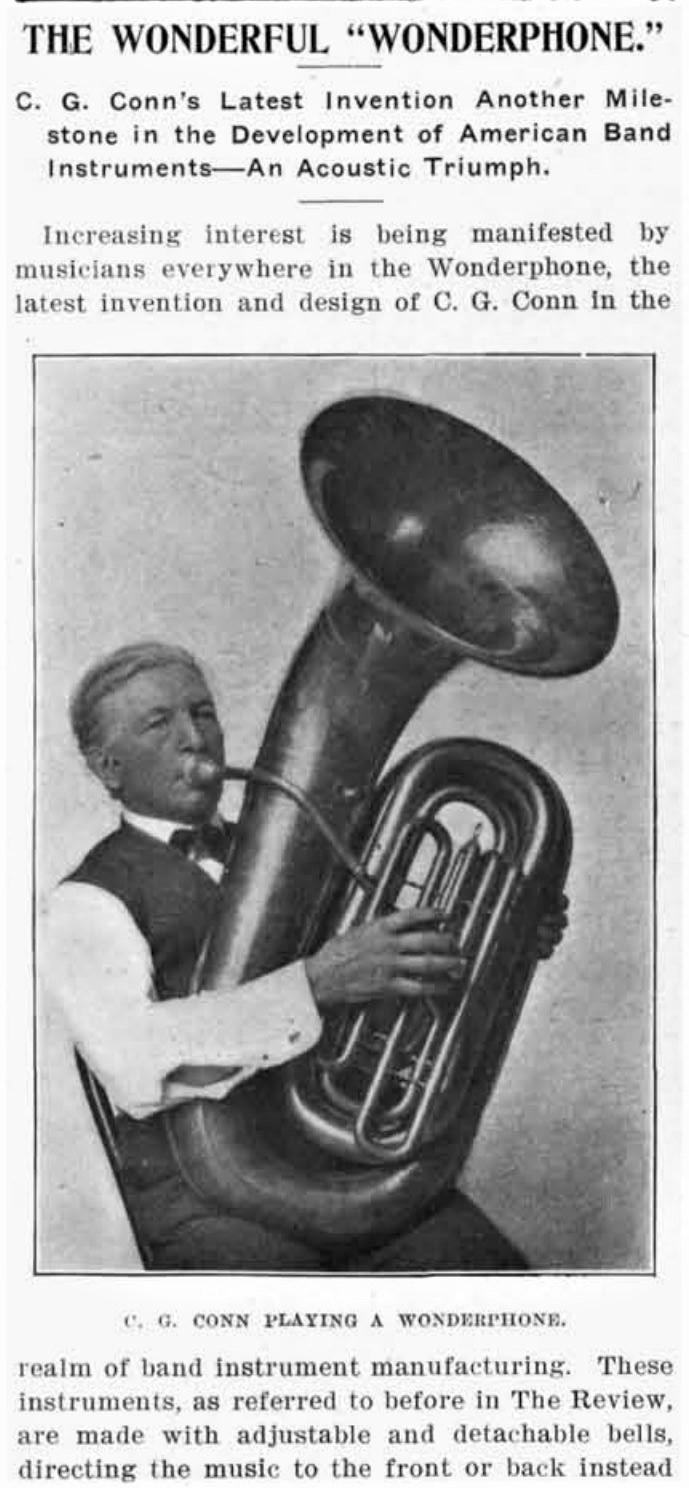
In the February 22, 1908 edition of The Music Trade Review, so just three weeks after the initial article, we learn more - and we get a rare look at Conn playing one of his inventions!

Added to the benefits now are 3) how the tuba or euphonium soloist would be better heard, and 4) how the band would look much more uniform, and therefore attractive, to the audience.

Five months later, The Music Trade Review ran yet another article - this time with photographs of each of the Wonderphone models, as well as a discussion of the Wonderphone cornet, which, of course, had no realignment of its bell (although, hey, Dizzy Gillespie did that years later!). This is the July 11, 1908 edition:


[For my first take on this topic, back in 2012, click here. The job of the historian is never done!]