Friday, February 25, 2022

The man behind my new vintage tuba

This past Saturday, FedEx delivered to my house a giant cardboard box that clearly said "TUBA" on both sides of it. I was stunned, because I hadn't ordered a tuba! But I had been tipped off a few days earlier, by a couple of dear friends of mine, that a surprise gift was on its way to me. But, come on, a tuba? Or was something else in that enormous box?!

Well, upon opening it, and after wrangling miles of bubble-wrap and a gazillion packing peanuts, here's what was inside: An American Model Monster BBb Bass built by C. G. Conn in 1899 (serial number 66235) - yes, 123 years ago, and just a year after Conn built his first Sousaphone for John Philip Sousa!


Here's a page from C. G. Conn's Truth from right around that time that features this very instrument:


Now, given the engravings on the bell (which I'll show you in just a minute), and looking at the fine print toward the bottom of the page above, this horn was built with "FINISH II - Engraved, triple silver plated," etc., and cost a whopping $120 in 1899!

And here's the fine print on either side of the illustration of the tuba, just to provide you with whole promotional story of this "Monster":
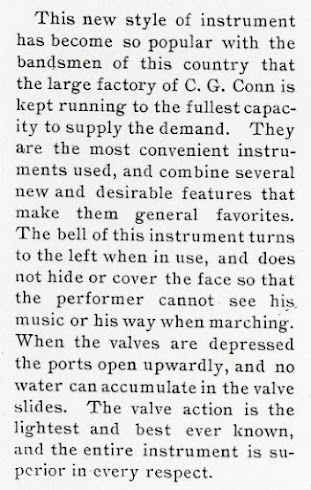


As it turns out, the specs are slightly off. While the weight is close (21 pounds), and the diameter of the bell is an inch larger (17 1/2 inches), the length is actually 35 1/2 inches - so, quite a bit taller than advertised.

And now, about those engravings on the bell - while they are not as ornate as what you see in the illustration above (that was apparently "FINISH I - Elegantly engraved," which cost an extra 10 bucks!), they are still spectacular, despite all the tarnish:


At the heart of the engraving, it reads "Made by C. G. Conn, Elkhart, Ind, [and] New York." But look toward the rim of the bell - there is a name engraved there that reads, "Rev. Robert Fansler Killgore," which is almost certainly the original owner. When I saw that, the historian in me started to geek out: "Who was that guy? I have to find out!"
[Quick side-note: Because of my email address, and Twitter handle, I am known as the "tubapastor" (that is, I am a pastor who happens to play the tuba). So how cool is it that the original owner of this vintage beauty was also a tubapastor? I suspected that my friends sent me this particular instrument because of that very fact, and I was right!]

Okay, back to the story, and the point of this blog post:


Who was Robert Fansler Killgore?

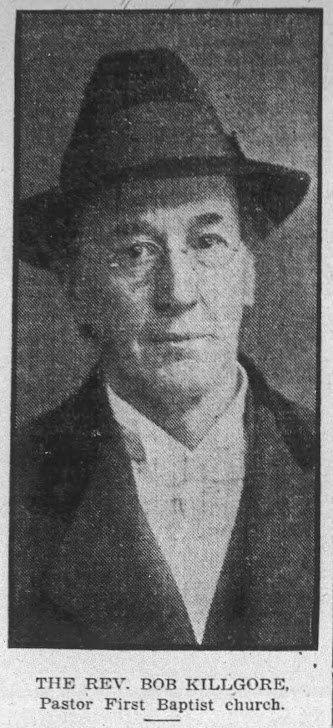
Well, to begin with, here is what he looked like in 1913, at age 53, when he was a pastor in Butte, Montana (and how about that very stylish hat?!):


The more I dug into his life story, the more fascinating it became, although by the end of my research, I found myself deeply disappointed in this fellow-pastor. But I'll allow all of that to unfold below.


The young cabinet-maker

Robert "Bob" Fansler Killgore was born on April 28, 1860, somewhere near Estillville, Virginia - probably Nickelsville. His dad was a farmer, and, at that time, Bob had four siblings, with three more to come.

In 1879, at the age of 19, he married 15-year-old Louisa "Lou" Ellen Hartsock (the same maiden name as his mother, so there might be story there), and they had a daughter, Lucy, born in 1881, and a son, David, born in 1883. The 1880 census lists Bob as "working in [a] cabinet shop" there in Scott County, Virginia.

But the marriage didn't last (he remarried in 1889, and she in 1891), and somewhere along the way Bob attended college in Tennessee, and that's when the story really picks up.


The fist-fighting lawyer

A report from 1912 revealed that Bob "was a graduate of Vanderbilt university" and that "following his collegiate work he studied law and was admitted to the bar. He practiced seven years in Florida."

I tracked him down in Pensacola, where he lived in the mid-to-late 1880s (perhaps already divorced). But he not only practiced law; he was also "a light-weight pugilist [meaning professional fighter], who trained with the great John L. and fought under the name of Smith."

"The great John L." would be John L. Sullivan, "the heavyweight champion of bare-knuckle boxing." One report boasts that Bob was "Sullivan's second [meaning sparring partner?] at the time of the Sullivan-Mitchell fight in France," which was a really big deal in March of 1888. Here's the poster from that event:


While his foray into pugilism perhaps led to the demise of his first marriage, as professional fighting was often condemned as immoral in those days, it apparently didn't deter Canadian Ada Simmons from tying the knot with Bob in 1889. The ceremony was rather abrupt, as noted in the November 23 edition of The Pensacola News:


[Another quick side note: Bob is listed here as a "carpenter," which squares with his background, but that does make me wonder whether he was still practicing law at this time - or if this is the same Robert Killgore. But he did marry a Canadian woman that year, and he was living in Pensacola at the time.]

Almost exactly two years later, the whole direction of Bob's life dramatically changed.


The reformed pugilist

John B. Culpepper, the celebrated Methodist evangelist, had come to Pensacola in November of 1891 to hold a number of revival meetings. They were supposed to happen in a big tent that was being constructed for these gatherings, but the seats weren't quite completed when they were ready to start, so the first meeting was held in the auditorium of the local Methodist Church.

At that time, Bob was "giving lessons in prize-ring gymnastics," and on the morning of Sunday, November 15, "he was passing the church on his way to give a lesson, when his attention was attracted by the immense crowd in front of the church. Stopping a moment, he was pushed into the narrow aisle left by the crowd on either side. While there, some ladies wanted to enter the church, and he was compelled to go in himself to get out of the way. While there he was converted."

But along with coming to faith in Christ, Bob felt called to be an evangelist himself, and Culpepper soon brought him on as his assistant, making good use of his gifts as a musician, and perhaps even his gifts as a personal body guard! (After all, God can use pugilistic gifts, right?!)

One report in the summer of 1893 called Bob a "zealous co-worker and able choir-leader" for Culpepper, adding that he was "a sweet-voiced singer for Christ, an evangel of God's power in music." And it mentioned that his wife traveled with him on these revival tours.

A year later, this report, from which I pulled the story of his conversion above, appeared in the January 24, 1894 edition of the St. Joseph News-Press:


The traveling evangelist

In 1893, or shortly thereafter, Bob attended the newly-founded Mendota College in Illinois, as it provided ministerial training, and by 1895, he was ready to launch out on his own as an evangelist.

He initially worked out of Macon, Georgia, as that was where Culpepper was based, but eventually settled in Bridgeport, Alabama. From that home base, he traveled for the next six years throughout portions of the South and Midwest, holding revival meetings and supporting the Women's Christian Temperance Union - often "accompanied by his musicians," which may have included a band, and, for at least one tour, featured "James W. Jones, a splendid trombonist."

This may suggest where the tuba fits into his life. He was clearly a gifted musician, and perhaps he played tuba along with his musicians at times, but I simply wasn't able to find anything to confirm such reasonable speculation. But as I said above, that beautiful bass that bears his name was built in 1899, so I'm guessing he bought it, or received it as a gift, that year.

What is clear, however, is that Bob was very successful as an evangelist. Here's one brief report from the June 17,1897 edition of The Scottsboro [AL] Citizen:


Almost exactly a year later, the success of his Chilhowee, Missouri revival meetings was hailed in the newspapers of that state, including the July 1, 1898 edition of The Sedalia Democrat:


Two weeks later it was reported that "The citizens of Chilhowee and vicinity became so infatuated with Kilgore that they offered him four lots, gratis, if he would build [a house] thereon." Bob accepted their kind offer, and proceeded to move his family from Alabama to the tiny Missouri hamlet, where he became known, for the next three years, as "The Chilhowee Evangelist."

While that was a significant change for Bob, an even bigger change would come in early 1901.


The ice-cold convert

Bob's parents were Baptist, but apparently that faith didn't take with their son. Upon his conversion under Culpepper in 1891, he embraced the Methodist faith, and he never looked back. That is, until he came to the conviction that a true follower or Jesus must be baptized by immersion as a believer - something he had never done. 

He came to this conviction in the winter of 1901, while he was conducting revival meetings in Illinois. The weather was harsh, but his resolve to be obedient to Christ was immovable. Here was the popular Methodist evangelist, braving the elements and converting to the Baptist faith of his parents. The story was so gripping, it showed up in papers throughout the Midwest, such as the February 5, 1901 edition of the Ottumwa [IA] Tri-Weekly Courier. Don't miss the chilling details (pun intended)!


The Baptist pastor-evangelist

Shortly after his ice-cold baptism, Bob became the pastor of the First Baptist Church of Olney, Illinois, where he served for three years. In 1904, he resigned to pastor the First Baptist Church of Reed City, Michigan. But by 1906, he was itching to return to the life of a traveling evangelist, without the responsibilities of shepherding a local congregation, so he became the Baptist State Evangelist for Michigan, based out of Grand Rapids.

It was during that time that the letters "D. D." (for Doctor of Divinity) began appearing after his name. Whether that degree was earned, or honorary, I can't say, but Dr. Bob seemed to rise to a new level of prominence during those years. Here's one report, from the December 19, 1907 edition of the Belding [MI] Banner:


But by 1910, Bob was eager to return to the pastorate, which he did for the First Baptist Church of Akron, Iowa, then, in 1912, the First Baptist Church of Butte, Montana, and finally, in 1915, the First Baptist Church of Oelwein, Iowa.

During these years, his wife, Ada, was revered as a Sunday school teacher, and their foster daughter (acc. to one source; I'm still trying to sort that out), May Runyan, played the pipe organ for the church. So, ministry was a family affair!

But by early 1916, at age 56, Bob was eager to move to a warmer climate, and so he moved the family to Tampa, Florida. After guest-preaching at the First Baptist Church of nearby Brooksville, that congregation called him to become their pastor, which is what he did for the next three years, until he moved the family to Crisfield, Maryland, where he took over the struggling Crisfield Baptist Temple. He turned that congregation around, and built a beautiful new building that was completed in 1922:


But here is where I learned something about Bob that made my heart sink.


The sadly-deceived preacher

His time at Crisfield would prove to be his longest pastorate (1919-1925), but during those years he became active in the Ku Klux Klan, which had been revived four years before his arrival in Maryland. Here's what History.com says about this regrettable organization:
In 1915, white Protestant nativists organized a revival of the Ku Klux Klan near Atlanta, Georgia, inspired by their romantic view of the Old South as well as Thomas Dixon’s 1905 book “The Clansman” and D.W. Griffith’s 1915 film “Birth of a Nation.” This second generation of the Klan was not only anti-Black but also took a stand against Roman Catholics, Jews, foreigners and organized labor. It was fueled by growing hostility to the surge in immigration that America experienced in the early 20th century along with fears of communist revolution akin to the Bolshevik triumph in Russia in 1917. The organization took as its symbol a burning cross and held rallies, parades and marches around the country. At its peak in the 1920s, Klan membership exceeded 4 million people nationwide.
Bob was swept up into the Klan during that peak. In 1923, as he hosted 200 klansmen at his church, it was reported that "The Rev. Killgore lauded the klan and said he was proud that he was a member." Two years later, while in Virginia, the land of his birth, he spoke to a huge crowd on "The Ku Klux Klan and What the People Should Know About Them."

Perhaps he wasn't fully bought in to the racism and hatred, as that same report said, "The speaker, Dr. Kilgore, has to a News reporter declared that if any expect a tirade of abuse hurled at any people, race or creed, they will be sadly or happily disappointed." And then the reporter concluded, "The speaker recognizes the Christ as the only criterion for the right." (For more about the Klan in the 1920s, click here.)

I wish I knew what all of that means, and how that squares with his membership in the Klan. But that's all I could find (so far). On July 28, 1928, at the age of 68, Bob passed from this life and stood before that very Christ. 

Here's his obituary, in the July 30 edition of The Baltimore Sun (where his age is incorrect):


And here is the only other photo I could find of Bob - this one from 1926, at age 66, two years before his passing:


So, there you have it - the fascinating, and ultimately disappointing, story of the man behind my new vintage tuba! Here's a simple timeline of his life and ministry career:

1860 - Born near Estillville, Virginia
1879 - Married Louisa Hartsock, with whom he had two children
188? - Divorced Louisa at some point
188? - Worked as a carpenter, lawyer, and pugilist
1889 - Married Ada Simmons (one child by birth; one foster)
1891 - Converted at revival held by evangelist John B. Culpepper
1891 - Became assistant evangelist to Culpepper, mainly as a singer
1895 - Launched his own revival ministry as a traveling evangelist
1899 - Purchased or received Conn tuba engraved with his name
1901 - Converted from the Methodist faith to the Baptist faith
1901 - Became pastor of First Baptist Church of Olney, Illinois
1904 - Became pastor of First Baptist Church of Reed City, Michigan
1906 - Became Baptist State Evangelist of Michigan
1910 - Became pastor of First Baptist Church of Akron, Iowa
1912 - Became pastor of First Baptist Church of Butte, Montana
1915 - Became pastor of First Baptist Church of Oelwein, Iowa
1916 - Became pastor of First Baptist Church of Brooksville, Florida
1919 - Became pastor of The Baptist Temple of Crisfield, Maryland
1925 - Retired from pastoral ministry
1928 - Died in Crisfield at age 68

For more photos of the tuba, including the cleaning and polishing I gave it, click here. And for photos of the work that Matt Walters did on it to restore its playability (and a bit of it's look), click here.

Monday, December 6, 2021

A Very Merry TubaChristmas 2021!


The prize-winning decorated tuba this year!

The oldest horn, from what I could tell - a late 1800s Conn helicon bass!

My old buddy, Wayne (on the right) from our MCCB days

Yours truly - with our 1927 Pan American Sousaphone!

Saturday, November 20, 2021

Wanna hear one of the largest tubas?

Thanks to Daniel Ridder for posting this brief encounter with one of the world's largest tubas! The basic specs on this subcontrabass are in my gallery in this post (number 3 in the ranking). Enjoy!


Saturday, October 16, 2021

Conn, the ardent autoist, motors west

Almost 20 years before Route 66 was completed, which "winds from Chicago to L. A.," and almost 40 years before that highway was memorialized in the hit song that began, "If you ever plan to motor west," C. G. Conn did indeed "motor west." However, he used the rough roads that would eventually become Interstate 80, winding from his hometown of Elkhart, Indiana to the Pacific Coast.

It was 1908, and Conn, the "ardent autoist" (referred to by one reporter as a "hard driver," supposedly using up "two to three cars a season") and wealthy manufacturer of band instruments, planned an almost 4,000 mile road trip in his brand-new American Simplex Touring Car. 

Here's that car from the following year's catalog:


The road trip was big news in northern Indiana, and the initial report, from the April 18, 1908 edition of the Elkhart Daily Review, revealed that various modifications were made to the car to prepare it for the arduous journey:


As that last paragraph clarified, while the trip was projected to take "a good share of the summer," it was planned primarily for pleasure, and would include times to hunt and fish along the way.

Travelling with Conn was his chauffeur, George Reims, his "companion and great fisherman," Arthur Wilson, and (as reported later) a mechanic by the name of Walter Woods (there may have been one other passenger, who was not named). Leaving Elkhart on the morning of April 29, their first stop was the American Simplex factory in nearby Mishawaka, where they were met with a "band playing and banners flying." Conn was a "heavy stockholder" in the car company.


They proceeded to South Bend, where we learn many more details about that first day, which was full of pageantry and celebration. With Conn for this short leg of the journey was his daughter, Sallie, but apparently not his wife. Here's the full report from that day's late edition of the South Bend Tribune:


Their next stop was Chicago, where they spent the better part of three days, and then they slowly made their way through Illinois, Iowa, Nebraska, and southern Wyoming, apparently without incident. But in Ogden, Utah, they were met with "wretched road conditions," due to heavy rain, and were forced to remain in that region for three weeks (see the full report below for details).

The challenges they faced as they made their way through northern Utah and Nevada are revealed in the following photos, included in the 1909 American Simplex catalog:


At some point, as they were heading toward San Francisco, Conn's chauffeur decided to return home, as reported in the June 12 edition of the South Bend Tribune:


But on June 23, Conn and the remainder of his party rolled into San Francisco, as reported in the July 2 edition of that same paper:


From there, they drove down the beautiful California coast, arriving in Los Angeles on July 10, after which the July 12 edition of The Los Angeles Times provided this full report of the 55 day, 3,706 mile journey:


Just over a week after their arrival in southern California, Conn went fishing around the Channel Islands, which is something he would do a lot in the years to come (more on that in a future post). Here's what the July 21 edition of The Los Angeles Times reported:


At that time, there were rumors about Conn running for governor of Indiana, but the July 29 edition of the Times made it clear what he was most interested in at that time:


Conn remained out west until late March 1909, at which point he took the train home, rather than making the return trip in his car, as the reports above mentioned. He had been away for almost exactly eleven months. Here's the brief notice of his return from the March 29 edition of the Elkhart Daily Review:


But within a few months, Conn was back fishing in the waters around Catalina Island, with one of the latest models of an American Simplex car awaiting his use when he was on the mainland. Here's the brief report in the September 12, 1909 edition of the Los Angeles Herald


Understandably, the Simplex Motor Car Co. used Conn's cross-country trip to boast about the quality of their automobiles. In their 1909 catalog, from which all of the photos above come, they wrote,
Perhaps the most conclusive test that has ever been made of American Simplex construction was embodied in an intensely interesting tour made early in the summer of 1908 by Colonel C. G. Conn of Elkhart, Ind., formerly Congressman from Indiana. Mr. Conn drove the car from the factory to Los Angeles, Cal., making side trips of great distances from the large cities through which he passed, so that the car traversed about 10,000 miles [apparently an overstatement]. These details have an important bearing on what follows as showing the absolute trustworthiness of the American Simplex.
Here's the cover of that catalog:


On October 29, 1909, Conn wrote a letter of endorsement to the company, based on his experience driving across the country:


In upcoming posts, I will dig a bit more into Conn as an "ardent autoist," as well as explore the new life he created for himself out west, which seems to have begun with this epic road trip in 1908. Stay tuned!

Friday, October 8, 2021

Eldon Baker - An Early Bass Soloist

Eldon Baker (1860-1935) with his bass Antoniophone in 1889 as part of Gilmore's Band

One of my favorite things to happen in the course of my research is to hear from someone who is related to a long-forgotten musician that I have drawn attention to in my work. Just last night I discovered a Facebook Messenger request from an 82-year-old woman who recently learned that the bass player above is her maternal great grandfather!

She has been working on her family tree to connect all of the dots, but reached out to me, based on an old TubeNet post of mine related to that funky instrument in the photo, to see if I could shed any light on Eldon as a musician. 

Well, I love this sort of thing, and welcomed the opportunity to dig back into my research files and see what I could piece together about this remarkable bass player. Here's what I've learned so far . . .

Eldon Baker (1860-1935) was born in Quebec, but by the time he was in his late teens, he was living with his family in St. Albans, Vermont, and performing with the St. Albans Brigade Band, which consisted of 24 young men, led by H. W. Hatch. In the band with him were his brothers, Calino (or Calno; Eb Clarionet) and Clarence (Solo Euphonium). Eldon himself was listed not merely as a tuba player, but as "Solo Tuba." Here's a brief review of the 19-year-old soloist in the November 1, 1879 edition of the Swanton Courier:


The three Baker brothers, along with three other musicians, formed a small dance orchestra, to perform at the dances that frequently followed concerts by the band. Eldon, it appears, played the upright bass in this group:


But it was his tuba solos with the band that continued to be popular with the audience, as noted here in the May 17, 1880 edition of the St. Alban's Daily Messenger:


By the end of that year, he was on the road with a minstrel show, as reported in the November 27, 1880 edition of that same paper. Keep in mind, he had just turned 20-years-old a few months earlier!


Two years later, Eldon went on the road with comedian Johnny (or Johnnie) Prindle. Here's what was reported in the August 12, 1882 edition of the Swanton Courier:


It should be noted that, in those days, as well as today, featuring, much less being, a tuba soloist was exceedingly rare. But Eldon was apparently quite a sensation! He was part of the "Silver Band and Classic Orchestra" that supported the "Chaste and Refined" comedy routines of Prindle (so, while it was billed as a "Pleasure Party," apparently the comedy was clean!):


By early 1885, he was based in Minneapolis and featured in "Prof. Danz' and Siebert's Orchestra," Here's the earliest notice I found about this, from the April 27 edition of the Minneapolis Tribune, and notice that he is, once again, a soloist:


Within a few months, Eldon was eager to upgrade his instrument, to keep pace with his rising star (this was reported in the June 13 edition of the Saint Paul Globe): 


It appears that he remained with the Danz Orchestra until sometime in 1886, when he moved to Knoxville, Tennessee to join Crouch's band (as reported in the September 26 edition of the Knoxville Journal):


A year later, we find him back in Minneapolis, but this time as a guest soloist with the Danz Orchestra, according to the October 6, 1887 edition of the Minneapolis Tribune:


But at some point shortly after that, Eldon hit the big time, as Patrick Sarsfield Gilmore, hailed as "the greatest bandmaster in the world," recruited him to join his celebrated band. Gilmore switched him from tuba to the unique new brass horn known as an Antoniophone, and here's one of the earliest references I found of him being featured as a soloist on the bass version of that instrument (from the May 3, 1888 edition of Nashville's Daily American):


At one point, Gilmore featured a quintette of Antoniophones in his band, as seen here in a photograph from the September 28, 1889 edition of Harper's Weekly (that's Eldon on the right, with the bass version):


The accompanying article had this to say about these horns:


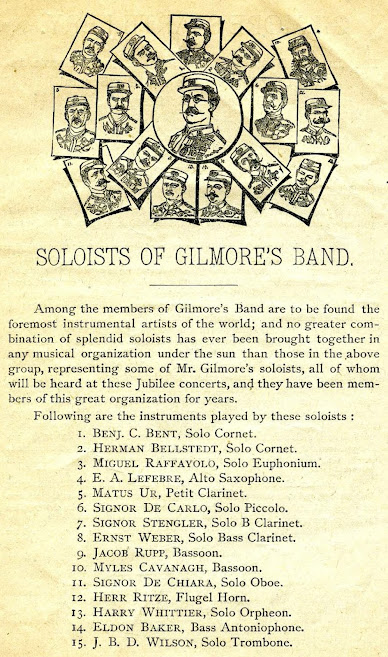
Later that year, while Gilmore's Band was touring the country, we learn that Eldon remained one of Gilmore's favorite soloists. Here's a page from the program created for the concerts in Portland, Oregon on November 4 and 5, 1889 (see number 14 below):


And here is yet another image of Eldon with Gilmore's Band that year (this time in St. Louis, a few months earlier; he is directly behind Gilmore's music stand, holding his bass Antoniophone):


A roster for Gilmore's Band from 1890 lists Eldon as having been in the band for three years by that point (so starting in either 1887 or 1888), and continues to connect him with the bass Antioniophone. Two years later, in 1892, Gilmore formed a band of one hundred, which he dubbed "The Greatest Band in the World," and Eldon was part of it.
Gilmore suddenly died while that massive band was at the St. Louis Exposition that fall, but when D. W. Reeves was elected Gilmore's successor, Eldon remained on the roster (number 89 below):


John Philip Sousa launched his new band just two days after Gilmore died, and eventually seventeen members of Gilmore's Band decided to join Sousa in the new venture (four joined prior to Gilmore's death, and thirteen after).

Eldon was one of those who left for Sousa after Gilmore's death, but apparently not until the Spring tour of 1893. Earlier that year, we find him playing tuba in a special New York orchestra of "Seventy Crack Musicians" that had just been formed (as reported in the February 25, 1893 edition of Brookyn's Standard Union):


But by April, Eldon is listed as one of Gilmore's former players who was now on tour with Sousa. This is from the April 23, 1893 edition of the Buffalo Sunday Morning News, where he is considered one of the "magnificent performers" on the tuba, along with Herman Conrad:


However, it appears that Eldon played with Sousa for just that year (there is no record of him in that band for any following year). But at some point he ended up in Frederick Innes' band, as noted in the July 18, 1895 edition of Canton, Ohio's Stark County Democrat:


After leaving Innes' band in a huff (as noted above!), it seems that he rejoined Gilmore's Band, which was now under the direction of Victor Herbert. Eldon was one of many former members of that band who had been active when Gilmore was still leading it, as reported in the September 26, 1896 edition of the Philadelphia Times:


It appears that Eldon remained with Gilmore's Band, under Herbert, until 1900, at which point he joined Phinney's United States Band, as reported in the September 8, 1902 edition of the St. Alban's Daily Messenger:


Here is a photo of that band from 1901, while they were at the Pan-American Exposition in Buffalo. Eldon is presumably in the photo, but I can't quite make him out:


The last reference I have found (so far!) to Eldon playing in a band or orchestra is from the January 6, 1911 edition of the Hastings Daily Republican. At that point, at age 50, he was playing with an orchestra that supported the travelling troupe that performed a revival of the Broadway musical, The Prince of Pilsen:


Where and when he may have played after 1911, and prior to his death in 1935, has yet to be discovered. But if I learn more, I'll add it to this post. 

However, it is quite clear from the evidence above that Eldon Baker was one of the truly great bass players, and perhaps one of the most celebrated bass soloists, of the late 19th and early 20th centuries, playing with some of the greatest bands of that era.

I would have loved to have heard him play!


UPDATE: While I haven't yet found an obituary, I did find this from the November 8, 1953 edition of the Vermont Sunday News, 18 years after Eldon's passing:


Wednesday, August 25, 2021

Wait, Patrick Stephen Gilmore? Yes!

I just ran across this when researching the sudden death of the legendary bandmaster typically known as Patrick Sarsfield Gilmore (1829-1892). I ran it by a Gilmore researcher I know, and he confirmed it. Now you know!


Here he is in June 1892 with his band of one hundred at Madison Square Garden: