
Tuesday, April 16, 2019
Bohemian Sousaphone by A.K. Huttl
This popped up on my Facebook feed the other day, from an undated catalog of instruments built by A. K. Huttl of Graslitz, Bohemia. It is listed as a "helicon - new model with removable bell." I would guess it's from the very early 20th century.


Saturday, March 30, 2019
Examining the store with the big bass

According to the March 24, 1929 edition of the Boston Globe, the Carl Fischer Music House on Cooper Square in New York City had for years been known as "The store with the big bass." Sure enough, from at least 1896 (as seen above), one could behold a ridiculously large tuba in one of the establishment's street-level windows. But how and when did that monster come to occupy that perch?
As I shared in a previous post, I am currently working with Steve Dillon, of Dillon Music in NJ, to conclusively answer that question - esp. now that Steve and his team are in the process of restoring that historic tuba. Here we are with the battered beast about a month ago (Steve on the left, me on the right), shortly after the horn arrived at his shop from Harvard University, where it has lived since 1948:

We have good reason to believe that this giant tuba, which was built by F. Besson & Co. and is fully functional, was created to be part of a display at the Paris Exposition of 1889. And, two years later, there is mention of an obscenely large tuba on exhibit in New York City, leading us to wonder if it might be the same horn.
The above-mentioned Boston Globe article contends that it was the great bandmaster Patrick Gilmore who came up with the idea for the tuba, ultimately planning to feature it in his band at the Chicago World's Fair of 1893. It continues, "Collaborating with the late Carl Fischer of New York, Mr. Gilmore planned and designed a huge bass horn which was executed by the London firm of Besson & Co."
The one clear piece of evidence that connects a giant Besson tuba with Gilmore's Band in the early 1890s is this undated lithograph (courtesy of Soulis Auctions):

Gilmore worked with a band of one hundred both in 1891, for his summer series of concerts at Madison Square Garden, and again for the band's Fall 1892 tour, so this lithograph could have been used for either of those stints (although the weight of evidence, at present, suggest the former). Or it could have been publicity for the band's proposed trip to Chicago in 1893. We're just not sure yet.
Regardless, the huge tuba in the middle of the back row is a dead-ringer for the one that is currently being restored at Dillon Music (although, yes, there is a discrepancy in the engravings on the bell; we have reason to believe that the current engravings were added later):

Was this horn first at the Paris Exposition of 1889, and then it came to America to make an appearance at the Chicago World's Fair of 1893? We're trying to sort that out, so stay tuned!
What is clear enough from the evidence is that this oversized tuba ended up in the window of Carl Fischer's store in New York at some point. Even the 1929 article states that "After the World's Fair it reposed in a store window in New York for many years and soon gained for the store the title, 'The store with the big bass.' Later it came to Boston, . . ."
Below is the visual evidence behind this history that we have been able to pull together so far.
1896 (the date of the image at the top of this post)
- We get our first glimpse of a giant tuba in the window at Carl Fischer's store at 6 and 8 Fourth Avenue in 1896 (from 1880 through 1893, the store was limited to 6 Fourth Ave., but 8 was added in 1894). Here's a close up of that window (original image courtesy of Robb Stewart):

- This image is clearly an artist's rendering, and the tuba is not exactly the way it looks (esp. the placement of the lead pipe), but it's close enough that we have no doubt it is the Harvard tuba, built by Besson.
- We have some evidence to suggest that this horn was in the Carl Fischer window as early as 1891, but we have yet to find an image confirming that.
- Upon closer examination, it appears that there are four cornets or trumpets sitting upright upon the top of the bell of the tuba. The giant horn at the Paris Exposition of 1889 was described as having various instruments spurting out of the top of the bell, which is one more reason to consider that this might be the very same tuba.
- The writing on the windows identifies the instrument makers of which Carl Fischer was the sole agent, including "Besson & Co., London, Eng."
1901 (or later)
- As of 1901, Fischer added no. 10 to his building, which was the identical three-windowed, four-story section to the right of the previous sections:

- This shifted the center of the building to the right, moving over the rooftop sign, as well as the two sign panels atop the windows, which all appear the same as before, except that the Besson & Co. sign no longer says "Paris" next to "London," as it did in the image from 1896.
- Also, the sign above the street-level windows has been changed, as have those windows and the entrance doors to the store.
- The giant tuba in the center street-level windows is clearly the Harvard tuba, laid out exactly as we see it today, only now it has a small tuba, or perhaps a euphonium, upside down on the bell:

- If only we could read the information posted at the base of the horn! Does it perhaps speak of its fame at the Paris Exposition of 1889? And does it reveal how Gilmore had planned to use the tuba?
1907 (or later)
- By this year, a fourth section of the building had been added on the right (no. 12). This shifted the center of the building again to the right, and enlarged the rooftop sign to read "Carl Fischer" instead of just "C. Fischer."

- At this time the address is listed as 48-54 Cooper Square, instead of just 6-12 Fourth Avenue.
- Unfortunately, we cannot tell if the giant tuba is still in the window, but we assume that it is.
- A postcard of Cooper Square was made around this time that shows 48-54 (on the left). as well as the J. Wanamaker building (the high rise in the middle). Curiously, the Carl Fischer building now shows a fifth story, but later photos of the building (e.g. 1923 below) only show four stories. Did the artist get the number of stories wrong?

1911
- This is the year the Besson tuba (i.e., the Harvard tuba) arrived up at the Carl Fischer store in Boston:

- The Boston store opened in 1911 first at 380 Boylston, then expanding to include 382 (as shown here), and the Besson tuba migrated up there at that time - probably to help kick off the opening, but also because "Big Carl" had either just arrived at the NYC store, or would be there soon (see below).
- Here's a close-up of the Harvard tuba in that image - showing the layout of engravings on the bell that are there today:

1911-12
- In 1911 or 12 Carl Fischer had an even larger tuba built for him - this time by Bohland & Fuchs - and this new horn replaced the giant Besson tuba as the spectacle in the window.
- Here is that new horn from a German article published that year, and titled, "The New Monster Bass (Sub-Contra Bass Tuba) from Bohland & Fuchs in Graslice." Next to it, for comparison purposes, is that horn today, which is affectionately known as "Big Carl":

- That German article quoted what the New York World said about this enormous new tuba: "Biggest Horn in the World. Built abroad for advertising purposes by a well-known New York House. Its tremendous notes will never be heard, for there is not a man in existence with a mouth big enough or lungs of sufficient capacity to blow it. But that does not matter, as it was made as an advertisement for a firm of musical instruments makers that has a house on Fourth Avenue. Its height is 9 1/2 feet, its bell is 3 feet across, and its mouthpiece is 5 inches in diameter."
- It should be noted that, unlike the Harvard tuba, which is fully functional, "Big Carl" does not have working valves. It is essentially a giant bugle that looks like a tuba!
1915 (or perhaps a bit earlier)
- Somewhere around this year the building was expanded further - this time to the left - creating 46 Cooper Square, to make the entire Carl Fischer address 46-54. Here is one undated drawing of that building (which, again, shows five stories, rather than four, although that doesn't match the later photographs below):

- Once again, we are unable to tell if there is a giant tuba in the window. But here is undated photograph of the building from around that time - although note the addition of fire escapes, suggesting that it is a few years later. Now we can clearly see "Big Carl," as well as an oversized string bass, in the window:

- Here's a closer look at those instruments:

1921
- Meanwhile, back at Carl Fischer in New York, the new giant tuba, built by Bohland & Fuchs in 1912, was enjoying its view from the storefront window. This photograph appeared in the June 4, 1921 edition of The Music Trade Review:

1923
- With continued growth, Carl Fischer planned and built what one paper called a "Gigantic New Music Establishment" right next to the previous building. However, Carl passed away on February 14 that year, just a month before the twelve-story building was ready for occupancy.
- Here is that building - 56-62 Cooper Square - right when it opened in 1923. Three of the five sections of the old building are seen to its left (again, note the fire escapes):

- "Big Carl" was likely moved to the new building at this time, although we have yet to find a photo of it from the early years of that new space. But here it is - in the far right window - a few decades later:

Today
- I was surprised to discover that two of the sections of the earlier building are sill there - 52-54 Cooper Square:

- The 1923 building was converted into condominiums in 2001, after the Carl Fischer corporate headquarters moved to 65 Bleecker Street in Greenwich Village in 1999.
- In 2013, the administrative offices moved to 48 Wall Street, which is where Big Carl can be found today.
- The Harvard tuba has become so-named because it found its way to the Harvard Band room in 1948, but that's another story for another blog post!
Carl Fischer's early history - a summary:
- 1872 - The first store was established at 79 E. Fourth St.
- 1880 - The store moved to 6 Fourth Ave.
- 1885 - Publication of The Metronome began, and Carl Fischer became the exclusive agent for Besson & Co.
- 1894 - The store expanded to 6 and 8 Fourth Ave.
- 1901 - The store further expanded to 6-10 Fourth Ave.
- 1907 - Publication of the Musical Observer began.
- 1907? - The store further expanded to 6-12 Fourth Ave., but started to be referred to as 48-54 Cooper Square.
- 1911? - The store further expanded to 46-54 Cooper Square, and the Boston store opened (definitely in 1911), with the giant tuba perhaps going up there for the opening.
- 1912 - "Big Carl" was built for Carl Fischer by Bohland & Fuchs.
- 1917 - The store expanded to 44 Cooper Square, through a lease agreement.
- 1919 - 56-62 Cooper Square is purchased, with plans for a huge new building there.
- 1923 - The new, twelve-story building opened, 56-62 Cooper Square
[For my original post on the Harvard tuba, click here.]
Friday, March 22, 2019
Carl Fischer Sousaphones in 1917
I stumbled upon this advertisement in the February 1917 edition of The Metronome, published by Carl Fischer:


Sunday, March 3, 2019
There are tubas, and then there's this

I was approached by the Harvard Gazette a few weeks back, as they were looking to do a short feature on the giant Besson tuba that has been living in the Harvard Bandroom since 1948, and is currently being renovated by my good friends at Dillon Music. Click here to read the article that was just published on Friday!
For my most recent blog post on this monster, scroll down or click here.
Monday, February 18, 2019
Yeah, it's not a Sousaphone, but wow!
Steve Dillon, of Dillon Music, and I have been trying to uncover the history behind the so-called "Harvard tuba," as his shop is in the process of restoring the vintage beast that has lived in the Harvard Band room since 1948. We've still got some gaps to fill in the story, but it's coming along, so stay tuned!
This morning I had the opportunity to see this monster up-close and personal, and I have to say - no photo does it justice. The horn is truly stunning to see in real life! But here are a few shots of my encounter with this rather hefty piece of history that dates to at least 1892, and perhaps even 1889:

That's Steve on the left, and me on the right, and I'm 5 feet 8 inches in height. The tuba is well over seven feet tall! Concerning when this horn was built, check out this side-by-side comparison:
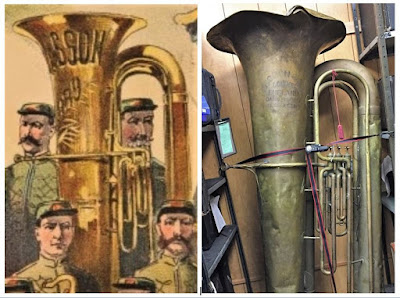
On the right is the tuba today, while on the left is what is almost certainly this exact horn, seen in a lithograph featuring Gilmore's Band of One Hundred in either 1892, or more likely 1891. But on the bell you can see a portion of the giant letters spelling "BESSON," and below that what appears to be the numbers 889 ascending from left to right. It probably reads "1889," which may very well be the year the horn was built.
The engravings on the bell are different today, but we're wondering if the lithographer added those important bits of information so that they could be seen in the poster. Or it could be that the engravings seen today (photo below) were added at a later date.

We thoroughly examined the bell, just in case there was a trace of "BESSON" and "1889" behind what is there today, but found nothing. But there was a small stamp on the back of the second valve:

Blowing that up, here's what we found:

It reads "F. Besson Bte S.G.D.G," which likely means the horn, or at least the valve section, was built in France by F. Besson. The "Bte S.G.D.G" is apparently an abbreviation for the French phrase, "Brevete sans garantie du gouvernement," meaning something like, "Patented without guarantee of the government." Not sure what to make of that yet, but such a stamp is found on many old Besson instruments.
Of course, as noted above, the bell says, "Besson & Co. London England Carl Fischer U. S. Agent New York," so we'll have to reconcile these differences. Was the horn built in France or England? Or, again, was that bell engraving added later to this French-built horn (Besson did have a London factory as well, and Carl Fischer did import Besson instruments).
So, again, stay tuned as we piece together the clues and tell the story of this amazing, oversized tuba! And I'll circle back with Steve in a couple of months when they are done restoring the horn. Until then, here's where it sits, waiting for its makeover:

For an earlier post on this monster, click here.
This morning I had the opportunity to see this monster up-close and personal, and I have to say - no photo does it justice. The horn is truly stunning to see in real life! But here are a few shots of my encounter with this rather hefty piece of history that dates to at least 1892, and perhaps even 1889:

That's Steve on the left, and me on the right, and I'm 5 feet 8 inches in height. The tuba is well over seven feet tall! Concerning when this horn was built, check out this side-by-side comparison:

On the right is the tuba today, while on the left is what is almost certainly this exact horn, seen in a lithograph featuring Gilmore's Band of One Hundred in either 1892, or more likely 1891. But on the bell you can see a portion of the giant letters spelling "BESSON," and below that what appears to be the numbers 889 ascending from left to right. It probably reads "1889," which may very well be the year the horn was built.
The engravings on the bell are different today, but we're wondering if the lithographer added those important bits of information so that they could be seen in the poster. Or it could be that the engravings seen today (photo below) were added at a later date.

We thoroughly examined the bell, just in case there was a trace of "BESSON" and "1889" behind what is there today, but found nothing. But there was a small stamp on the back of the second valve:

Blowing that up, here's what we found:

It reads "F. Besson Bte S.G.D.G," which likely means the horn, or at least the valve section, was built in France by F. Besson. The "Bte S.G.D.G" is apparently an abbreviation for the French phrase, "Brevete sans garantie du gouvernement," meaning something like, "Patented without guarantee of the government." Not sure what to make of that yet, but such a stamp is found on many old Besson instruments.
Of course, as noted above, the bell says, "Besson & Co. London England Carl Fischer U. S. Agent New York," so we'll have to reconcile these differences. Was the horn built in France or England? Or, again, was that bell engraving added later to this French-built horn (Besson did have a London factory as well, and Carl Fischer did import Besson instruments).
So, again, stay tuned as we piece together the clues and tell the story of this amazing, oversized tuba! And I'll circle back with Steve in a couple of months when they are done restoring the horn. Until then, here's where it sits, waiting for its makeover:

For an earlier post on this monster, click here.
Thursday, January 24, 2019
Did Conn make the first Sousaphone?
The answer is most definitely "No!" My research has made it clear that J. W. Pepper made the first Sousaphone in 1895. But for years just about everyone believed that C. G. Conn was responsible for the original Sousaphone. For example, check out this article in the April 9, 1934 edition of the Battle Creek Enquirer:

Where exactly did Mr. Oxley get his information? Well, from C. G. Conn, Ltd! As early as 1921, the Conn catalog said this, "The first Sousaphone Bass ever made was built in the Conn factories more than a score of years ago" (opening line in the page below):

And just today, almost one hundred years since that catalog came out, I checked the Conn-Selmer website, and they are still making this claim! Note the very last line, which says, "Conn continued on a series of 'firsts,' building . . . the first sousaphone, built to John Philip Sousa's specifications":

It is no surprise, then, to find this claim scattered across the past one hundred years. For example, here it is in the 1926 brochure on "New Wonder Basses"; note the last paragraph:


And here it is in a newspaper article on the Conn company from 1943:

And here it is in The Instrumentalist in 1949 where, once again, the Sousaphone featured is not even Conn's first:

And this particular Sousaphone persists as being viewed as the original. Here it is in a cute photo in the July 15, 1951 edition of the Chicago Tribune, with the date now a year earlier:

And again from that same year, this time in The Instrumentalist:

And here it is yet again, this time in the December 1959 edition of Popular Mechanics:

This particular Sousaphone, believed to be the very first one ever made, was eventually donated to the Interlochen Center for the Arts in 1970:

Here it is, two years later, being played at Interlochen by none other than Harvey Phillips!

And here's a Conn catalog page from the 1980s, making the same claim, that "Conn made the first Sousaphone." Except that he didn't!

Now, the truth is that Conn did make the first Sousaphone that Sousa kept in his band for years. In fact, Conn Sousaphones were used exclusively by Sousa from the time the first one was built, in 1898, until Sousa died in 1932.
Here is the notice of that very first Conn Sousaphone in the January 22, 1898 edition of the Music Trade Review:

But make no mistake about it. J. W. Pepper built the original Sousaphone almost three years earlier. Time to finally correct your website, Conn-Selmer!

.jpg)
.jpg)

Where exactly did Mr. Oxley get his information? Well, from C. G. Conn, Ltd! As early as 1921, the Conn catalog said this, "The first Sousaphone Bass ever made was built in the Conn factories more than a score of years ago" (opening line in the page below):

And just today, almost one hundred years since that catalog came out, I checked the Conn-Selmer website, and they are still making this claim! Note the very last line, which says, "Conn continued on a series of 'firsts,' building . . . the first sousaphone, built to John Philip Sousa's specifications":

It is no surprise, then, to find this claim scattered across the past one hundred years. For example, here it is in the 1926 brochure on "New Wonder Basses"; note the last paragraph:

And here it is in the 1935 Conn catalog (and the horn pictured is not even the first Conn Sousaphone!):

And here it is in a newspaper article on the Conn company from 1943:

And here it is in The Instrumentalist in 1949 where, once again, the Sousaphone featured is not even Conn's first:

And this particular Sousaphone persists as being viewed as the original. Here it is in a cute photo in the July 15, 1951 edition of the Chicago Tribune, with the date now a year earlier:

And again from that same year, this time in The Instrumentalist:

And here it is yet again, this time in the December 1959 edition of Popular Mechanics:

This particular Sousaphone, believed to be the very first one ever made, was eventually donated to the Interlochen Center for the Arts in 1970:

Here it is, two years later, being played at Interlochen by none other than Harvey Phillips!

And here's a Conn catalog page from the 1980s, making the same claim, that "Conn made the first Sousaphone." Except that he didn't!

Now, the truth is that Conn did make the first Sousaphone that Sousa kept in his band for years. In fact, Conn Sousaphones were used exclusively by Sousa from the time the first one was built, in 1898, until Sousa died in 1932.
Here is the notice of that very first Conn Sousaphone in the January 22, 1898 edition of the Music Trade Review:

But make no mistake about it. J. W. Pepper built the original Sousaphone almost three years earlier. Time to finally correct your website, Conn-Selmer!
UPDATE: August 13, 2023 - I hadn't checked in a while, but it looks like the main Conn-Selmer website no longer talks about the history of C. G. Conn, and therefore there is no mention (finally!) of "building . . . the first Sousaphone." However, the European site for Conn-Selmer still says that. We're halfway to finally eliminating this over-a-century-long false claim!
UPDATE: February 17, 2024 - I recently stumbled upon what is now the earliest reference to Conn supposedly inventing the Sousaphone. It goes way back to 1907, in the January 3 edition of the Mountain Home [Idaho] Maverick newspaper:

.jpg)
The column also lists the entire roster of the 1907 Maverick Home Band, so I thought I would give them their due! J. H. Garrett, "with a physique adapted to gracefully carry it" (as it says above!), was the one playing that very early C. G. Conn Sousaphone:
.jpg)
Tuesday, January 22, 2019
Conrad sighting on the train in 1899!
I'm pretty selective with whose feed I see on facebook, focusing primarily on family members and people or organizations that are related to my research. I have a lot of "friends," but only follow a few, just to keep life a bit more simple!
Today, Loras Schissel, who works with the Library of Congress, posted a photo on facebook of a few Sousa Band members playing cards on the train during a tour in 1899. The moment I saw it, I thought, "My goodness, that guy on the left looks like Herman Conrad!" Loras thought so as well. The monster handlebar mustache was one clue, but the face looks right as well.
Here is the world's first Sousaphonist in all of his card-playing glory! I wonder what they were playing, and did the other guy just realize that he won?!

Today, Loras Schissel, who works with the Library of Congress, posted a photo on facebook of a few Sousa Band members playing cards on the train during a tour in 1899. The moment I saw it, I thought, "My goodness, that guy on the left looks like Herman Conrad!" Loras thought so as well. The monster handlebar mustache was one clue, but the face looks right as well.
Here is the world's first Sousaphonist in all of his card-playing glory! I wonder what they were playing, and did the other guy just realize that he won?!

Sunday, January 20, 2019
Did it end up in the Ringgold Band?
One of the more curious things about the original Sousaphone, built by J. W. Pepper in 1895, is that it seems to have disappeared after being featured in the early 1896 tour of Sousa's Band. And by early 1898, Conn's first Sousaphone is being used by Sousa, instead of the Pepper horn.
So where did the original Sousaphone end up?
Having examined Pepper's horn up-close, it clearly has a lot of miles on it, but where was it played after it left Sousa's Band? Well, a possible answer appeared in the January 16, 1937 edition of the Philadelphia Inquirer, where the topic was . . .

First of all, note that the author, J. S. Willing, confidently affirms that the original Sousaphone was "manufactured here in Philadelphia," rather than in Elkhart, Indiana. He's right, of course, but I wonder how he knew that? For years, even at this point (1937), Conn had claimed to build the very first one, and that seems to be what everyone believed.
Second, I've contacted the folks at the Ringgold Band to see if they have any record of that historic horn being used in their band way back then. But, so far, they have not been able to find anything.
After searching a bit myself, I did find a few photos of the band. Here's one from 1904, eight years after the Pepper horn was last seen. There is a helicon shown, but no Sousaphone:

And here's a shot from around 1911, or about seven years later. Now there are two monster helicon basses dominating the back row, but still no sign of a Sousaphone:

Of course, the article mentions the original Sousaphone being in the Ringgold Band around 1937, so perhaps it was added to that historic ensemble closer to that time. We just don't know - yet!
However, it should be noted that John Bailey, the man who re-discovered the Pepper Sousaphone back in 1973, and sold it to the Pepper Co. in 1991, is still active in the Ringgold band! Interesting, huh?! And he found the long lost horn 45 years ago at Renninger's Flea Market in Adamstown, PA - not too far from where the Ringgold Band is based.
Very curious indeed!
So where did the original Sousaphone end up?
Having examined Pepper's horn up-close, it clearly has a lot of miles on it, but where was it played after it left Sousa's Band? Well, a possible answer appeared in the January 16, 1937 edition of the Philadelphia Inquirer, where the topic was . . .

First of all, note that the author, J. S. Willing, confidently affirms that the original Sousaphone was "manufactured here in Philadelphia," rather than in Elkhart, Indiana. He's right, of course, but I wonder how he knew that? For years, even at this point (1937), Conn had claimed to build the very first one, and that seems to be what everyone believed.
Second, I've contacted the folks at the Ringgold Band to see if they have any record of that historic horn being used in their band way back then. But, so far, they have not been able to find anything.
After searching a bit myself, I did find a few photos of the band. Here's one from 1904, eight years after the Pepper horn was last seen. There is a helicon shown, but no Sousaphone:

And here's a shot from around 1911, or about seven years later. Now there are two monster helicon basses dominating the back row, but still no sign of a Sousaphone:

Of course, the article mentions the original Sousaphone being in the Ringgold Band around 1937, so perhaps it was added to that historic ensemble closer to that time. We just don't know - yet!
However, it should be noted that John Bailey, the man who re-discovered the Pepper Sousaphone back in 1973, and sold it to the Pepper Co. in 1991, is still active in the Ringgold band! Interesting, huh?! And he found the long lost horn 45 years ago at Renninger's Flea Market in Adamstown, PA - not too far from where the Ringgold Band is based.
Very curious indeed!
Saturday, January 19, 2019
Who remembered Conrad in 1945?
I came across this random newspaper clip the other day, from the February 14, 1945 edition of The Missoulian - almost 25 years after Herman Conrad died. Note the last question:

I'm encouraged to know that the person who wrote this clearly remembered Conrad, who was an immigrant from West Prussia, all those years later. Although, technically, he was not "first Sousaphone" with Sousa; Conrad played the one and only Sousaphone featured in that great band during the time he was in it (1893-1903). The other basses during that decade were all standard tubas.
And, hey, since this clip came out on Valentine's Day 1945, I'll go ahead and post this doctored up photo of Conrad from a few years ago!:


I'm encouraged to know that the person who wrote this clearly remembered Conrad, who was an immigrant from West Prussia, all those years later. Although, technically, he was not "first Sousaphone" with Sousa; Conrad played the one and only Sousaphone featured in that great band during the time he was in it (1893-1903). The other basses during that decade were all standard tubas.
And, hey, since this clip came out on Valentine's Day 1945, I'll go ahead and post this doctored up photo of Conrad from a few years ago!:

Subscribe to:
Posts (Atom)