Monday, July 22, 2024

More early references to the big horn

 As more newspapers are added to newspapers.com, I am finding more early references to the Sousaphone. Here is one, in the June 4, 1896 edition of a Canadian newspaper, mentioning the original Sousaphone, built by J. W. Pepper in 1895, while it was on tour with Sousa's Band in 1896:


And here is mention of C. G. Conn's first Sousaphone, in the December 18, 1898 edition of the Pittsburgh Post:


Finally, here is a drawing of Herman Conrad with Conn's first Sousaphone in 1901, featured in the Sydney, Australia newspaper, The Sunday Times, with a brief note in the accompanying article suggesting that Sousa was already planning to take his band to Australia in the near future (that trip didn't happen until 10 years later):


Saturday, May 18, 2024

An Accessible Version On YouTube!

While I have researched and written extensively on the history of the Sousaphone, most often in The ITEA Journal, I thought it might be nice to get a simple, visually interesting summary of the story behind the original Sousaphone out to the general public - just in case you're interested. Enjoy!


Monday, February 12, 2024

Sousaphones shine at the Super Bowl!


While Ludacris and Usher were doing their thing at the Super Bowl halftime show last night, I was delighted to see them briefly upstaged by, of all things, Sousaphones!

The bass players hoisting these silver-plated monsters were members of the Jackson State University Marching Band, known as "The Sonic Boom of the South," and they were having the time of their lives, adding a distinctively college football vibe to the whole halftime spectacle.

Here are a few more photos, showing that there were at least eight in the section, along with other band members, of course, and they appeared to be playing Conn 20Ks (if you look closely, you can just make out the short action valves).


Here's a closer look at the horn itself, which has been reinforced with a few more braces than you normally see on a Conn 20K. I would imagine these guys give these beasts a workout every time they play - sonic boom, indeed!


Friday, January 26, 2024

Chris-Kratt/A. K. Huttl Sousaphone


This past Tuesday we had our quarterly staff training day, called "LCBC U," where, at lunchtime, we decided to have a little fun by hosting a "Hidden Talent Show." The planning team knows that I am a tuba player and Sousaphone historian, so they pretty much demanded that I play my Sousaphone in the show! While the introvert in me hesitated briefly, it was ultimately an easy yes. Here's the back story . . .

When I joined the LCBC staff eleven years ago, I learned that the Lead Worship Pastor, Matt Goss, was also a tuba player, and a serious one at that (he's on the left above, and that's me on the right)! He had studied jazz tuba at Berklee College of Music in Boston. Ever since discovering our mutual love for the tuba, we have kicked around the idea of doing something, just for fun, to play together there at the church. Now, after all these years, we finally had the perfect opportunity!

I grabbed one of John Sass's cool bass lines ("Soul of Song"), and pulled in Jeff Culp, an accomplished drummer (and also a Berklee grad) who oversees music production at the church, and we put together this short Sousaphone feature:


The staff had no idea it was coming (we were introduced as a heavy metal band!), but it was great fun!

I played my son's 1925 Pan American 64K (basically a Conn 14K), and Matt played his grandfather's Chris-Kratt/Huttl Sousaphone - an importer and maker about which I knew almost nothing. Here's more about that apparently rare horn, starting with some photos of it:


The bell engraving, in case you can't make everything out, says this:

Chris-Kratt
INSTRUMENT CO. INC.
HUTTL
BAIERSDORF
UNION N. J.
MADE IN
WEST GERMANY

From what I've been able to piece together from some quick online research, Christian Kratt (1899-1982) was born in Trossingen, Germany and emigrated to New York in 1926 as a clerk. By 1934 he was a musical instrument importer living in Brooklyn and by 1940 was located in Union, NJ, running his own importing business. He lived there until his death (census & immigration records).

In 1877, Anton Konrad Huttl founded his instrument company in Graslitz, Austria/Bohemia (now Kraslice, Czech Republic), and in 1954 the company moved to Baiersdorf, West Germany. This is exactly what we see on the bell, which means that Matt's Sousaphone was built no earlier than 1954. Huttl Band Instruments went out of business in 1979, so, in theory, the horn could have been made anytime between 1954 and 1979.

However, given the very low serial number of "27" on the second valve casing (seen above, assuming that is a serial number), it suggests that it is one of the first Chris-Kratt instruments to come out of the Huttl factory in Baiersdorf. So, perhaps 1954 is a safe bet for dating Matt's Sousaphone.

Regardless, it was cool both to play with Matt (and Jeff), and to become better acquainted with a lesser known Sousaphone maker and importer from years ago!

Saturday, January 13, 2024

Jack Richardson's last personal tuba

For quite a few months now, I have been researching John W. "Jack" Richardson (1874-1939), who was the longest tenured tubist in John Philip Sousa's band, joining that world-class ensemble in 1904 (or possibly late 1903), and playing with it for a combined 22 years. During that period, Jack was likely the most recognizable bass player on the planet, being 6 feet 6 inches tall and anchoring Sousa's bass section on the massive upright bell Sousaphone that Sousa himself designed years earlier.

Here is Jack with Sousa's Band in St. Louis in 1904:

Shortly after the death of Sousa in 1932, Jack retired to Steelton, PA, near Harrisburg, where he opened his own cigar store, returning to what may very well have been his first love. His earliest known work as a young man growing up in Lancaster County, PA, was hand rolling cigars in Rothsville, near his hometown of Akron. He was then recruited by a cigar maker up in Newark, NY, both to work in his cigar factory, but also to play in the company band. It was at that time that Jack decided to make music his career - and the rest, as they say, is history.

Over the years, it appears that Jack owned a number of different bass horns. While he initially played a BBb helicon built by the Boston Musical Instrument Co., he eventually owned his own C. G. Conn New Invention Sousaphone, even though Sousa supplied him with a huge 4-valve Conn Sousaphone, built in 1905 it seems, to play when touring with that band.

But somewhere along the line - perhaps much later in life - Jack ended up with a small BBb concert tuba built by Rudolf Sander of Kaiserslautern, Germany. The reason I know this is that I was able to track down Jack's great nephew, Jim Richardson, who was not only aware of his famous tuba-playing great uncle, but also had in his possession Jack's Sander tuba, along with his personal mouthpiece - a gold-plated Frank Holton 51, with an unusually thin rim, and stamped "J. R." on the side, that polished up quite nicely!

When I was finally able to get together with Jack's great nephew, sharing with him everything I had been learning about Jack, he brought both the horn and the mouthpiece with him and graciously gave them to me, both for research-purposes and to eventually find a proper home for these historic items.

With these treasures in hand, my next move was to bring them out to Steve Dillon, of Dillon Music, NJ, and his famous "tuba-whisperer," Matt Walters. I was eager to get their insight on them, as well as to see what it might take to get the tuba back to reasonable playing shape - if that was even possible. I made that familiar pilgrimage yesterday (Steve, Matt and I have worked on a number of historical projects over the years)!

Here is a photo record of my visit, where Matt, and his new apprentice, Ryan, were indeed able to get the valves working again, which was the biggest issue - as well as remove the worst of the dents:


It ended up being a bigger challenge than any of us expected, but that is often how working on vintage horns goes, as Matt reminded me! And while the rotary valve rigging, with its outdated string-pulling design (which caused considerable grief for poor Matt!) would need to be upgraded in order for this little horn to be a great player, it still sounds pretty good for such an old tuba.

SIDE NOTE: Just how old the tuba is is not clear, as there is no serial number to be found on it, and we simply don't know for sure whether Jack bought it new or used. But given that he passed in 1939, it obviously was built before then, and perhaps well before then, given that Sander started making tubas in the 1890s, it seems. Here's the simple stamp on the bell:


This was not the first time Matt has worked on an old Sander tuba (he even has an old photo above his desk showing Gus Helleberg and his two sons with their Sander tubas way back when), but he did point out a strange find about this particular horn when he pulled out the old rotary valves:

"Do you know if Jack was a smoker?" he asked me. I then told him about how Jack was quite the cigar guy, and Matt then explained that there was a lot of tar, or some sort of what appeared to be tobacco residue, in the valves! Yep, that makes sense!

Finally, here is Ryan giving this historic Sander tuba its first test drive!


Next up is seeing if I can polish up what's left of the silver plating. Stay tuned for an "after" photo when that is done!

UPDATE: February 17, 2024 - with a snow day today, I tackled the polishing of this little treasure. Here is a before and after shot:


Now, if only TubaChristmas wasn't so far away! I'd love to take this horn out for a spin!

Thursday, November 30, 2023

To be published this coming March!


In a rare detour into research and writing that is not explicitly about the history of the tuba, I was asked, gosh, almost three years ago now, if I would contribute to an academic book on American band history as a way to honor two senior musicologists, Raoul Camus and Frank Cipolla.

As luck would have it, I had recently been exploring the transition time between P. S. Gilmore and his famous band and the launch of John Philip Sousa's new civilian band, and felt there was a story there (side note: the first Sousaphonist, Herman Conrad, played in both bands). I now had a reason to really dig into that research! Bryan Proksch, the editor who reached out to me, loved the idea, and he brought me on board - even though I was not a professor or the type of scholar who normally contributes to such a work as this. I was honored.

My chapter is titled, "From Gilmore to Sousa: How One Legendary Bandmaster Gave Rise to Another." While it is not my favorite bit of writing (the constraints of academic writing take most of the fun out of telling a story!), it is, in many ways, groundbreaking research that provides a great deal of insight into a pivotal moment in American band history.

Click here if you would like to know more about the book, which is scheduled to be published in March 2024 (yes, it has been a looooong process!). While the hardcover will cost you an arm-and-a-leg (as academic books tend to do), the ebook is far more reasonable. Enjoy!

Friday, November 17, 2023

From cigars to Sousa and back again

 
John W. "Jack" Richardson (1874-1939) started working as a cigar maker in Rothsville, Pennsylvania, by at least the age of 19 or 20. Many small cigar factories were spread throughout Lancaster County in those days, so it is not surprising to discover that his first line of work was hand rolling cigars.

At the same time, Richardson started playing Eb bass in the Rothsville Cornet Band, followed by the Lititz Military Band, a few miles down the road, which was formed in late 1895, mostly of Rothsville Band members. Here's that band shortly after the time that Richardson played in it:

Two years later, in 1897, we find Richardson in Newark, New York (note, not New Jersey), working for George Croucher in his cigar factory, and playing in his newly formed "Cigar-Makers Band," officially named the Newark Band (see the photo at the top of this post, where Jack is in the middle of the back row holding a BBb helicon bass). It was while he was playing in this band that he chose to make music his career, and, apparently, picked up the nickname, "Big John" (Richardson was 6 feet 6 inches tall, or thereabouts, as you can see from the photo above!).

In the 1978 history of that region of New York, Annals of Arcadia, by Cecilia Jackson, we read the following:

Cigars in those early days were five cents and only a few reached the high price of ten cents. All were hand made. ... Newton Burrud and George W. Croucher were partners in one of the earliest of the cigar companies. They employed 20 men who were of Pennsylvania Dutch extraction, according to William Croucher, son of George Croucher. These men were all musicians and formed one of the first bands in town.
She then adds this:
Our present day band concerts were a direct result of the early band formed by those cigar makers. In those days the concerts were held from a band wagon at the four corners on Saturday nights. The cigar makers were musicians and three of them went on to play for Sousa, according to William Croucher. They were John Richardson, Arthur Bryer and Walt Shafer.
While there is no record of an Arthur Bryer ever playing with Sousa, Walt Sheaffer is said to have played Bb Clarinet on Sousa's 1911 world tour. But Richardson was with Sousa for twenty-two combined years (1904-1910, 1912-1917, 1923-1931). He was recruited by Sousa after obtaining much-needed professional experience with the 65th Regiment Band of Buffalo, New York (1900-1901), which performed at the Pan-American Exposition, and T. P. Brooke's Chicago Marine Band (1902-1903).

But for the purposes of this post, I simply want to note that when Sousa passed away in early 1932, which understandably led to Sousa's band disbanding, Richardson chose to retire to Steelton, Pennsylvania, the home town of his youngest brother, James Thomas Richardson, and return to his first love, so to speak. He purchased a cigar store there. Here's what I've learned about that . . .


"Jack Richardson's Cigar Store" opened at 2 South Front Street on August 19, 1933, directly across from the stately Peoples Bank (built in 1920). It was a prime location, at the corner of Front and Locust. Richardson had purchased the store from the estate of Robert H. Fairlamb, who had died suddenly of a heart attack, at age 45, about a month earlier.

Robert H. had come to own the store when his father, Robert V. Fairlamb, suddenly died in 1921, at the age of 61. The obituary for the latter reveals that he had been in the tobacco business (and other interests) in Harrisburg and Steelton for the previous 35 years. Prior to that, he had worked at the Steelton Post Office for a time, which, interestingly, was in the very same space that became Jack's Cigar Store in 1933. Here's a photo, reportedly from 1871 (the corner unit on the right):


While the elder Fairlamb had maintained a cigar store for years in Steelton on Market Street, by 1902, if not a bit earlier, he had another cigar shop at 1 South Front Street, directly across from where the post office was (or had been). Here's an old postcard, created by Fairlamb, showing his shop at that location (note the brown sign on the right, at the corner, hanging over the sidewalk on a horizontal pole, that says "Cigars"):


When the plan for building the Peoples Bank was settled, Fairlamb moved his cigar store directly across the street, to 2 South Front St. (again, the old post office space), as noted in the August 1, 1919 edition of the Harrisburg Telegraph:


Fourteen years later, in 1933, shortly after the death of Fairlamb's son, Richardson purchased the shop and slapped his well-known name on it:


I don't smoke, but if I was alive at that time, I would definitely have made a pilgrimage to that cigar store to talk to the owner and get him sharing stories about his time with Sousa!

As it turned out, barely five years later, Richardson was in the hospital, reportedly related to his struggles with arthritis (but bone cancer may have been an issue as well), and he never went home again. Entering the Geisinger Memorial Hospital in Danville, PA, on May 5, 1938, he was eventually transferred to the Keystone Hospital in Harrisburg, where he passed on August 12, 1939.

I wonder if he enjoyed one last smoke of a 5-cent hand-rolled cigar?

Oh, and that building, where Jack had his cigar shop for those handful of years, remains standing today. It currently houses a skateshop, according to Google maps!


*            *            *

One last bit of trivia to include here, having to do with Fairlamb the elder, as it adds some color to his career back in those early days of the twentieth century. This is from the January 16, 1902 edition of the Harrisburg Daily Independent:


Monday, November 13, 2023

My latest article on the Sousaphone


Here is the title page for my article in the Fall 2023 edition of the ITEA Journal, which will be coming out shortly (I just received the final proof).

As I've meandered along in my research on the Sousaphone over these past 11 years, I've had it in the back of my mind to write the definitive history of that unique instrument in the context of the band led by the one who dreamed up the horn - John Philip Sousa. But, as typically happens with me, I get happily sidetracked by other projects, and pour myself into those.

Finally, however, while occasionally assisting Douglas Yeo this past year with his research on John Kuhn, who briefly played Sousaphone in Sousa's Band, my motivation to pursue this topic was re-awakened, and I gladly jumped back into the research. The result is this article, of which I am very pleased!

But don't miss Doug's fabulous article on Kuhn in the Winter edition of the ITEA Journal. I only briefly touch on Kuhn in my article, but Doug, in his characteristically thorough fashion, tells the whole story of this amazing musician. I hope to do something similar for Jack Richardson and Herman Conrad in the near future - unless I get distracted again, which I probably will!

Saturday, October 28, 2023

Original Sousaphone Sighting, 1902!

The Iroquois Band of Lancaster, PA, in 1902

As often happens, while rummaging through historical archives the other day to try to find one specific thing, I stumbled upon something significant that I wasn't even looking for! Let me explain . . .

I'm neck-deep in researching John Philip Sousa's longest tenured tubist, John W. "Jack" Richardson (1874-1939), and because he was born and raised in Lancaster County, Pennsylvania, I've been learning about the band scene in that region during his lifetime. One of those bands, formed in late 1888, was the Iroquois Cornet Band, or simply the Iroquois Band.

Here's the notice of its formation in the August 29, 1888 edition of the Lancaster Daily Intelligencer:

Within a few weeks, their snappy new blue uniforms had been ordered, as noted in the September 12, 1888 edition of Lancaster's Daily New Era:


This local band proved to be quite successful over many years, and various images of it can be found in the archives at Lancaster History. But what caught my eye was the photo at the top of this post, from 1902. That raincatcher Sousaphone in the front row, with its upright bell pitched forward, looked very familiar to me!

Well, sure enough, when I compared it to photos I have of the original Sousaphone, built by J. W. Pepper in 1895, it's a dead-ringer! Make particular note of the valve cluster and lead pipe:

Given that Pepper only ever made that one Sousaphone, it is virtually certain that the instrument used in the Iroquois Band in 1902 is indeed that original one-of-a-kind treasure! And this begins to fill in one of the most curious gaps in that historic horn's history.

After being played by Herman Conrad on the 1896 cross-country tour of Sousa's Band, the instrument seems to have quietly disappeared. From that point on, it is never seen in that famous band again, and by the beginning of 1898, the Sousaphone that does appear is C. G. Conn's first.

So, where did the world's first Sousaphone go after 1896? Until now, I had no evidence to put forth a definitive answer.

However, having examined and played this horn myself, it clearly has a lot of miles on it, so I knew it had been played somewhere - probably for years. And now we can say with almost absolute certainty that, for a time at least, it was played in the Iroquois Band of Lancaster! And it most likely remained in that area for the rest of its active life, until it was discovered in 1973 at Renninger's Flea Market in Lancaster County - a story I have told earlier in this blog.

Here's to hoping that another sighting of this historic horn will show up in my research!
 

Sunday, September 3, 2023

Bands at the World's Fair in Buffalo


As I continue to research John W. "Jack" Richardson, who ended up playing Sousaphone for a combined 22 years in John Philip Sousa's famous band, I'm learning more about his earliest years as a professional musician. In 1900, he moved from Newark, NJ, to Buffalo, NY, where he played with various groups, including the 65th Regiment Band (shown above - and that may be Richardson with the helicon bass directly behind John Powell, the band leader).

In 1901, from May 1 to November 2, Buffalo hosted the Pan-American Exposition, and many of the best bands in the country were featured for this World's Fair, including this hometown ensemble. But the headliners were Brooke, Innes, and especially Sousa, who had just toured Europe for the first time the previous year. Shortly after the Exposition, Richardson was recruited by Brooke to play in his Chicago Marine Band, and two years later, after the tubist had returned to Buffalo, Sousa plucked him up to fill the band's iconic Sousaphone post that had recently been vacated by Herman Conrad.

I have a sneaking suspicion that both Brooke and Sousa heard about, or perhaps literally heard, Richardson performing with the 65th Regiment Band at the Exposition, leading them to entice this outstanding bass player to join their bands when they needed a top player.

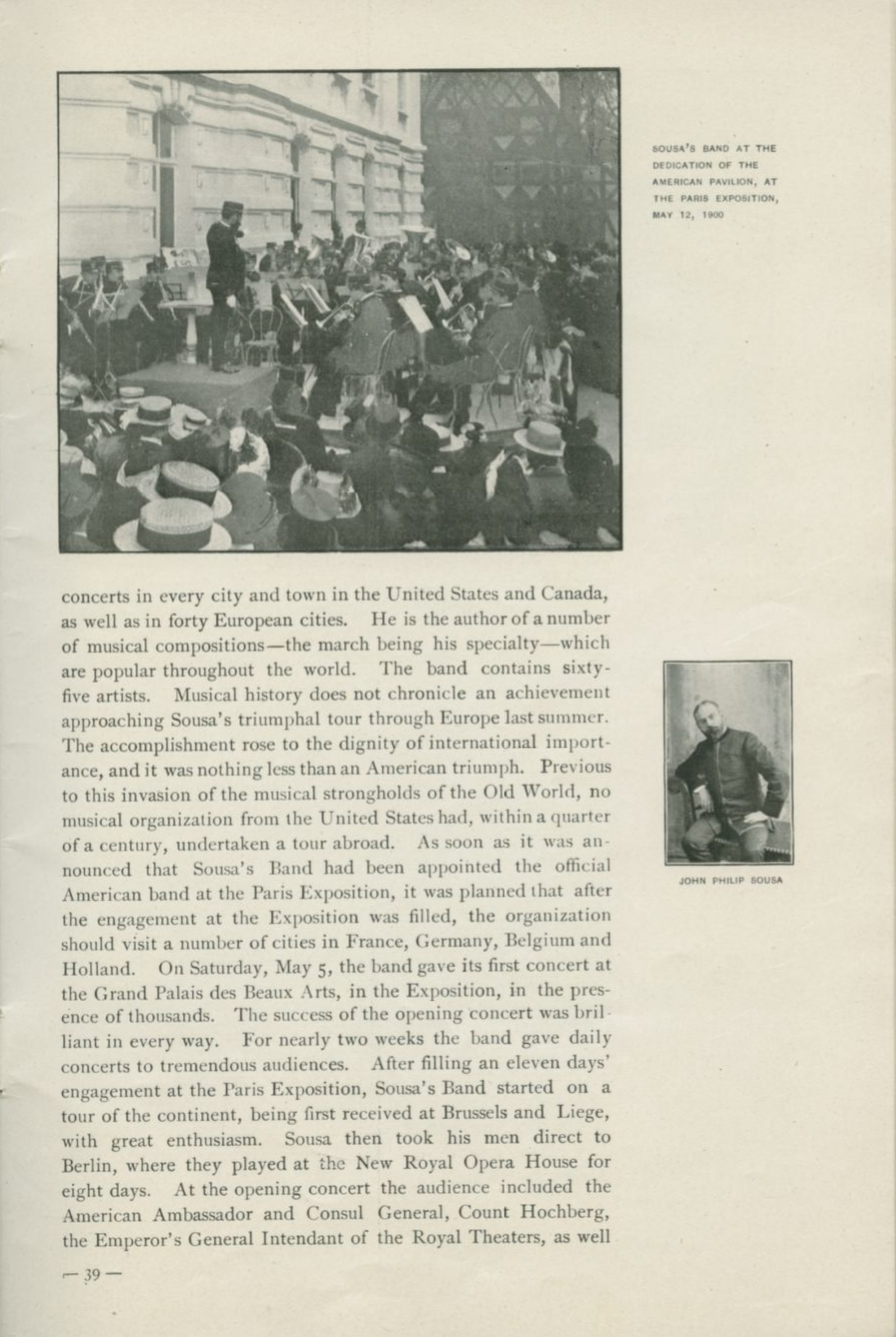
Here are the relevant pages from a little booklet published in 1901 to help people get excited about the great music they would hear if they made their way to the Exposition (images courtesy of the Theodore Roosevelt Inaugural Site Foundation):