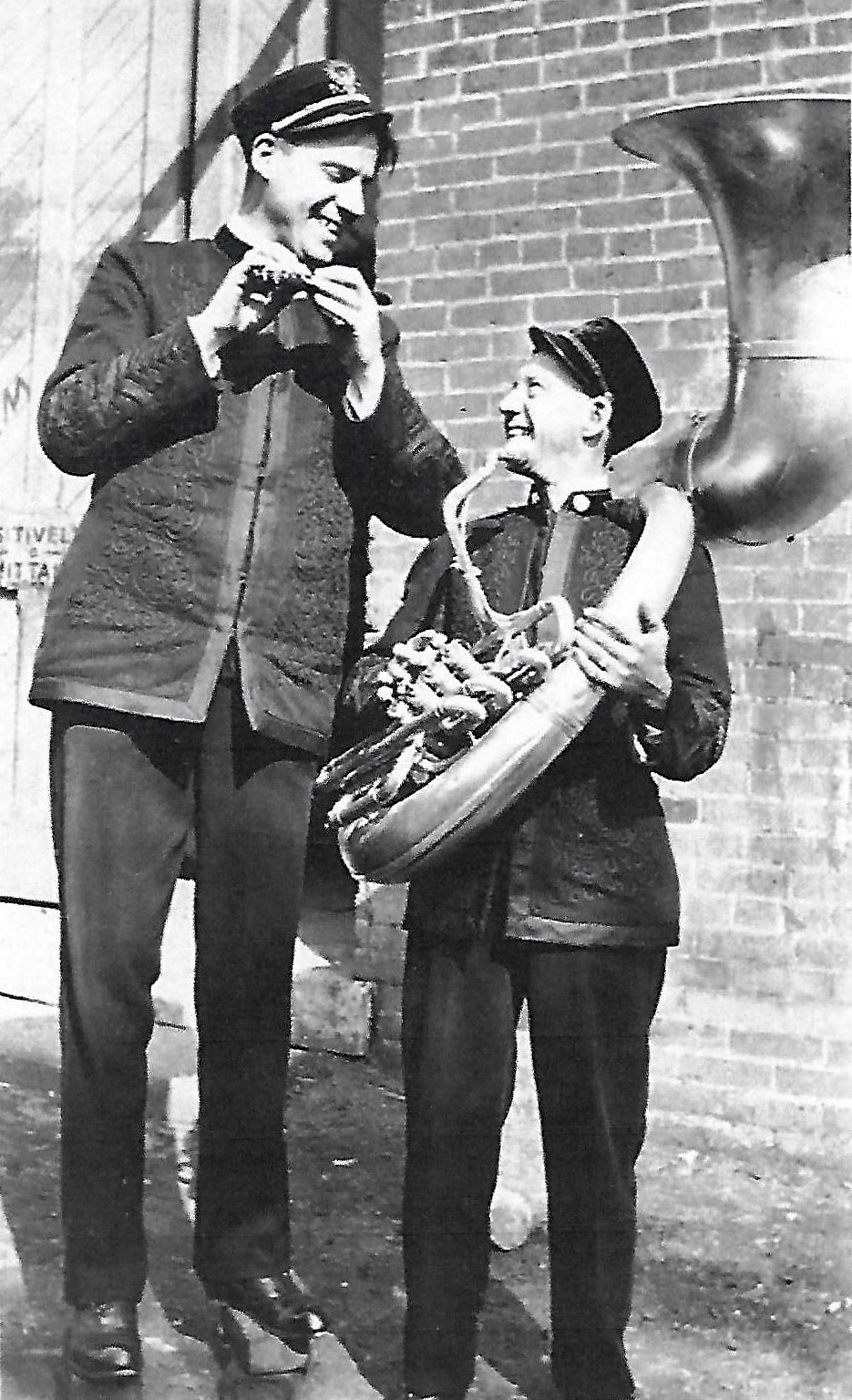
As this blog has made abundantly clear, the Sousaphone was created, at the request of the great bandmaster John Philip Sousa, by J. W. Pepper in 1895. But who all played this modified helicon bass over the years in Sousa's Peerless Band - and how many Sousaphones where featured?
I've gone through my Sousa research files and cross-checked all of the relevant data in Paul Bierley's magisterial book,
The Incredible Band of John Philip Sousa, and here's what I've found, organized around eight Sousaphone milestones:
Milestone #1 - Sousa tolerates the helicon
When Herman Conrad joined Sousa's new band in early 1893, he brought with him the monster helicon bass that he had played in Gilmore's Band the previous five years (1888-1892). You can see it in the upper right corner of this 1893 photo of Sousa's Band in St. Louis:
However, Sousa was not a fan of the helicon bass. As he put it, years later, in an obscure newspaper article in 1922:
It was all right enough for street-parade work, but its tone was apt to shoot ahead too prominently and explosively to suit me for concert performances, so I spoke to Mr. Pepper relative to constructing a bass instrument in which the bell would turn upwards and be adjustable for concert purposes. He built one, and grateful to me for the suggestion, called it a Sousaphone.
As it turned out, after the suggestion was made by Sousa in 1892, Pepper took a few years to tinker with the idea before coming up with the solution in 1895.
Milestone #2 - Pepper modifies the monster
The earliest - and only - known photo of this brand-new instrument, showing it with Sousa's Band, is from the Spring tour of 1896, while performing in Salt Lake City, UT:
Granted, the photo is quite fuzzy (hey, it was taken from the other end of the Mormon Tabernacle!), but you can still make out that first Sousaphone, with its huge upright bell, directly above the heads of the first clarinet row.
Milestone #3 - Conn creates his own version(s)
A few years later, for reasons that we can only offer as educated guesses (just not now), C. G. Conn created his own version of the Sousaphone, adding a fourth valve. Conrad is seen with this horn in 1898 in St. Louis:
Conn continued to modify his Sousaphone design, creating a second version that Conrad is seen with in Hamburg, Germany, on the band's first European tour in 1900:
But Conn still wasn't done playing with the design. Here is Conrad with a third version of his Sousaphone in London in 1903:
While Conn had already started building smaller, three-valve Sousaphones by this time, and Sousa would eventually include them as well, this monster four-valve version remained in the band until the end (1931), as we shall see.
Milestone #4 - One giant succeeds another
In 1903, after eight years of being the world's most famous Sousaphonist (and the only one to play this unique horn in Sousa's Band), Conrad parted with Sousa in order to play with Arthur Pryor's new band, and to work as one of the founding members of the Victor Orchestra, which provided music for hundreds of recordings for the Victor Talking Machine Co.
Conrad, if you weren't already aware, was somewhere between 6' 4" and 6' 8" tall (reports vary; but the average height for a man in those days was apparently only 5' 6"). His replacement in Sousa's Band was John W. Richardson, known as Jack, who fit the mold perfectly at somewhere between 6' 4" and 6' 6" (again, reports vary)! Here he is in 1905, at Willow Grove Park, PA:
And here he is in 1907, at the Corn Palace, in Mitchell, SD:
Richardson played the Sousaphone with Sousa for the following eight years (1903-1910). But, for some reason, he opted not to fill that attractive post on the world tour of 1911. Taking his place was Arthur L. Griswold, playfully referred to as "Shorty," due to being
only 6' 2" tall!
Milestone #5 - "Shorty" travels the world
Here is Griswold when the band was in Johannesburg, South Africa in the Spring of 1911:
Shorty's time with the Sousa Band turned out to be, well, short! By 1912, following the world tour, Richardson was back at his post as the sole Sousaphonist in Sousa's Band. But then, three years later, Sousa decided to give his beloved giant a partner.
Milestone #6 - A second Sousaphone is added
I have yet to discover what prompted Sousa to add a second horn, but you can see both of them below, serving as "bookends" in the back row while the band was in San Francisco for the Panama Pacific International Exposition. The photo is dated July 4, 1915.
A year later (1916), we get a little better look at these two Sousaphones. While the one on the left is almost certainly the same horn that Richardson (as well as Griswold in 1911, and perhaps Conrad in 1903) had been playing all along, the other, on the right, is a smaller, three-valve Sousaphone built by Conn:
The photo is captioned, "Sousa's Bass Section," and just like the photo above it, we see that, for the first time, there were now
six basses in the section (although it would drop down to four for the 1916-17 tour). And here's what I have pieced together, concerning the two Sousaphonists over the next six to seven years:
- For the 1915 tour: Jack Richardson and John M. Kuhn
- For the 1916-17 tour: Jack Richardson and Oscar R. Cott
- For the 1917 and 1918 tours: Jack Richardson (although perhaps not for the 1918 tour) and either Oscar Cott or John Kuhn?
At some point in 1918, Richardson left to join the Anglo-Canadian Leather Company Band in Huntsville, Ontario, Canada (there's a fascinating story there, but for another time!). For the following Sousa Band tours, the two Sousaphonists were as follows:
- For the 1919-20 tour: John Kuhn and W. V. Webster, then Henry P. Stern
- For the 1920 tour: John Kuhn and Walter Goble
- For the 1921 tour: Edward J. Burant and Daniel J. Markert, and one source suggests that a third Sousaphone was added for that tour (or even the previous tour), perhaps played by Fred E. Pfaff or Nicola Ferrara.
Here is a shot of the band from June 1919, performing in Calgary, Alberta, where it appears that the Sousaphonist right above Sousa is standing, and so perhaps being featured (I'm pretty sure it's Kuhn):
Then, for the 1921-22 tour, Sousa decided to scrap the remaining standard tuba(s) and go with all Sousaphones!
Milestone #7 - Sousaphones take over the section
The earliest clue to this revolutionary development that I have found is in the November 5, 1921 edition of the
Minneapolis Star, promoting an upcoming concert in that city:
Toward the bottom, after declaring Sousa's men to be "The Largest Band in the World - Nearly 100 of the Finest Musicians in America" (actually, only 76 by my count), the fine print above the word "AUDITORIUM" adds that there would be "6 Sousaphones" featured. Bierley, however, lists only five for that tour. And when the band was in San Francisco a month later, in late December 1921, we get a glimpse of these five players and their horns:
According to Bierley, they are, from left to right:
- Nicola Ferrara (who may have been on the previous tour)
- Daniel J. Markert (who was on the previous tour)
- Earl W. Field (new to the section)
- Donald C. Gardner (new to the section)
- William J. Bell (who may have been on the previous tour)
However, a couple of sources suggest that only three Sousaphones may have been featured for at least the early part of this tour. And yet another source mentions "four big Sousaphones" at a concert that following March. But by the 1922 tour, which began in July, there were as many as five, with Bill Bell emerging as a favorite soloist.
Here is a photo showing the bass section on what I'm pretty sure is March 5, 1922, at the NY Hippodrome. There are four Sousaphones seen clearly (all had been set on the floor, and there may be a fifth in the middle), and the second one from the left appears to be a bell-front horn, just as we see in the middle of the photo above:
A letter dated July 22, 1922, written by C. G. Conn's secretary, J. F. Boyer, to Sousa's personnel manager, Jay G. Sims, seems to shed some light on the situation:
I was very sorry that we were unable to get another Sousaphone on to you. I know that Mr. Sousa is very much put out about it, but it was utterly impossible.The one Bass returned to us as defective, is being overhauled, so we will send that one on as soon as the work is completed on same, and it will reach you at Willow Grove [in early August]. The big Bass we are building as a duplicate of the old large Sousaphone you sent us for repair, is not quite finished, but will be completed in a couple of days, and as soon as that instrument is ready, it will be forwarded also.
Why was Sousa so "put out about it"? Almost certainly because the bell-front horn that Earl Field brought with him upon joining the band in late 1921 (Conn built that instrument for Field in 1917) was not really a Sousaphone in the bandmaster's eyes.
Milestone #8 - No bell-front version allowed
While Conn designed and patented the bell-front version way back in 1908 (calling it not a Sousaphone, but the Wonderphone Helicon), Sousa wanted nothing to do with it, as it created the same problem that he had with the semi-bell-front helicon bass. I'll quote the bandmaster once more, this time from his autobiography, published in 1928:
I strove in every way to improve the quality and variety of the instruments. Way back when I was with the Marines they used a Helicon tuba wound around the body. I disliked it for concert work because the tone would shoot ahead and be too violent. I suggested to a manufacturer [I'm not sure why he doesn't name Pepper here] that we have an upright bell of large size so that the sound would diffuse over the entire band like the frosting on a cake! He designed a horn after that description and it has been in use ever since, by many bands, under the name of the Sousaphone.
Regarding the photo above, Bierley writes, "Sousa temporarily permitted the 'bell-front' sousaphone in the back row while a 'bell-up' model, like the other four, was being manufactured." This is referring to Earl Field (above), who I have discovered had been playing a bell-front Conn Sousaphone since 1917, first with Kryl's Band, and then, apparently, with the Seattle Symphony Orchestra, which he left to join Sousa in 1921!
Conn was still building bell-up horns (ending production five years later, in 1926), but the bell-front horns were far more popular at this time - just not for Sousa! So Field had to hunt down one of the older models, and fast!
Here is a similar line-up of Sousaphones, although the bell-front one appears to be a different model, and most of the players are different:
The photo, from the Harold B. Stephens collection, is dated "c. 1924," but I'm thinking it might be from the 1923-24 tour, based on the names written at each man's feet:
- Earl Field (sporting his "new" upright bell Sousaphone!)
- Arthur Raymond (new to the section)
- It says "Don't know," but it could be James Romeril (new to the section)
- Wm. Bill Bell
- Jack Richardson (who was back again, starting with the 1923-24 tour, and staying through 1931)
However, by the time the tour had started, the problem had been fixed (that is, no more bell-front horn), as seen in this photo, reportedly from 1923 (note that, for the first time, we see a second four-valve horn, second from the right, which is probably that "duplicate of the old large Sousaphone" mentioned in Boyer's letter above):
The names here, according to Bierley, are, from left to right:
- Gabe Russ (new to the section)
- James Romeril (looks like the guy in the middle two photos up)
- Earl Field (again, the height seems right, as does the face)
- Jack Richardson (with the new four-valve horn)
- Bill Bell (with the old large four-valve)
Fred Grabner and Arthur Raymond are also listed for the 1923-24 tour, with Grabner dying on the road on July 25, 1923, and Romeril taking his place. A number of sources from late 1923 and early 1924 do say that there were six Sousaphones in the band, so we should probably add Raymond to the list above.
The 1924 tour, which started in late June, featured these five on Sousaphone:
From left to right, they are:
- Herbert E. C. Weber (new to the section)
- Martin J. O'Connor (new to the section)
- William Herb (new to the section)
- Gabe Russ
- Jack Richardson
Romeril apparently played for part of the 1924 tour as well, either as a replacement for one of the men above, or as an addition to the section.
1925 saw the section rise back to six players. Here's a photo of that group, from behind, at the Hershey, PA, Convention Hall:
The players for that tour (the first part of the 1925-26 tour, including the time at Willow Grove) were:
- Donald C. Gardner (back, after a few years away)
- William Herb
- Earl Keller (new to the section)
- Nathan C. Lower (new to the section)
- Jack Richardson
- Gabe Russ
The remainder of that tour (1925-26) featured a slightly different group:
From left to right, they are:
- Paul Kniss (new to the section)
- William Herb
- Arthur (Dave) Davenport (new to the section, or on 1923 tour?)
- Nathan C. Lower
- Gabe Russ
- Jack Richardson
The 1926 tour had three, or perhaps as many as five, Sousaphonists at a time:
- William Herb (partial)
- Loren E. Kent (partial, new to the section)
- Jack Richardson
- Gabe Russ
- Albert L. Weber (partial, new to the section)
- Herbert E. C. Weber (partial, back after a year away)
The 1927 tour featured five players:
From left to right, these men are:
- Frank Tritton (new to the section)
- Elvin L. "Jake" Freeman (new to the section)
- Loren E. Kent
- Gabe Russ
- Jack Richardson
And here is a photo from that same year, when only three of the members of this section were featured:
The 1928 tour had six Sousaphones once again:
- Edwin R. Bearman (new to the section)
- Reuben C. Evans (new to the section)
- Elvin L. Freeman
- Arbor L. "Bob" Fuller (new to the section)
- Nathan C. Lower (back, after a few years away)
- Jack Richardson
The 1929 tour had four playing the big horns:
Shown here in Independence, Kansas on September 11, 1929, they are, from left to right:
- Arbor L. Fuller
- William Herb (back after a few years away)
- Reuben C. Evans
- Jack Richardson
The 1930 tour also had four, with the horns seen here on the boardwalk in Atlantic City, NJ:
This time, the line-up of players was:
- William Herb
- R. B. Merville (new to the section)
- Jack Richardson
- George Woolley (new to the section)
Here they are in action, from behind, on the Steel Pier:
Finally, the 1931 tour, the last before Sousa died, featured only three Sousaphones (the same group as above, minus Merville):
I'm not sure of the order in this photo (other than Richardson being on the right), but they were:
- William Herb
- Jack Richardson
- George Woolley
Sousa's Sousaphonists: There were at least 35
While I may be missing a few names (there are a couple of years where I have not been able to confirm exactly who was in the section playing the Sousaphone), here are 35 confirmed Sousaphonists, listed in my best guess at their order of appearance with Sousa's Band, as well as the years they were playing the big horn with that group:
- Herman Conrad (1896-1903)
- Jack Richardson (1903-1910, 1912-1918, 1923-1931)
- Arthur Griswold (1911)
- John Kuhn (1915, 1916-1918?, 1919-1920)
- Oscar Cott (1916-1917)
- W. V. Webster (1919)
- Henry Stern (1919-1920)
- Walter Goble (1920)
- Edward Burant (1921)
- Daniel Markert (1921-1922)
- Nicola Ferrara (1921-1922)
- Fred Pfaff (1921-1922, 1929-1930 radio broadcasts?)
- Earl Field (1921-1924)
- Donald Gardner (1921-1922, 1925-1926)
- Bill Bell (1921-1924)
- Arthur Raymond (1923-1924)
- Fred Grabner (1923)
- James Romeril (1923-1924)
- Gabe Russ (1923-1927)
- Martin O'Conner (1924)
- William Herb (1924-1926, 1929-1931)
- Herbert Weber (1924, 1926)
- Earl Keller (1925-1926)
- Nathan Lower (1925-1926, 1928, 1930?)
- Arthur Davenport (1925-1926)
- Paul Kniss (1925-1926)
- Loren Kent (1926-1927)
- Albert Weber (1926)
- Elvin Freeman (1927-1928)
- Frank Tritton (1927)
- Edwin Bearman (1928)
- Reuben Evans (1928-1929)
- Arbor Fuller (1928-1929, 1930?)
- R. B. Merville (1930)
- George Woolley (1930-1931)
Why go with Sousaphones? Sousa explains
The quotes by Sousa earlier in this post already give us a clue that Sousa was looking for a particular sound from his bass section, but it is interesting that he shifted from featuring only one Sousaphone, along with two to three standard tubas, from 1896-1915, to two Sousaphones, along with two to four tubas, from 1915-1921, to all Sousaphones from 1921-1931. So, his preferred sound essentially evolved over many years.
In an interview from 1922, included in an article titled, "Sousaphone Seen as Possible Substitute for Upright Tuba" (also the source of the first quote above), Sousa provides his simple rationale:
From one Sousaphone in use in my band during its earliest days, I gradually eliminated the upright E-flat and double B-flat tubas, and use at the present five double B-flat Sousaphones. . . . It is my belief, when properly played, that the Sousaphone tone mingles with better effect with the tones of other instruments, string and brass, than is the case with the ordinary bass instruments.
So there you have it!